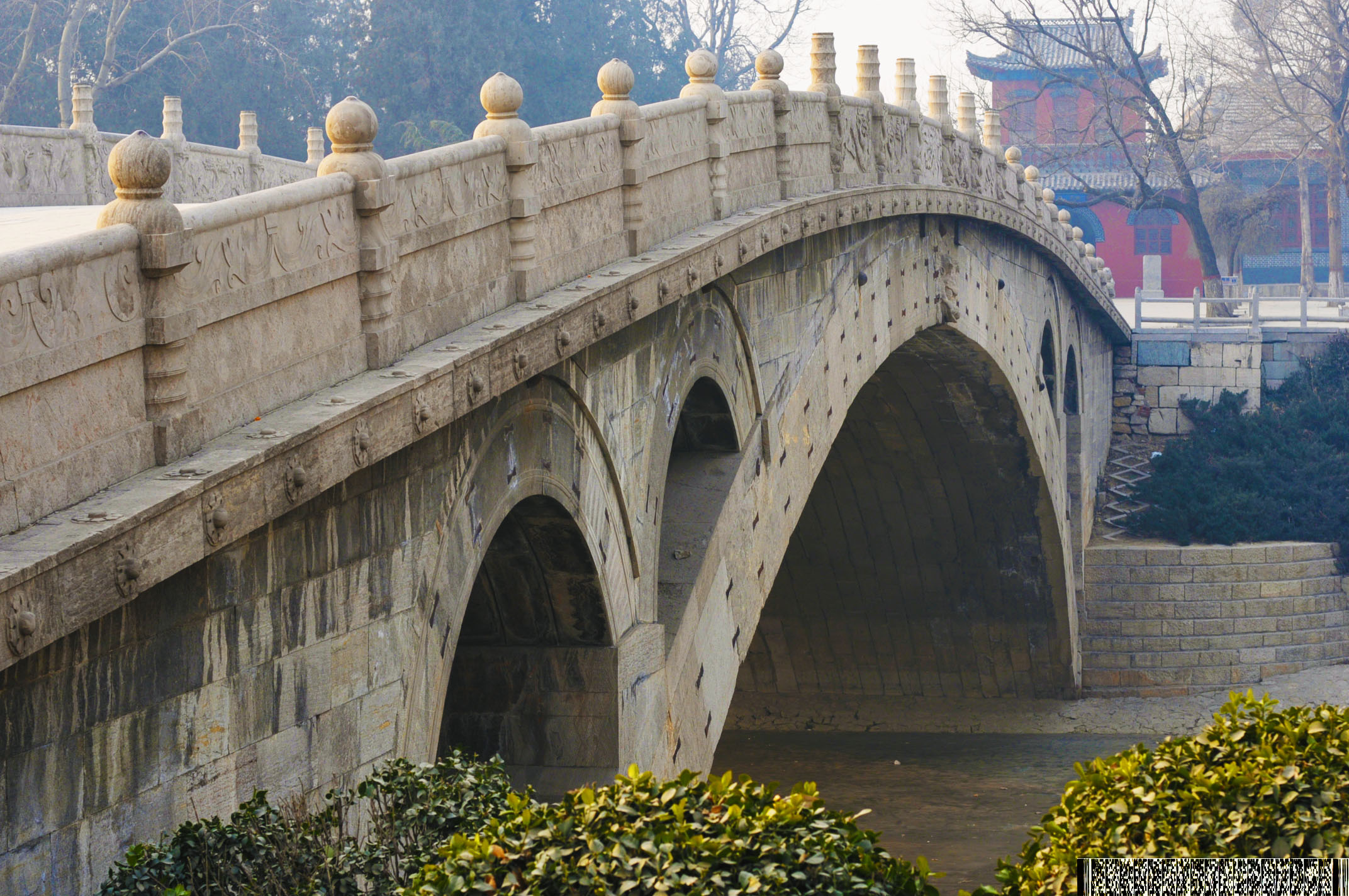
Anji Bridge
Fourteen centuries before modern engineers would rediscover the principle, a craftsman named Li Chun built a bridge that shouldn't have worked. The Anji Bridge -- also known as the Zhaozhou Bridge or Great Stone Bridge -- stretches 64 meters across the Xiaohe River in Zhao County, Hebei Province, its shallow segmental arch rising only 7.3 meters above the water. By every rule of contemporary bridge building, it should have collapsed under its own weight. Instead, it has outlasted dynasties, earthquakes, floods, and wars. Completed in 605 AD during the Sui dynasty, it remains the world's oldest open-spandrel segmental arch bridge of stone construction, and it is still standing.
The Genius of the Shallow Arch
What makes the Anji Bridge revolutionary is what it lacks. A conventional semicircular arch bridge rises to half its span -- high, heavy, and demanding steep approach ramps. Li Chun's arch covers only 84 degrees of a circle, with a rise-to-span ratio of roughly 0.197, which is flatter than a quarter circle. This radical geometry saved approximately 40 percent in materials compared to a semicircular design, making the bridge dramatically lighter. But a shallow arch transfers tremendous lateral force to its abutments, a problem that would have destroyed a lesser structure. Li Chun solved this by building the central arch from 28 thin, curved limestone slabs joined with iron butterfly joints, allowing the arch to flex slightly and absorb shifts in its supports without cracking apart.
Holes That Hold It Up
The bridge's four small side arches -- two flanking each end of the main span -- are perhaps its most ingenious feature. They reduce the bridge's total weight by about 15 percent, roughly 700 tons, which is critical given the lateral forces generated by the shallow main arch. More remarkably, they serve as flood channels. When the Xiaohe River rises and submerges the bridge, water flows through these openings rather than pressing against a solid wall of stone, dramatically reducing the hydraulic forces that would otherwise tear the structure apart. This open-spandrel design would not appear in European engineering for another 800 years. Tang dynasty officials, visiting the bridge just 70 years after its construction, left inscriptions praising its beauty. Ming dynasty poets compared it to a new moon rising above the clouds and a long rainbow hanging on a mountain waterfall.
Legend and Legacy
A bridge this improbable inevitably attracted myth. According to one legend, the master architect Lu Ban built it in a single night during the mid-first millennium BC. In another story, two immortals tested the bridge by crossing it simultaneously, and Lu Ban waded into the river to hold it up with his bare hands. The legends reveal something true about the Anji Bridge: it inspired disbelief. In 1991, the American Society of Civil Engineers designated it an International Historic Civil Engineering Landmark. Five years later, China nominated it for the UNESCO World Heritage List, citing its significance in the global history of bridge building. The bridge is considered one of the Four Treasures of Hebei, a distinction it shares with only three other cultural artifacts from the province.
A Trade Route's Crossing
The Anji Bridge exists because of economics. The Sui dynasty, which reunified China beginning in 581 AD, undertook immense infrastructure projects -- rebuilding capitals, excavating the 2,400-kilometer Grand Canal, and fortifying the northern frontier. The movement of goods between the North China Plain and the Central Plains around Kaifeng and Luoyang required crossing the Xiao River near Zhaozhou, in what is now Zhao County, roughly 52 kilometers southeast of the provincial capital Shijiazhuang. The river was simultaneously a trade artery and an obstacle, and the bridge Li Chun designed to span it needed to be low enough for loaded carts yet strong enough to survive the region's seasonal floods. That he achieved both -- and that his solution endures fourteen centuries later -- makes the Anji Bridge not just a monument to ancient engineering, but a rebuke to anyone who assumes that older means simpler.
From the Air
Located at 37.72N, 114.76E in Zhao County, Hebei Province, crossing the Xiaohe River. The bridge is 64 meters long and visible from low altitude. Nearest major airport is Shijiazhuang Zhengding International (ZBSJ), approximately 52 km to the northwest. Best observed at 2,000-3,000 feet AGL in clear conditions. The flat North China Plain terrain makes for easy visual identification of the river crossing.