Ankarana Special Reserve: Madagascar's Limestone Labyrinth
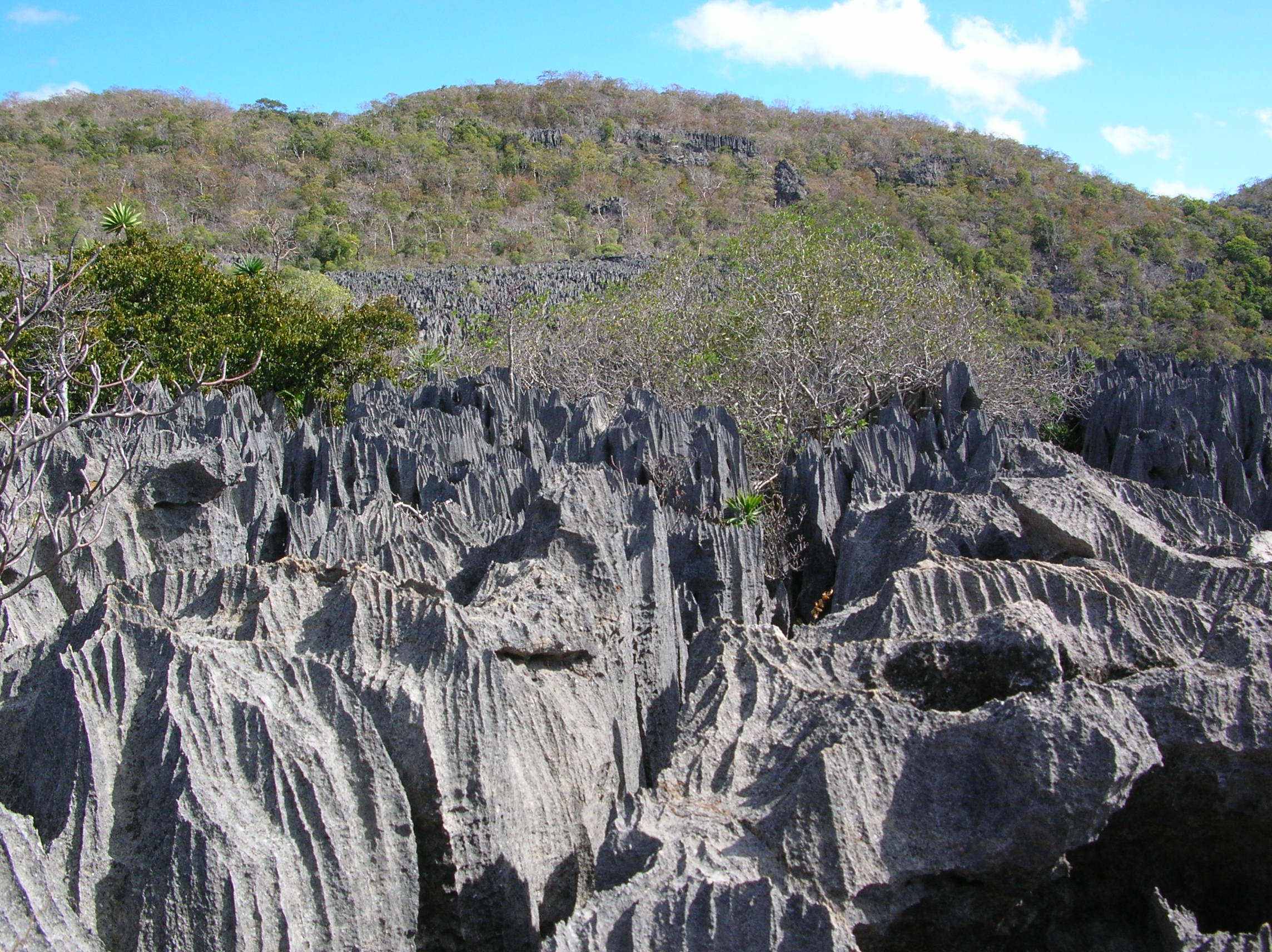
The Malagasy word tsingy means "where one cannot walk barefoot," and the name is not metaphor. In Ankarana Special Reserve, 150-million-year-old Jurassic limestone has been carved by rainfall and seismic forces into channels and ridges so sharp they will cut through boot leather. Between these blade-like formations, deep gorges drop into darkness, and cave passages wind for over 100 kilometers beneath the massif - the longest cave systems in Madagascar and likely on the entire African continent. Established as a protected area in 1956, Ankarana sits in the north of Madagascar, a plateau that looks from above like a crumbling fortress, its ramparts broken into separate spires of tower karst to the south while its interior hides canyons choked with basalt boulders and draped in ribbons of flowstone.
A World Below the Surface
La Grotte d'Andrafiabe, one of the most accessible caves in the reserve, extends for at least eight kilometers of horizontal passages - and it is just one entrance to the underground network. Around 100 kilometers of cave passages have been mapped within the massif, and expeditions continue to find more. Where the calcific upper layers of limestone have been completely eroded away, the harder base rock beneath emerges as the tsingy - etched and sharpened by millennia of tropical rain falling at an average of 2,000 millimeters per year. Basalt, both as scattered boulders on the surface and as deep flows filling the canyons, adds geological complexity to a landscape already unlike anything else on the island. The caves themselves shelter species found nowhere else: blind fish, cave-adapted shrimp, and invertebrates that had never been described by science before the 1980s expeditions brought them to light.
Lemurs of the Lost World
When British expeditions first began cataloguing Ankarana's wildlife in the 1980s, the discoveries were striking enough to inspire a book title. Dr. Jane Wilson-Howarth's travel narrative Lemurs of the Lost World chronicled what the teams found: subfossil remains of giant extinct lemurs alongside living species that had never been formally described. Today, the reserve protects at least eleven lemur species. Crowned lemurs and Sanford's brown lemurs are the most visible, often spotted moving through the dry deciduous forest canopy. The aye-aye, Madagascar's strangest primate - nocturnal, with elongated skeletal fingers for extracting grubs from bark - also inhabits these forests. So does Perrier's sifaka, one of the most endangered of all lemurs, its population fragmented across the far north of the island.
Songbirds in Formation
During the 1986 expedition, ornithologists Phil Chapman and Jean-Elie Randriamasy documented 65 bird species from 32 families at Ankarana - nearly a third of all bird species that breed in Madagascar. What caught their attention was not just the diversity but the behavior. Small insect-eating songbirds across multiple species had formed mixed foraging bands, traveling together through the forest in coordinated groups. Paradise flycatchers hunted alongside common jerys and greenbuls. Sunbirds flew with vangas. Within each band, different species specialized in where they searched: some on tree trunks and branches, some along slender boughs, others beneath leaves. The arrangement benefited everyone. Each species caught insects that escaped the others, and the larger group was far more likely to spot approaching predators than any single bird foraging alone.
Ghosts in the Limestone
The subfossil record at Ankarana reads like a catalogue of what Madagascar has lost. Bones of the sloth lemur Babakotia radofilai, an animal that hung from branches like its namesake, were first described from specimens found here. The massive Megaladapis - sometimes called the koala lemur for its size and likely mode of clinging to trees - left its remains in these caves, as did the baboon lemur Archaeolemur and the giant Palaeopropithecus. These were not small creatures; some weighed as much as a human adult. Their disappearance, likely within the last two thousand years, tracks with human arrival on Madagascar. What survives at Ankarana is remarkable precisely because of what has already vanished. The reserve is not just a refuge for living species but a geological archive of the island's recent evolutionary past, preserved in limestone that was ancient when dinosaurs still walked.
From the Air
Located at 13.07S, 48.91E in the Diana Region of northern Madagascar. The limestone massif is visible from altitude as a pale, broken plateau surrounded by greener lowland forest. The tsingy formations create a distinctive texture visible from several thousand feet. Nearest airport: Arrachart Airport (FMNA) at Diego Suarez/Antsiranana, approximately 100 km to the northeast. The reserve sits inland from the Mozambique Channel coast. Best viewed at 3,000-5,000 feet AGL for the contrast between the sharp limestone and surrounding vegetation.