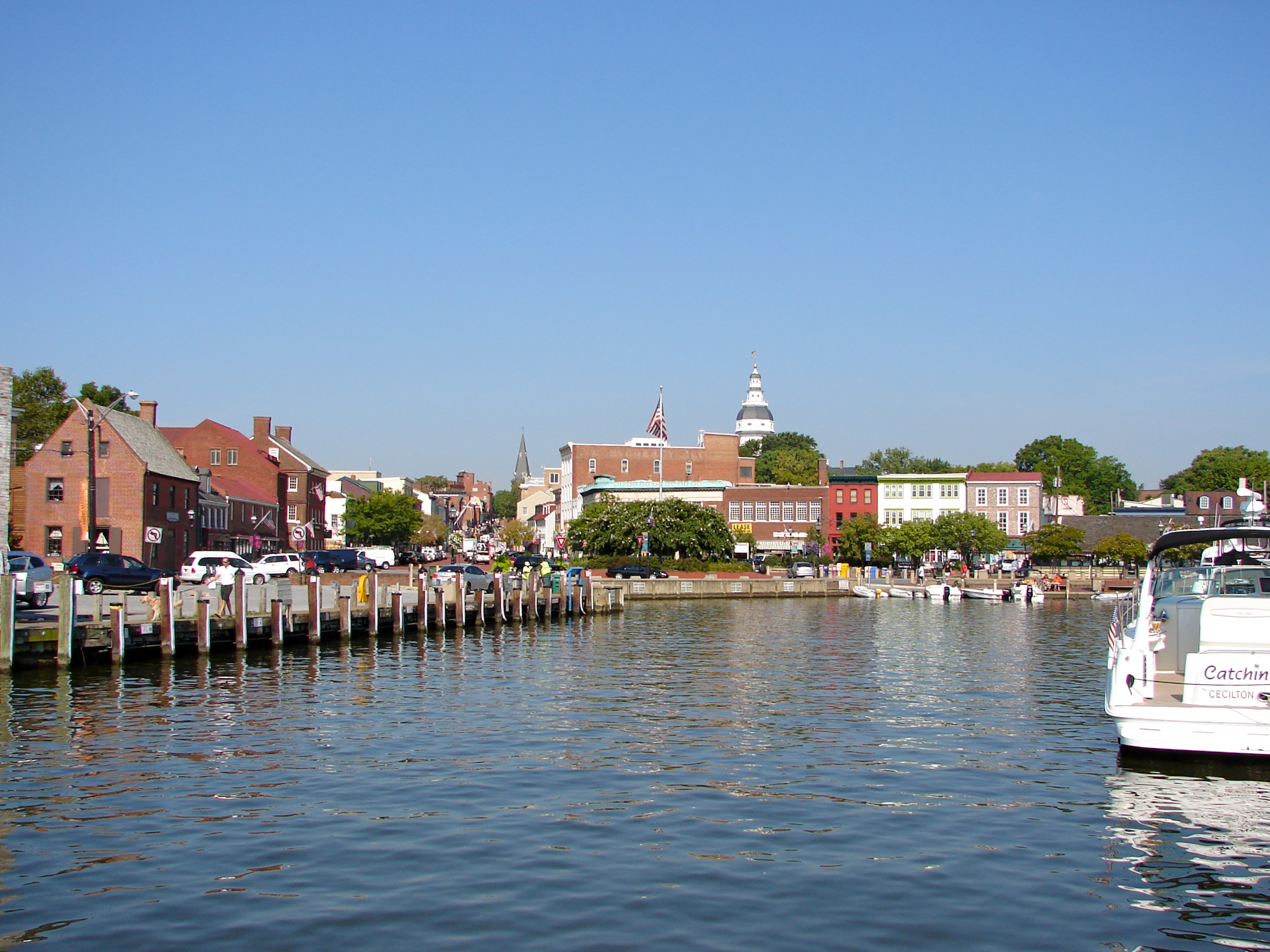
Annapolis: The Sailing Capital Where Congress Once Met
For nine months in 1783-84, Annapolis was the capital of the United States. The Maryland State House, completed in 1779, is the oldest state capitol in continuous legislative use - and it's where the Continental Congress ratified the Treaty of Paris, officially ending the Revolutionary War, and where George Washington resigned his military commission. That brief moment of national importance passed when the capital moved elsewhere, leaving Annapolis to become what it is now: a remarkably intact colonial seaport, home to the Naval Academy since 1845, and America's sailing capital. The harbor is dense with masts; Wednesday night races fill Chesapeake Bay; sailboat brokerages outnumber car dealers. Annapolis found its identity in water, and has kept it for two centuries.
The Capital That Was
The Maryland State House occupies the highest point in Annapolis, its wooden dome visible for miles. Built between 1772 and 1779, it hosted the Continental Congress when Annapolis briefly served as the national capital. In the Old Senate Chamber, George Washington appeared on December 23, 1783, to resign his commission as commander of the Continental Army - a voluntary surrender of power that amazed European observers and set a precedent for civilian control of the military. The Treaty of Paris was ratified here on January 14, 1784. Then the capital moved on - to Trenton, New York, and eventually to Washington's new federal city. Annapolis returned to being a Maryland town, but the State House kept its history.
The Naval Academy
The United States Naval Academy was founded in 1845 on a former Army fort at the point where the Severn River meets Chesapeake Bay. The campus - called the Yard - spans 338 acres of waterfront, its Beaux-Arts buildings, anchored by Bancroft Hall (the largest dormitory in the world), creating a distinct architectural character. 4,400 midshipmen attend, training to become Navy and Marine Corps officers. The chapel contains the crypt of John Paul Jones, 'father of the American Navy.' Commissioning Week in late May fills the town with families; the Army-Navy football game defines fall. The Academy dominates Annapolis - economically, culturally, and visually - a federal installation at the heart of a colonial city.
Sailing Capital
Annapolis claims to be the sailing capital of the United States, and the evidence supports it: more recreational sailboats per capita than any American city, the Eastport neighborhood devoted to the sailing industry, Wednesday night racing drawing hundreds of boats to the bay. The Annapolis to Bermuda Race departs biennially; the Annapolis Boat Shows (sailboat in October, powerboat in October) are the largest in-water boat shows in America. The sailing culture isn't just recreational - it's commercial, with yacht brokers, sailmakers, rigging shops, and charter companies concentrated around Eastport and the waterfront. The Chesapeake Bay provides protected sailing waters; Annapolis provides the infrastructure and community.
Colonial Downtown
Annapolis's historic district contains hundreds of 18th and 19th century buildings, remarkably well-preserved. Main Street drops from the State House to the city dock, lined with brick buildings housing restaurants, shops, and a few remaining ship chandleries. The William Paca House, built 1763, offers a glimpse of colonial wealth. The Hammond-Harwood House is considered one of the finest Georgian houses in America. The colonial character is genuine - this isn't reconstruction but survival. The U.S. Naval Academy Visitor Center provides guided tours of the Yard. City Dock, where colonial ships once unloaded, now hosts restaurants and the ketch 'Wooden boat' arrivals during Boat Show season.
Chesapeake Gateway
Baltimore-Washington International Airport (BWI) lies 25 miles north, the closest commercial airport. Washington D.C. is 30 miles southwest. The town is walkable; parking is the challenge - the colonial streets weren't designed for automobiles. The waterfront restaurants serve Chesapeake blue crabs (in season, steamed and dumped on newspaper-covered tables). The Spa Creek drawbridge creates traffic delays that locals accept as part of the sailing life. From altitude, Annapolis appears as a compact colonial town at the junction of the Severn River and Chesapeake Bay - the State House dome visible, the Naval Academy occupying the point, sailboat masts clustered in every waterway. The capital that was, now the sailing capital that is.
From the Air
Located at 38.98°N, 76.49°W where the Severn River enters Chesapeake Bay. From altitude, Annapolis appears as a compact colonial town on the water - the State House dome prominent, the Naval Academy occupying the peninsula, Spa Creek and Back Creek dense with sailboat masts. The Severn River bridges are visible to the west. What appears from the air as a small waterfront city is the sailing capital - where Washington resigned, where the Treaty of Paris was ratified, and where more sailboats dock than anywhere in America.