Anne Frank House
The bookcase swings open on its hinges, revealing the narrow doorway behind. This is the entrance to the Achterhuis, the Secret Annex, where Anne Frank, her family, and four others spent two years and one month hiding from Nazi persecution. The building at Prinsengracht 263 was constructed in 1635, renovated in 1740, and had served as everything from a private residence to a stable to a piano roll factory before Otto Frank moved his spice company there in December 1940. Less than two years later, the back of this ordinary canal house would become the setting for one of the most widely read books of the twentieth century.
The Annex
The Achterhuis, Dutch for back house, was concealed from view by buildings on all four sides of a quadrangle. Its secluded position made it an ideal hiding place for the Frank family, the Van Pels family, and Fritz Pfeffer, eight people in total. Johannes Voskuijl, father of one of Otto Frank's employees, built the movable bookcase that covered the entrance in 1942. The hiding place was small, the inhabited rooms totaling only about 50 square meters, yet Anne Frank wrote in her diary that it was relatively luxurious compared to other hiding places they had heard about. From July 1942 until August 1944, the eight residents lived above the working offices of the spice company, listening to the employees below, using a radio to follow the war's progress until 1943 when the Nazis began confiscating Dutch radios and it had to be surrendered.
Helpers and Hiding
Otto Frank's employees risked their lives to protect the hidden families. Miep Gies and Bep Voskuijl worked in the front office, keeping the business running while secretly supplying the annex with food and news. Johannes Kleiman and Victor Kugler managed the company and the deception. For two years and one month, this small group maintained the secret, but on August 4, 1944, the hiding place was raided by Nazi authorities. All eight were arrested and deported to concentration camps. Only Otto Frank survived. After the arrest, the annex was ordered cleared, and all belongings were seized for distribution to bombed-out families in Germany. But before this could happen, Miep Gies and Bep Voskuijl, defying orders from Dutch police, returned to the hiding place and rescued books and papers, including the diaries and loose pages that would become The Diary of Anne Frank.
From Diary to Museum
Otto Frank returned to Amsterdam in June 1945 and was given his daughter's diaries. He compiled her writings into a book published in Dutch in 1947 under the title Het Achterhuis, the name Anne had chosen for a future memoir about her experiences. The English translation, released as The Diary of a Young Girl, rendered the architectural term as the more evocative Secret Annex. Shortly after publication, Otto Frank's former employees began showing visitors the rooms where the families had hidden. By 1955, the building faced demolition when the Berghaus clothing company bought the row of houses for expansion. Public outcry and a campaign led by the newspaper Het Vrije Volk saved the building. The Anne Frank Foundation was established in 1957, and the Berghaus Company ultimately donated the building. After restoration, the museum opened to the public in 1960, drawing over 9,000 visitors in its first year.
Living Memory
Today, the Anne Frank House receives over 1.2 million visitors annually, making it the third most visited museum in the Netherlands after the Van Gogh Museum and the Rijksmuseum. The rooms of the Secret Annex remain empty, as they were after the Nazi raid, but the building has been expanded with additional structures to accommodate the crowds. A virtual reality tour allows visitors to see interpretations of the furnished rooms as they appeared from 1942 to 1944. Among the artifacts on display is the Academy Award that Shelley Winters won for her portrayal of Mrs. Van Daan in the 1959 film adaptation of the diary; Winters donated it to the museum, where it now sits in a bulletproof glass case. The Anne Frank House also operates the Anne Frank Zentrum in Berlin, opened in 1998, extending the educational mission beyond Amsterdam. The museum stands as a reminder that behind one ordinary bookcase, in one ordinary building, the human spirit persisted against impossible circumstances, and left a record that still speaks to millions.
From the Air
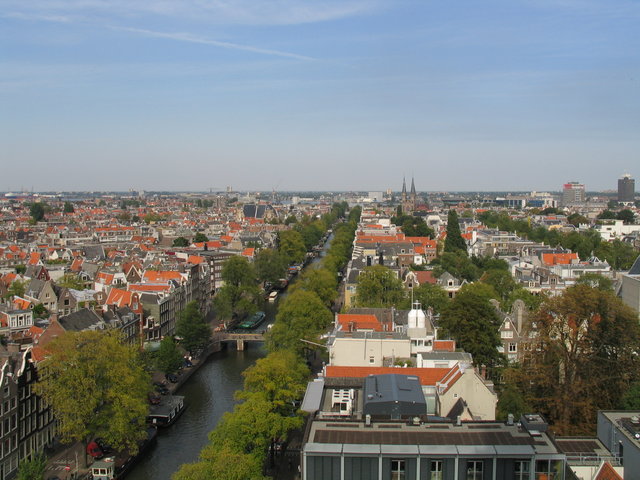
The Anne Frank House is located at 52.38N, 4.88E on the Prinsengracht canal in central Amsterdam. The narrow, gabled canal houses of the Jordaan neighborhood are a distinctive pattern from the air, with the parallel canals creating Amsterdam's characteristic ring structure. Best viewed at lower altitudes (1,000-2,000 feet) in clear conditions. Amsterdam Schiphol Airport (EHAM) is approximately 12 km to the southwest. The Westerkerk church tower adjacent to the museum serves as a useful visual landmark, its distinctive crown visible from altitude.