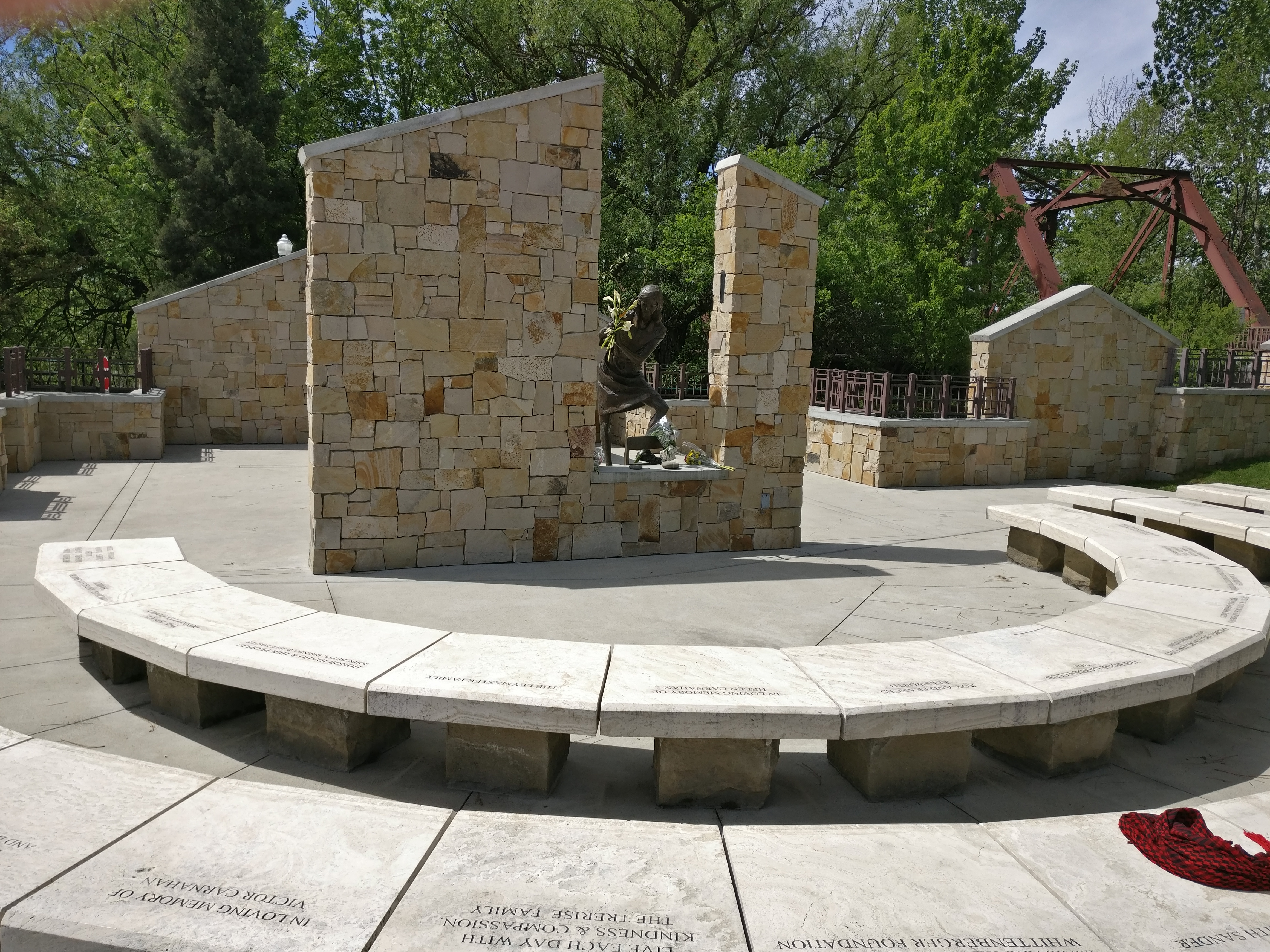
Anne Frank Human Rights Memorial
The tree that Anne Frank watched from the attic window of the Secret Annex fell in an Amsterdam storm in 2010, but its offspring survive in eleven locations across the United States. One grows in Boise, Idaho, in a memorial park that exists because of a former Catholic priest who dedicated his life to human rights after witnessing white supremacist violence in the Pacific Northwest. The Anne Frank Human Rights Memorial is the only memorial to Anne Frank in the country - a cenotaph complex designed by Idaho Falls architect Kurt Karst, where running water flows past quotations from poets and politicians, survivors and victims, and where newly commissioned Boise police officers come to reflect before they begin field training.
Words Carved in Stone
Quotations from some sixty voices line the memorial's walls - words from those who survived the Holocaust and those who did not, from activists and diplomats, poets and ordinary people whose names history barely remembers. The memorial features one of the few permanent public installations of the complete text of the Universal Declaration of Human Rights, the 1948 document that emerged from the ashes of World War II. The Wassmuth Center for Human Rights maintains the site jointly with the Boise Department of Parks and Recreation. In 2018, the park underwent a thorough renovation that added an outdoor classroom and a new sculpture called "The Spiral of Injustice." The International Coalition of Sites of Conscience has recognized and accepted the memorial as a member site.
The Sapling's Journey
Before it fell, the horse chestnut tree outside Anne Frank's window in Amsterdam had become a living symbol - the bit of nature the young diarist could glimpse from her hiding place during two years of confinement. Cuttings were propagated and distributed to sites around the world. The Boise sapling is one of only eleven in the United States, planted in soil thousands of miles from Amsterdam but connected to that attic window by biology and memory. It grows near the statue of Anne Frank that serves as the memorial's centerpiece, a bronze figure of the girl who wrote in her diary that she still believed people were good at heart, even as the Holocaust closed in around her.
Contested Ground
The memorial has drawn both reverence and hatred. In early May 2017, vandals defaced the plaque displaying the Universal Declaration of Human Rights with antisemitic graffiti, then returned days later to spray racist slurs against Black people and Jews across different areas of the site. The damage totaled $20,000, partly because initial repair attempts went poorly. It was the first vandalism since the memorial's dedication in 2002. Donations for restoration poured in, including a single $20,000 contribution. In December 2020, papers reading "we are everywhere" with swastika imagery appeared at the site, prompting Mayor Lauren McLean to declare that "bad actors who use racist and violent rhetoric are not welcome in this community." The attacks have only deepened the memorial's purpose.
A Place for Reflection
Museum researcher Brigitte Sion has noted that the memorial emphasizes universal human rights over Anne Frank's specific identity as a Jewish victim of the Holocaust, an approach she finds troubling in its abstraction. The criticism reflects an ongoing tension in how societies memorialize victims - whether to emphasize the particular or the universal, the historical specifics or the broader lessons. Whatever the interpretation, the site serves multiple functions: a staging area for rallies and protests, a quiet spot for contemplation near the Boise Greenbelt and Public Library, and a training ground where police officers begin their careers by confronting questions of human dignity and civil rights. The water runs, the chestnut grows, and the words of sixty voices remain carved in stone.
From the Air
The Anne Frank Human Rights Memorial is located at 43.61N, 116.21W in downtown Boise, Idaho, adjacent to the Boise Public Library and the Boise River Greenbelt. As a small urban park, it is not readily visible from altitude but can be located by reference to the distinctive Boise River corridor and downtown landmarks. Boise Air Terminal (KBOI) is the nearest major airport, approximately 4 miles south. The site is best appreciated from the ground, though the Boise Greenbelt provides an excellent visual reference for navigation at lower altitudes.