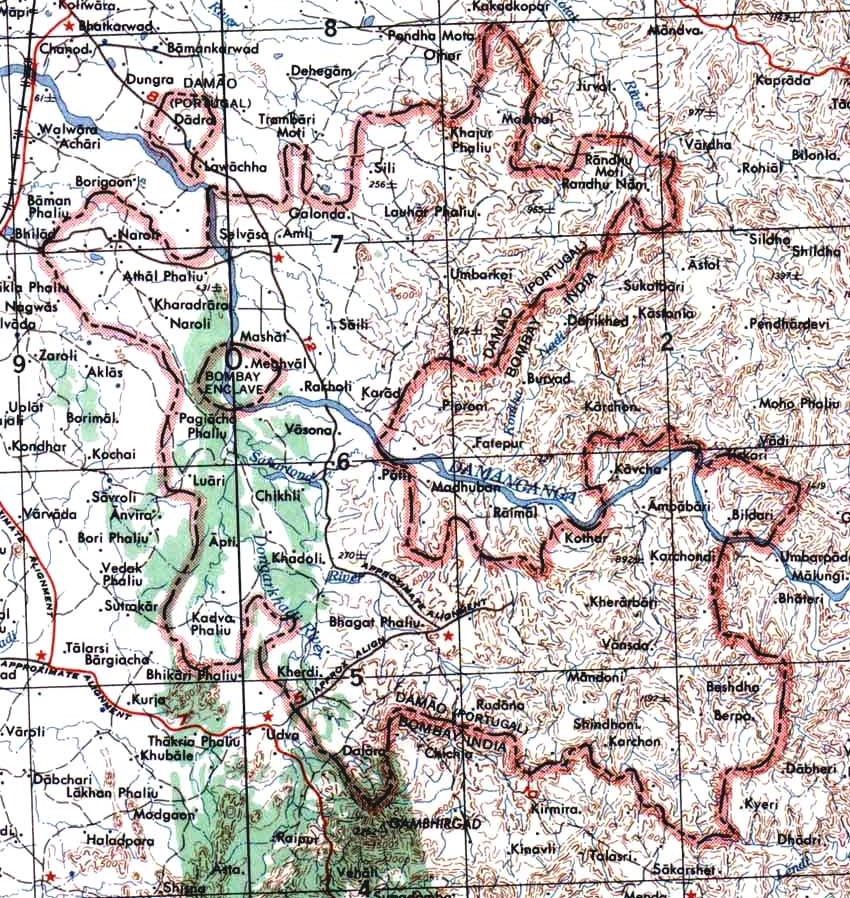
Annexation of Dadra and Nagar Haveli
For 175 years, two small patches of land in western India belonged to Portugal. Dadra and Nagar Haveli had no coastline, no strategic port, no military garrison to speak of - just forested enclaves surrounded entirely by Indian territory, administered from the distant colonial capital of Daman under the terms of a 1779 treaty with the Maratha Empire. When India won independence in 1947, these remnants of the Portuguese Estado Novo became an awkward anachronism: foreign-ruled territory deep inside a sovereign nation. By 1954, a motley coalition of Goan nationalists, communist organizers, tribal Warli farmers, and RSS volunteers would take matters into their own hands.
Enclaves Without an Exit
The geography alone made Portuguese control tenuous. Dadra and Nagar Haveli were landlocked enclaves - no access to the sea, no physical connection to Goa or Daman except through Indian soil. The Portuguese administered them from the district of Daman, but maintaining authority over territories you cannot reach without crossing another country's roads is a proposition with a built-in expiration date. After 1947, pro-India activists in the Portuguese Indian provinces began agitating for integration. Mahatma Gandhi himself had declared that "Goa cannot be allowed to exist as a separate entity in opposition to the laws of the free State." The question was never whether these enclaves would eventually become Indian, but how - and who would make the first move.
An Unlikely Alliance
The forces that converged on Dadra and Nagar Haveli in 1954 could hardly have been more ideologically diverse. Appasaheb Karmalkar, a bank employee in the Goan government, led the National Liberation Movement Organization. The Communist Party of India and the Goan People's Party had spent years arming and mobilizing Warli adivasis - indigenous tribal people in the surrounding districts - under the rallying cry "Land to the tiller!" Godavari Parulekar, known as Godutai, led the Warli communist contingent alongside L.B. Dhangar and Roopji Kadu. Simultaneously, the nationalist Azad Gomantak Dal, led by Vishwanath Lawande and Dattatraya Deshpande, planned an armed assault. These groups agreed to form a united front in April 1954. Communists, nationalists, tribal farmers, and the RSS - organizations that disagreed about nearly everything else - found common cause in ending Portuguese rule over Indian soil.
A Swift Liberation
The operation unfolded rapidly. Indian Special Reserve Police, ostensibly positioned to prevent Portuguese military infiltration, were commanded by DIG J. D. Nagarwala - who happened to be sympathetic to the rebels and quietly advised them on their next moves. Dadra fell first. By morning, an Indian flag flew over the territory, and a local gram panchayat was formed under Jayanti Bhai Desai. When word spread that thousands of Warli communists and United Front of Goans fighters were massing for an assault on Silvassa, the Portuguese police retreated, leaving only five officers to protect the village of Piparia. Rebels led by RSS and AGD volunteers crossed the river and captured it. The Portuguese administration of Nagar Haveli collapsed without a major battle. For the next seven years, the territories existed in a curious state of de facto independence, routing their mail through the Indian border town of Vapi and overprinting leftover Portuguese stamps with the words "LIBERATED AREAS."
A One-Day Prime Minister
The formal end came in 1961. When Indian forces took over Goa, Daman, and Diu in December of that year, the question of Dadra and Nagar Haveli's legal status needed resolution. The solution was creative: Badlani was designated Prime Minister of Dadra and Nagar Haveli for a single day - just long enough to sign an agreement with Indian Prime Minister Jawaharlal Nehru, formally merging the territories into the Republic of India through the Tenth Amendment of the Constitution. Portugal did not recognize any of this until the Carnation Revolution of 1974 toppled the Estado Novo dictatorship in Lisbon. On December 31, 1974, India and Portugal signed a treaty acknowledging Indian sovereignty over all former Portuguese possessions. In a final colonial footnote, Portugal continued to offer citizenship to anyone born in Dadra and Nagar Haveli - right up until 2006, when eligibility was restricted to those born before December 19, 1961.
From the Air
Located at 20.27°N, 73.02°E in the forested interior of western India, between Daman on the coast and the Western Ghats foothills. The territory of Dadra and Nagar Haveli is a densely wooded enclave visible as green patches amid surrounding farmland. The administrative capital Silvassa sits along a river. Nearest airports are Surat Airport (STV/VASU), about 100 km north, and Mumbai (BOM/VABB), about 170 km south. At low altitude, look for the forested terrain contrasting with the agricultural plains. Recommended viewing altitude: 5,000-8,000 feet AGL.