Annexation of Tibet by China
The Tibetan government consulted oracles before deciding what to do. In late 1950, as Chinese troops advanced from five directions into eastern Tibet, officials in Lhasa performed a divination before the Six-Armed Mahakala deities. The answer was unambiguous: the three conditions China had proposed could not be accepted, because Tibet would fall under foreign domination. The divination proved correct. What followed -- a military operation, a coerced agreement, an uprising, and an exile that continues today -- transformed Tibet from an isolated theocratic state into one of the most contested territories on Earth.
The Fall of Chamdo
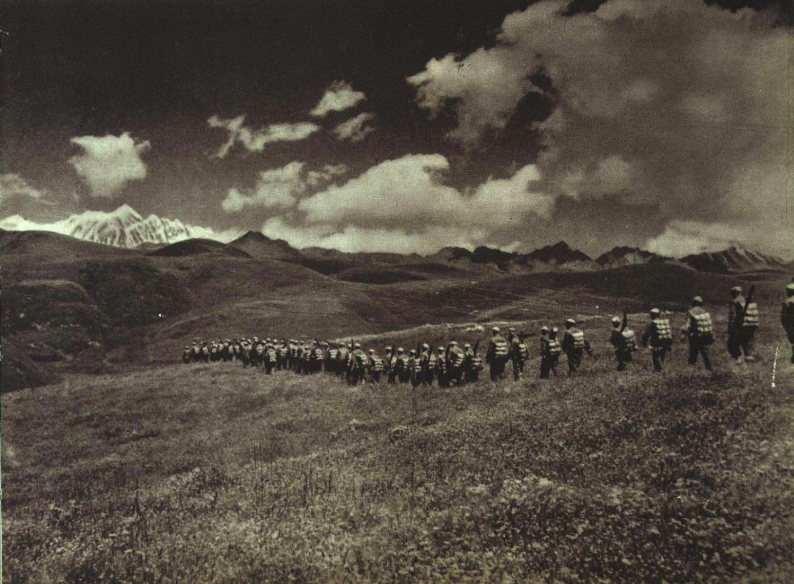
On October 6 or 7, 1950, the People's Liberation Army crossed the Jinsha River into eastern Tibet. The operation's goal was not a full-scale invasion but something more precise: capture the Tibetan army at the border town of Chamdo, demoralize the government in Lhasa, and force Tibetan negotiators to Beijing. Two PLA units quickly surrounded the outnumbered Tibetan forces. By October 19, Chamdo had fallen. The PLA reported 114 of its soldiers killed or wounded and claimed over 5,700 Tibetan troops "destroyed," with more than 3,000 surrendering peacefully. The Peace Research Institute Oslo later estimated 2,000 dead on each side, including noncombatants. Active hostilities were confined to the border area northeast of the Gyamo Ngul Chu River. After taking Chamdo, the PLA stopped, released a captured commander named Ngapoi Ngawang Jigme, and sent him to Lhasa to reiterate terms.
A Document Already Written
Tibetan negotiators arrived in Beijing to find that the agreement was already finished. The document, commonly known as the Seventeen Point Agreement, was not a negotiation but a presentation. China would allow Tibet to reform at its own pace, maintain internal self-governance, and practice religious freedom -- but Tibet would have to accept being part of China. The Tibetan delegates were not allowed to communicate with their government on this point, and they had never been authorized to sign anything in the name of the Tibetan state. On May 23, 1951, they signed anyway, under pressure they later described as coercive. It was the first time in Tibetan history that its government had accepted China's claim of sovereignty -- and it was accepted unwillingly, by representatives acting beyond their authority. El Salvador had tried to bring a complaint on Tibet's behalf to the United Nations one month after the invasion, but India and the United Kingdom blocked it from being debated.
An Uneasy Coexistence
For several years, the Tibetan government continued to function in areas it had ruled before the hostilities, maintaining its traditional social structure. The region around Chamdo, however, was placed under a separate PLA-controlled committee, outside Lhasa's authority. The Dalai Lama, who had ascended to the throne, chose not to flee into exile and formally accepted the agreement in October 1951. Chinese broadcasts had promised Tibetan elites they could keep their positions and power if Tibet was "peacefully liberated." For a time, this held. The arrangement was unstable, but it held -- until land reform experiments in eastern Kham ignited the resistance that would eventually consume everything.
The Uprising and the Exile
In 1956, Tibetan militias in the ethnically Tibetan region of eastern Kham, just outside the formal Tibet Autonomous Region, began fighting against PRC-imposed land reforms. The various militia groups united to form the Chushi Gangdruk Volunteer Force. When the fighting spread to Lhasa itself in March 1959, the Dalai Lama made his decision. On March 17, accompanied by an entourage of twenty people including six cabinet ministers, he left Lhasa and crossed into India. Both the Dalai Lama and the Chinese government subsequently repudiated the Seventeen Point Agreement. The PRC dissolved the Tibetan local government. What China calls the "Peaceful Liberation of Tibet" had arrived at its conclusion: an exile government in India, a dissolved government in Lhasa, and a contested sovereignty that remains unresolved.
Two Histories, One Place
The annexation of Tibet is one of those events that exists in two irreconcilable versions. China's official narrative frames it as a peaceful liberation -- the reunification of a territory that had always been part of China, freeing a population from feudal theocratic rule. The Tibetan narrative describes an invasion, a coerced treaty, and the destruction of an independent state. Historians from outside both traditions have documented the military pressure, the signing under duress, and the subsequent suppression of Tibetan institutions. What is beyond dispute is the transformation itself: in less than a decade, a territory that had governed itself for centuries became a region of the People's Republic of China. The consequences -- for Tibetan culture, for religious practice, for the millions of people who live there -- continue to unfold over Lhasa and across the plateau.
From the Air
The events of the annexation centered on Lhasa (29.65°N, 91.13°E) and Chamdo (31.14°N, 97.17°E) in eastern Tibet. Lhasa sits at approximately 3,650 m (11,975 ft). The nearest airport to Lhasa is Lhasa Gonggar Airport (ZULS), about 60 km southwest. Chamdo Bangda Airport (ZUBD) serves eastern Tibet. The PLA's advance followed routes across the Jinsha River (upper Yangtze) into the Tibetan Plateau. The vast, high-altitude terrain between Chamdo and Lhasa is visible from cruising altitude on clear days.