Anniston and Birmingham Bus Attacks
The photograph traveled the world in a single day: a Greyhound bus engulfed in flames on the shoulder of a highway outside Anniston, Alabama, black smoke billowing into a spring sky. It was Mother's Day, May 14, 1961, and an interracial group of civil rights activists called Freedom Riders had just learned what it cost to sit together on a bus in the Deep South. The image of that burning bus became one of the defining photographs of the civil rights movement, and the violence that produced it forced the United States to confront the gap between its laws and its reality. The Supreme Court had already ruled, twice, that segregation on interstate buses was unconstitutional. Alabama did not care.
A Ride Designed to Provoke
The Congress of Racial Equality organized the Freedom Ride with a deliberately provocative strategy. CORE had been founded in 1942 by James Farmer and other members of the pacifist Fellowship of Reconciliation, inspired by Mahatma Gandhi's principles of nonviolent resistance. On May 4, 1961, thirteen Riders left Washington, D.C., on Greyhound and Trailways buses, traveling south toward New Orleans. The plan was simple and dangerous: an interracial group would ride together, ignoring the "white" and "colored" signs at bus terminals, until the resistance they provoked forced the federal government to enforce its own laws. CORE scout Tom Gaither identified Anniston and Birmingham as the most dangerous stops on the route. Birmingham had already earned the grim nickname "Bombingham" for the more than forty dynamite attacks carried out against African Americans and civil rights activists between 1947 and 1965. Local activist Fred Shuttlesworth warned that the city was "a racial powder keg."
Collusion in Broad Daylight
The violence of May 14 was not spontaneous. Birmingham Police Commissioner Eugene "Bull" Connor conspired with local Ku Klux Klan chapters to orchestrate the attacks, and the FBI, which had foreknowledge of the plans through its informants, did nothing to prevent them. Police Sergeant Tom Cook, a fervent Klan supporter, fed information from the FBI directly to the Alabama Knights, including details of the Freedom Riders' entire route. Connor promised Klansmen fifteen uninterrupted minutes to beat the Riders at the Birmingham Trailways station before police would arrive. The arrangement was so brazen that the front page of The Birmingham News would later headline: "People Are Asking: 'Where Were The Police?'" The answer was that they were exactly where Connor wanted them, nowhere near the bus station.
Fire and Fists
In Anniston, a mob swarmed the Greyhound bus at the station while local police looked the other way. Officers made a pretense of clearing the crowd, then escorted the bus to the city limits, where they abandoned it to a pursuing convoy of Klan vehicles. The mob slashed the tires and firebombed the bus. Passengers stumbled out choking on smoke, only to face further assault. One man feigned concern toward rider Hank Thomas before striking him in the head with a baseball bat. Armed Alabama Highway Patrol agents prevented the Riders from being lynched. The Trailways bus arrived about an hour later, where Klansmen boarded and beat the Riders, forcing black passengers to the back. In Birmingham, the mob was waiting. Klansmen armed with chains, pipes, and clubs descended on the Trailways terminal. Walter Bergman was beaten so severely that he suffered a stroke a week later, leaving him paralyzed for the rest of his life. Another Rider's semi-conscious body was thrown into a trash bin.
The World Was Watching
The attacks backfired spectacularly on their orchestrators. Photographs of the burning bus ran on front pages from New York to Tokyo. In Japan, Birmingham's incoming Chamber of Commerce president Sidney Smyer was confronted by Japanese hosts holding a newspaper with the burning bus photograph, making painfully clear the damage to Birmingham's international business reputation. Eastern Bloc countries seized on the images for propaganda, while Cold War allies expressed dismay. Connor and the Klan had intended to deter future Rides. Instead, the violence inspired hundreds of new volunteers. Over the summer of 1961, more than sixty separate Freedom Rides carried activists into the Deep South. When Attorney General Robert Kennedy urged a "cooling off" period, CORE's response was blunt: "For 300 years we have been cooling off." On May 29, Robert Kennedy petitioned the Interstate Commerce Commission to enforce its own rulings. On November 1, 1961, new ICC regulations ended segregation in interstate transportation. "White" and "colored" signs came down from terminals across the South.
Ground That Remembers
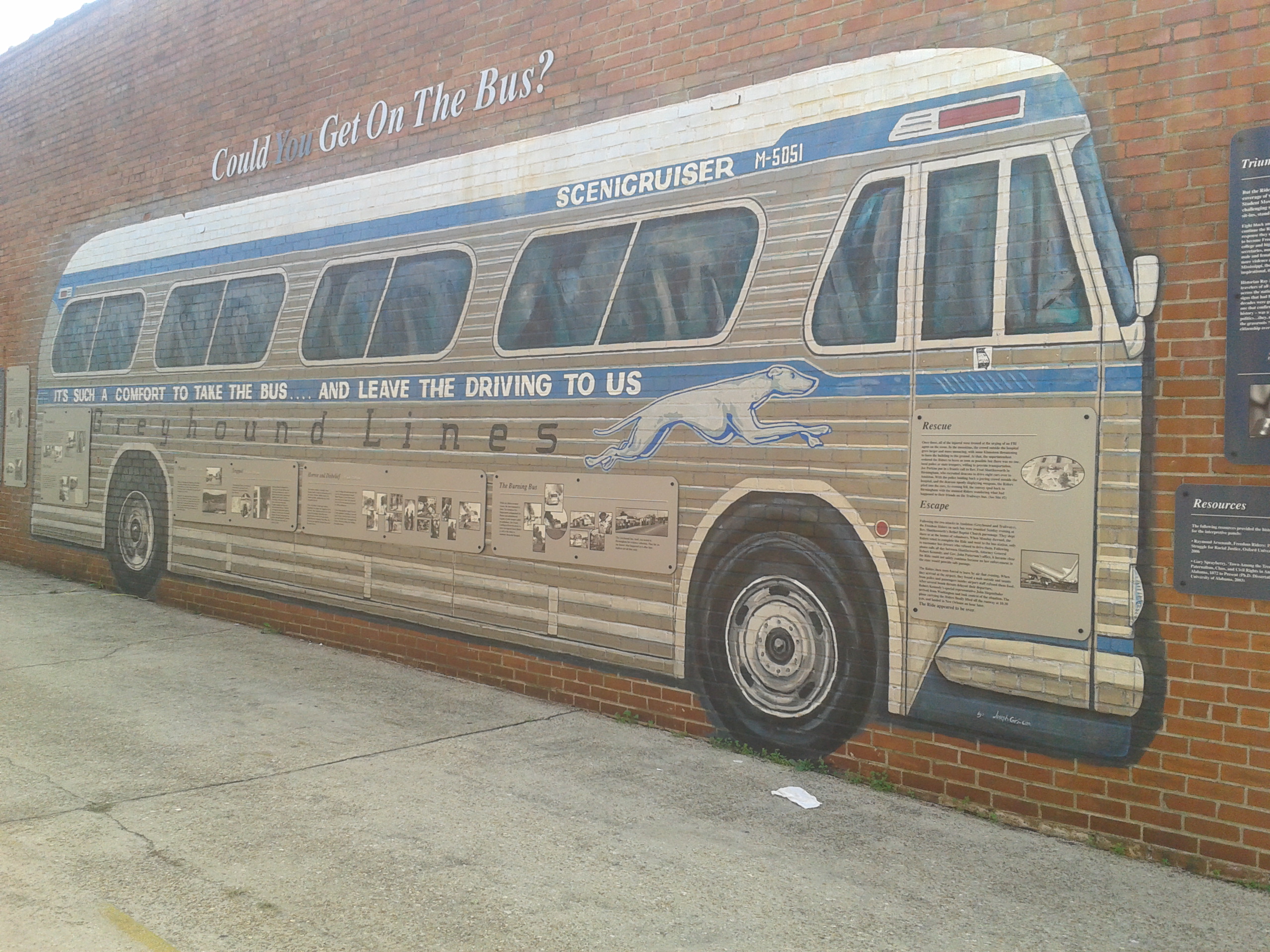
In January 2017, President Barack Obama established the Freedom Riders National Monument in Anniston, administered by the National Park Service. The site preserves the stretch of Old Birmingham Highway where the Greyhound bus burned, along with informational markers erected in 2007 by the Theta Tau chapter of Omega Psi Phi fraternity. In downtown Anniston, two murals depict the Greyhound and Trailways buses as they appeared in 1961. The Greyhound mural by local artist Joseph Giri stands at 1031 Gurnee Avenue beside the former bus depot, which now serves as a Freedom Rides information center. A Civil Rights Trail guides visitors through sites where the attacks unfolded. The ground where the bus burned, where the Riders bled, and where the photographs were taken that changed a nation's conscience is now preserved so that the story cannot be forgotten.
From the Air
The Anniston attack site is located at approximately 33.66N, 85.83W along Old Birmingham Highway (State Route 202) east of Anniston, Alabama. Birmingham, where the Trailways station attack occurred, is roughly 60 miles to the west. From the air, Anniston sits in the foothills of the Appalachian Mountains in Calhoun County. Anniston Regional Airport (KANB) is the nearest field. Birmingham-Shuttlesworth International Airport (KBHM) serves the Birmingham area. The Freedom Riders National Monument is visible as a roadside memorial site along SR-202. Best viewed at 2,000-4,000 feet AGL to follow the route the buses traveled between Anniston and Birmingham.