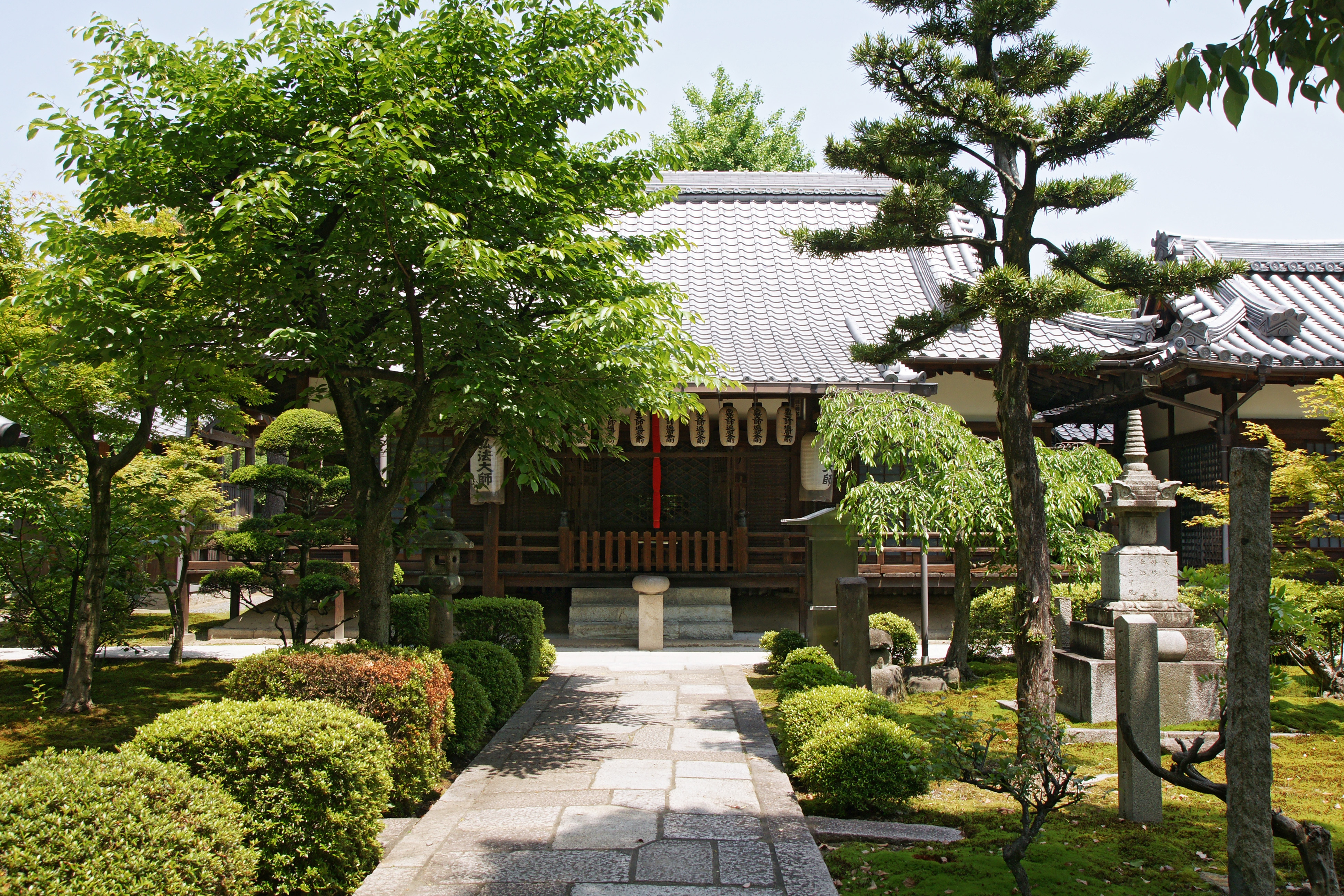
Anrakuju-in
Two emperors rest beneath pagoda roofs in a quiet corner of Fushimi, far from the tourist circuits of central Kyoto. Anrakuju-in does not appear on most travel itineraries, yet this Shingon Buddhist temple preserves something that the famous Golden Pavilion and Silver Pavilion cannot claim: the actual burial sites of Emperor Toba and Emperor Konoe, father and son, whose reigns shaped one of the most politically turbulent centuries in Japanese history. The temple grounds sit atop what was once the eastern palace of the Toba Imperial Villa, a sprawling estate three kilometers south of ancient Heian-kyo that functioned as the true seat of power during the era of cloistered rule.
Where Rivers Meet and Empires Ruled
The site's location was no accident. The area called Toba sat at the confluence of the Kamo River and the Katsura River, a natural crossroads where the San'yodo highway to western Japan met the river port that connected to the capital via Suzaku-oji, Heian-kyo's main boulevard. Aristocrats had long favored Toba for its scenic landscapes, building hunting lodges and summer retreats along the riverbanks. In the 11th century, a courtier named Fujiwara no Suetsuna presented his villa here to the retired Emperor Shirakawa. What followed was a transformation on a grand scale. Shirakawa expanded the property into a compound roughly 1.7 kilometers east-to-west and 1.1 kilometers north-to-south, with five separate palace complexes -- Nanden, Kitaden, Izumi, Higashiden, and Tanaka -- each with its own attached Buddhist temple. The Toba Imperial Villa became the headquarters of cloistered government, where retired emperors wielded real political authority behind the scenes.
Fire, Earthquake, and Slow Ruin
Anrakuju-in was the temple built within the Higashiden Palace, established in 1137. Its original compound included a Main Hall and two tahoto pagodas -- the distinctive two-story style with a square lower story and a round upper story -- that served as the imperial tombs. But the centuries were not kind. Fire swept through in 1296, destroying much of the complex. Another blaze struck in 1548. Then, in 1596, the devastating Keicho-Fushimi earthquake shattered what remained, toppling the Main Hall and both pagodas. By the end of the 16th century, the temple that had housed an emperor's eternal rest lay in ruins. It was Toyotomi Hideyoshi, the warlord who had just unified Japan, who ensured the temple's survival by granting it estates producing 500 koku of rice for its maintenance. A temporary hall went up in 1612, but the site would wait centuries more for proper restoration.
The Pagoda Tombs
What stands today is a testament to patient rebuilding across eras. The tomb of Emperor Konoe -- the so-called New Pagoda -- was reconstructed in 1606 by Toyotomi Hideyori under the supervision of magistrate Katagiri Katsumoto. It remains one of the rarest structures in Japan: a pagoda that serves as an emperor's mausoleum. This pagoda stands south of the main temple grounds and is managed by the Imperial Household Agency as the Anrakujuin Southern Mausoleum. Emperor Toba's tomb took far longer to rebuild. The Main Pagoda was not restored until 1864, near the end of the Edo period, and even then it was rebuilt not as a pagoda but as a Buddhist hall with a tiled roof. It sits to the west of the temple, designated as the Anrakujuin Mausoleum. The bell tower, also rebuilt by Hideyori in 1606, completes the ensemble. Among the surviving treasures are Important Cultural Properties dating to the Heian period, including inscriptions from 1287.
Quiet Authority
Anrakuju-in today is a place of deep stillness. The temple belongs to the Shingon sect, and its principal image is a statue of Amida Nyorai, the Buddha of Infinite Light. The entire precinct is protected as a National Historic Site under the designation of the Toba Imperial Villa. Unlike the crowds at Kinkaku-ji or the camera-wielding masses at Fushimi Inari just a few kilometers to the north, Anrakuju-in receives few visitors. The surrounding Takeda neighborhood in Fushimi ward feels residential and unhurried. Yet the weight of history here is immense. This ground was where cloistered emperors governed Japan, where the Fujiwara and imperial lines competed for influence, and where the estates that funded the Daikakuji line of the imperial family were first established. The rivers that made this location strategic still flow nearby, though the Kamo's shifting course has erased the villa's western boundary entirely.
From the Air
Located at 34.9525N, 135.7549E in the Fushimi ward of southern Kyoto, Japan. The temple sits in a residential area near the confluence of the Kamo and Katsura Rivers, roughly 3km south of central Kyoto. From the air, look for the distinctive pagoda structures amid the dense urban grid. Nearest major airport: Osaka Kansai International (RJBB) approximately 50nm south. Itami Airport (RJOO) is approximately 20nm southwest. Kyoto itself has no commercial airport. The area is best viewed at altitudes between 2,000-5,000 feet AGL in clear weather, when the river confluence and temple rooflines become distinguishable from the surrounding residential fabric.