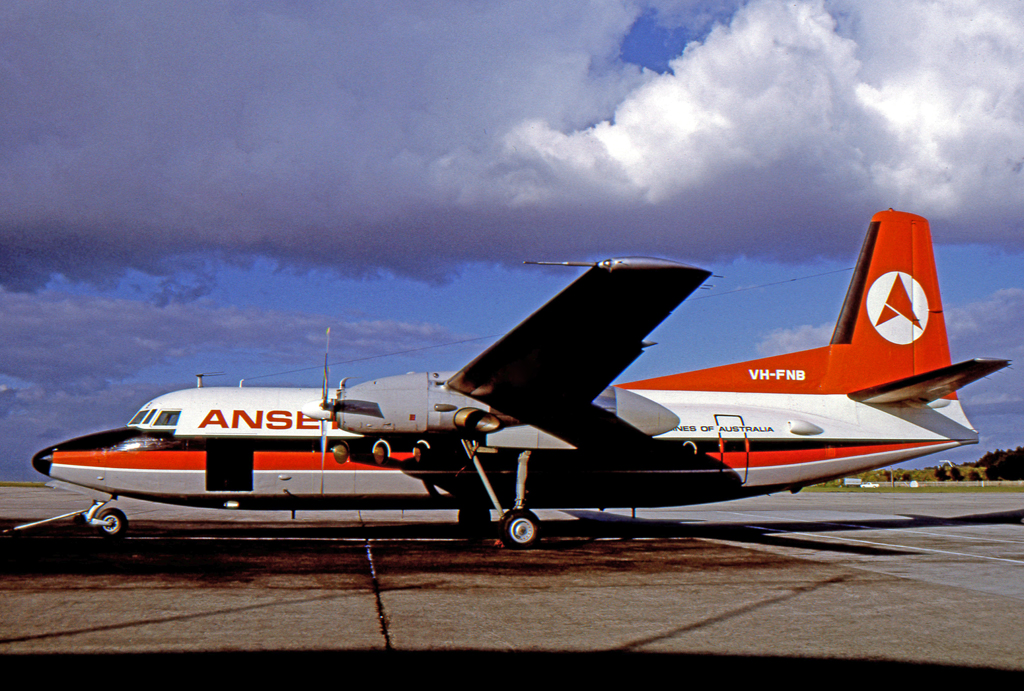
Ansett Australia Flight 232
"This is a hijack." The words came from a man standing in the aisle of a Fokker Friendship, a sawn-off .22 ArmaLite rifle in one hand, a flight attendant walking ahead of him toward the cockpit. It was 15 November 1972, and Ansett Australia Flight 232 was on its descent into Alice Springs from Adelaide. What followed was not a Hollywood hostage drama but something stranger and sadder -- a hijacking driven not by politics or ransom, but by a man's desire to die in the most remote landscape he could reach.
A Calm Descent Into Crisis
The hijacker was Miloslav Hrabinec, a Czech migrant who had boarded the flight in Adelaide carrying a concealed weapon and a sheath knife strapped to his leg. About thirty minutes before landing, he emerged from the aircraft lavatory, produced the rifle, and confronted flight attendant Gai Rennie. Rennie kept her composure. She walked through the cabin with the armed man behind her, calmly alerted her colleague Kaye Goreham, and together they approached the cockpit. Captain Young, focused on his landing approach, responded with a bluntness that defused the immediate threat: he told the hijacker he was busy landing the plane and would talk on the ground. Hrabinec, remarkably, complied. He sat down and fastened his seatbelt for the descent into Alice Springs Airport.
A Wish to Disappear
After the Fokker Friendship landed and police surrounded the aircraft, Hrabinec's demands revealed a motive that confounded negotiators. He asked for no money. He made no political statement. Instead, he told police he wanted a light aircraft, a parachute, and a jumpsuit. His plan, as he explained it, was to parachute into a remote area of the Australian outback and survive as long as he could before taking his own life. It was not a hijacking in any conventional sense -- it was an elaborate attempt to stage his own disappearance in the most dramatic way possible. The outback around Alice Springs, where the nearest settlement can be hundreds of kilometres away, offered the kind of emptiness Hrabinec was seeking.
Gunfire on the Tarmac
Ossie Watts, manager of the local Aero Club, volunteered his Cessna and himself as pilot. An undercover police constable named Paul Sandeman was placed aboard as a supposed navigator. Hrabinec grew suspicious almost immediately. He asked Goreham to search Sandeman for weapons. She did -- and when she felt a concealed firearm, she said nothing. The silence did not hold. Sandeman reached for his gun, and Hrabinec fired first, striking the constable in the hand, stomach, right shoulder, and left arm. As the hijacker fled the Cessna, Watts -- who had been given a gun and a crash course in how to use it only minutes earlier -- opened fire. Police marksmen joined in. Wounded, Hrabinec retreated to a ditch beside the runway, where he turned the rifle on himself.
An Identity Recovered
Constable Paul Sandeman survived his wounds and was awarded the Queen's Commendation for Bravery. The flight attendants who had maintained calm throughout the ordeal -- Gai Rennie, who first confronted the hijacker, and Kaye Goreham, whose split-second decision not to reveal Sandeman's weapon shaped the outcome -- received far less public recognition. Hrabinec himself was not identified until May 1973, more than five months after his death. The hijacking was only the second in Australian aviation history, following an attempted takeover of a Trans Australia Airlines flight in 1960. Alice Springs Airport, already remote by any standard, would be scarred by aviation violence again just five years later in the Connellan air disaster of 1977.
From the Air
Located at Alice Springs Airport (YBAS), 23.80S, 133.90E, elevation 1,789 feet AMSL. The airport sits on flat desert terrain southwest of Alice Springs township. Visible from any altitude in the typically clear outback skies. The MacDonnell Ranges form a dramatic east-west ridge line to the south. Nearest alternate airports include Tennant Creek (YTNK, 500 km north) and Yulara/Ayers Rock (YAYE, 450 km southwest).