Antique Gas and Steam Engine Museum
The two boilers that power Steam Engine Row have names: Pat and Rich, christened after the longtime volunteers who keep them fired and functioning. This tells you everything about the Antique Gas and Steam Engine Museum in Vista, California. Founded in 1969 on county-owned land, AGSEM is not a museum where machines sit behind velvet ropes. It is a place where a monstrous Allis Chalmers Corliss engine still turns its massive flywheel, where an 1895 Russell and Company steam tractor can be seen steaming around the grounds, and where blacksmiths light their forges during show days while a 1917 Mogul gasoline engine powers the line shaft above their heads.
Engines That Still Breathe
Gas Engine Row preserves the industrial heritage of early 20th-century America in working condition. An operational Fairbanks-Morse mine hoist winding engine sits alongside a pumphouse powered by another Fairbanks-Morse, a 1922 Fairbanks-Morse type YV engine connected to a large alternator, and an enormous 1914 Chicago-Pneumatic hot-bulb air compressor. Multiple Western engines of varying sizes line the row. Almost all of these machines can be seen running during the museum's bi-annual shows, held on the third and fourth weekends of June and October. The sound and smell of these century-old engines in operation connects visitors to an era when power came from pistons, not pixels.
Steam Power Lives
Six operational steam traction engines work the grounds, with a 1913 Buffalo-Pitts steamroller and a 1909 Case currently undergoing restoration. The running fleet includes an 1895 Russell and Company 15-30 steam tractor, a 1902 Advance 16-30, a 1912 J.I. Case, a 1920 Minneapolis, and a 1916 Russell and Company 15-30. Steam Engine Row showcases stationary steam engines of every size, from the Allis Chalmers Corliss with its enormous flywheel down to a small J. Lefel and Sons portable engine. Pat and Rich, the two large boilers named for their caretakers, provide the steam that brings these machines to life during show days.
Iron, Grain, and Cloth
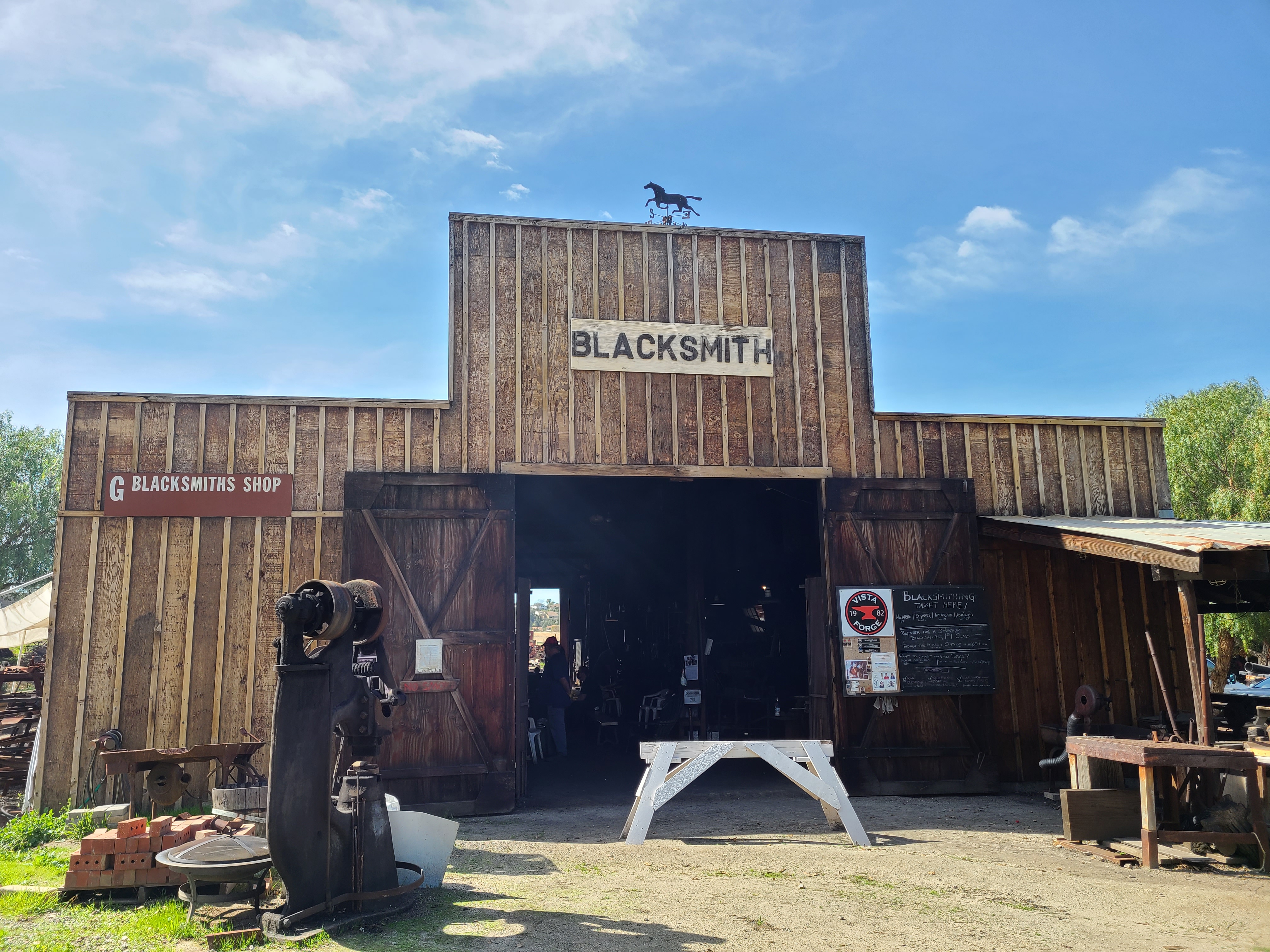
The blacksmith shop operates with an authentic line shaft setup powered by a 15-horsepower 1917 Mogul gasoline engine. Multiple forges glow during shows, with blacksmiths demonstrating the transformation of raw iron into useful objects. The working gristmill grinds wheat and corn into flour available for purchase during shows, and each summer the museum grows sorghum cane that becomes molasses for the fall event. The Museum Weavers occupy a barn with more than 50 working looms, teaching weaving, rug-making, and rope-making. Even the sawmill runs, powered by a D-3000 Cat diesel engine, likely the only operational sawmill in San Diego County.
Tracks Through History
The museum grounds host the Short Track Model Railroad Club, an educational organization with an NTrak model railroad featuring trains traveling through more than 40 modules. Miniature scenes include a drive-in movie theater, fairgrounds, farms, towns, and a coal mine. Their Donner Pass exhibit recreates the Southern Pacific crossing of the Sierra Mountains between Colfax and West Reno. A smaller layout allows children to operate trains themselves. But the full-scale machinery remains the draw: two D8 Caterpillars, a D9, 1930s Caterpillars, Best crawlers, a 1924 Buffalo-Springfield road roller, a gigantic 1918 30-60 Aultman-Taylor gas tractor, a 1911 Fairbanks-Morse kerosene tractor, a 1915 International Harvester Mogul 8-16, and several Rumely Oil-Pulls.
From the Air
Located at 33.23N, 117.26W on the outskirts of Vista, San Diego County, California. The museum occupies county-owned land at 2040 N Santa Fe Ave. Best viewed at 1,500-2,000 feet AGL; the open grounds and equipment displays may be visible on clear days. McClellan-Palomar Airport (KCRQ) lies 5nm to the southwest. Oceanside Municipal (KOKB) is 7nm to the northwest. The museum is open almost every day of the year, with major shows on the third and fourth weekends of June and October.