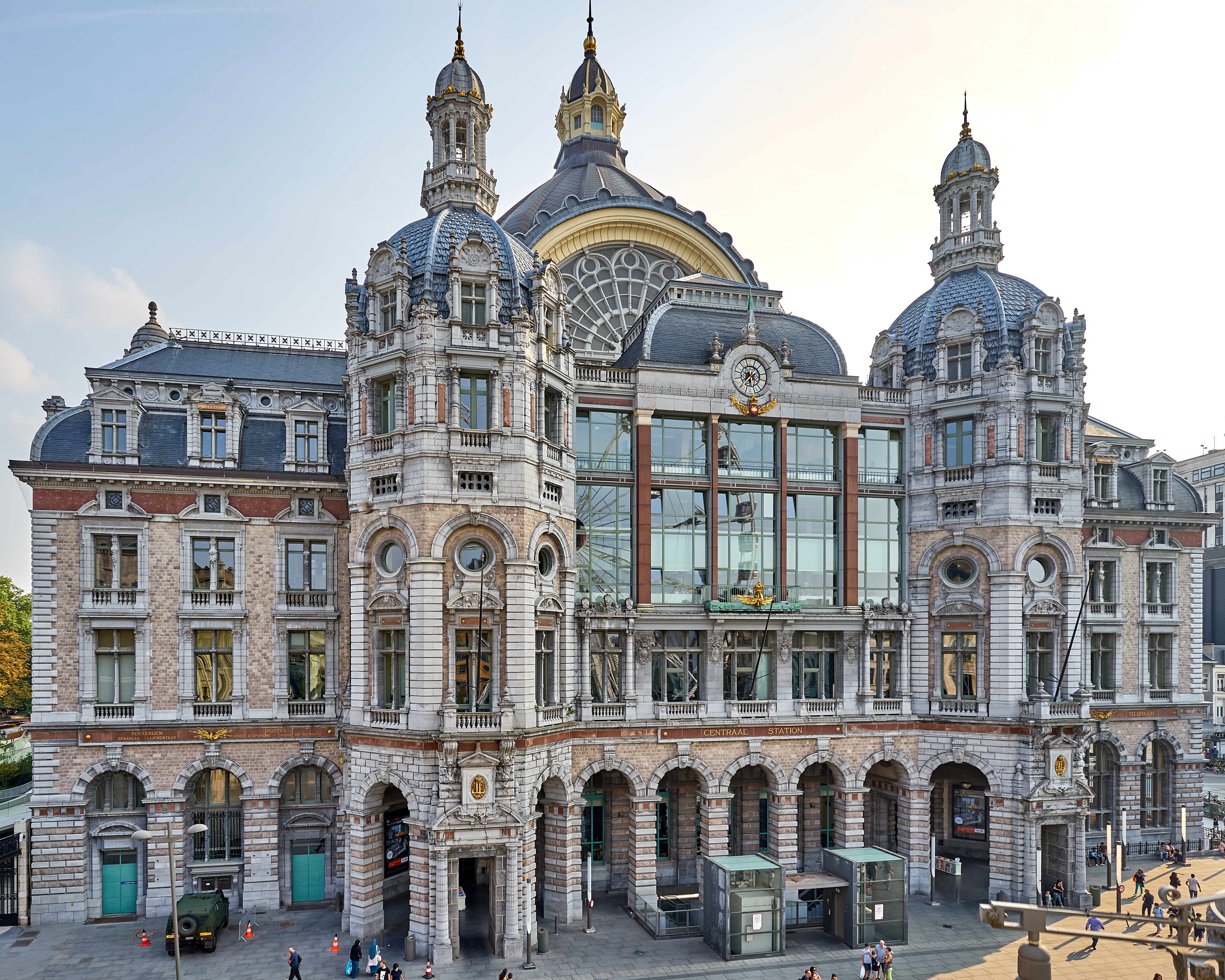
Antwerpen-Centraal Railway Station
Step off a train onto Platform 21, eighteen meters below the streets of Antwerp, and the first thing you do is look up. Through four open levels of marble, ironwork, and gilded balustrades, sunlight falls from a glass vault more than forty meters overhead. Locals call this building the spoorwegkathedraal - the railway cathedral - and the name fits. Louis Delacenserie designed Antwerpen-Centraal between 1895 and 1905 to be a temple of movement, and a century later it still feels like one.
An Architect's Reckless Eclecticism
Delacenserie refused to choose a single style. Beaux-Arts, neo-Baroque, Renaissance revival, hints of Byzantium - the stone-clad facade borrows from all of them, and the train hall by engineer Clement Van Bogaert wraps the eclecticism in 12,000 square meters of iron and glass. Historians have argued for decades about which label fits, and they have mostly given up trying. W. G. Sebald used the question as a literary device in his novel Austerlitz; the ability to appreciate every influence layered into Delacenserie's design is what marks the brilliance of his fictional architectural historian. The height of the train hall was not vanity, either. The roof had to rise that far above the platforms to dissipate the smoke of steam locomotives, which once filled the space with a permanent grey haze.
Bombs, Polycarbonate, and a Roof That Refused to Fall
During the Second World War, V-2 rockets struck the train hall hard. The structure held, but the stress kept working through the bones of the building for decades. By the 1980s, condition reports were grim enough that demolition was openly discussed. The station closed on 31 January 1986 and restoration crews moved in. Their cleverest fix sounds almost mundane: they replaced the original glass panels of the roof with polycarbonate sheets, which weigh forty percent less and flex enough to absorb the warping that the bombs had introduced. The substitution avoided the need for new supporting pillars that would have ruined the soaring lines of the hall. In 2011 the restoration won the Grand Prix of the European Union Prize for Cultural Heritage. The total bill for the works, including the new tunnels, came to 765 million euros.
From Terminus to Through-Station
For more than 130 years, Antwerpen-Centraal was a dead end. Trains arrived from Brussels and Mechelen, unloaded, and reversed direction. That changed on 23 March 2007, when a tunnel with two continuous tracks was opened beneath part of the city and beneath the station itself. Today the building stacks four levels of traffic - terminating platforms on top, through-tracks for high-speed Thalys and Eurostar services to Amsterdam and Paris running silently underneath. The plaque on the north wall still reads Middenstatie, an archaic Dutch phrase meaning Middle Station, a name nobody has used in living memory.
When the Hall Burst Into Song
In early 2009, two hundred dancers gathered in the main concourse and broke into the Do-Re-Mi number from The Sound of Music, joined by dozens of bewildered commuters who simply jumped in. The flash mob, staged to promote a Belgian televised search for a stage Maria, became one of the viral videos that defined the era. Mashable named Antwerpen-Centraal the most beautiful railway station in the world in 2014. Newsweek had already called it a destination that matched the journey. The building shows up in Agatha Christie's Poirot as a Brussels station, and Sebald's Austerlitz opens beneath its dome. People keep finding reasons to film here. The reason is always the same: the look on a traveler's face when they walk in for the first time.
From the Air
Located at 51.2169 N, 4.4211 E in central Antwerp. The vast green oxidized-copper dome stands out clearly from the air against the surrounding city blocks, roughly 4 km northeast of the Scheldt riverfront. Nearest major airport is Brussels Airport (EBBR), about 35 km south; Antwerp International (EBAW) sits 5 km southeast. Best viewed from low cruising altitudes in clear weather, with the station crown visible alongside the wedge-shaped Koningin Astridplein square that fans out in front of it.