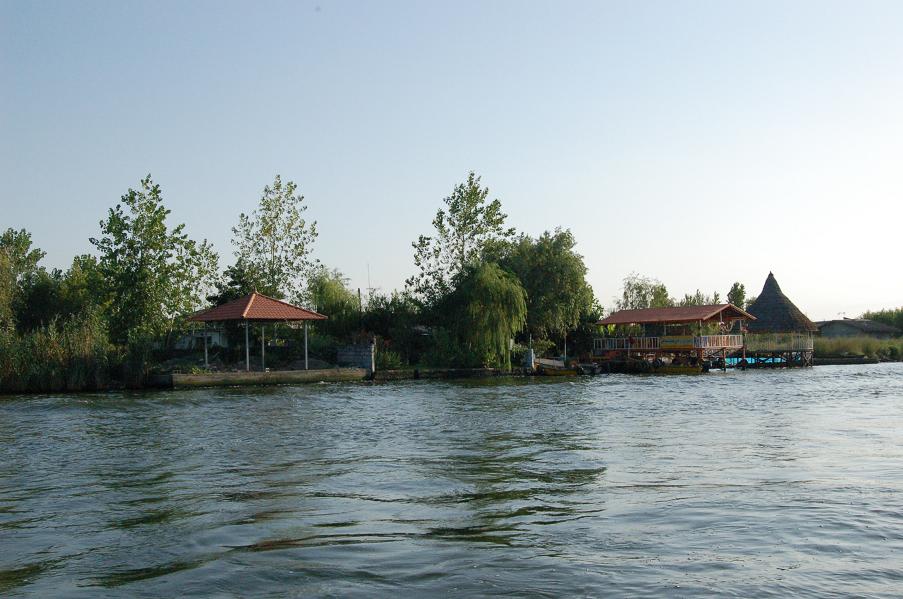
Anzali Lagoon
Before 1950, the Anzali Lagoon produced 5,000 tons of fish every year -- roughly 70 percent of all commercial fish caught in Gilan Province. It was the engine of an economy, a nursery for Caspian sturgeon, and a wintering ground for birds migrating between Siberia and Africa. Today the lagoon covers less than a quarter of the area it occupied in the 1930s. The water is shallower. The pollution is worse. And yet 243 species of birds still arrive every year, because even diminished, Anzali remains one of the most important wetlands in Iran.
A Lagoon That Splits a City
Anzali Lagoon stretches across 15,000 hectares near the Caspian port city of Bandar-e Anzali in Gilan Province. The lagoon physically divides the city in two, a body of water so large that it defines the urban geography of the community built around it. Within its boundaries lie the Selke Wildlife Refuge and the Siahkesheem Marsh, along with islands including Bozorg, Kouchak, and Mianposhteh. Eleven main rivers and 30 tributaries feed the lagoon, draining rice paddies and farmland upstream before entering the wetland carrying nutrients, sediment, and, increasingly, pollutants. The maximum depth reaches only 2.5 meters in spring, in the western reaches, and fluctuates with the unpredictable water level of the Caspian Sea.
Wings Over the Wetland
Of the 243 bird species identified at Anzali, 112 are aquatic and 131 terrestrial. More than 70 percent are migratory or wintering visitors, arriving on schedules that have not changed since long before the lagoon earned its Ramsar Convention listing on December 21, 1975. Spring brings the greatest diversity. Nine species found here are classified as at risk of extinction, making Anzali a conservation site of global significance despite its degraded condition. The lagoon also serves as a spawning ground for Caspian fish, with more than 50 species reported in its waters. The Cyprinidae, Gobiidae, and Clupeidae families dominate, constituting about 75 percent of the total Caspian Sea fish population that uses the lagoon at some stage of life.
Shrinking Waters
The lagoon's decline has been steady and largely self-inflicted. Urban waste from Bandar-e Anzali flows directly into the water. Industrial runoff adds chemical contamination. The city dump once sat on the wetland's bank. Caspian lotus and mats of Azolla fern have proliferated across the surface, choking waterways that once ran clear. The catchment area encompasses 374,000 hectares, and every hectare sends its runoff lagoonward. The climate is hot and humid in summer, mild in winter, with temperatures ranging from near zero in January to 36 degrees Celsius in July. Humidity within the lagoon consistently exceeds that of surrounding areas, creating a microclimate that sustains the wetland's biological richness even as human activity degrades its water quality.
Conservation Under Pressure
Anzali was among the first Iranian wetlands listed under the Ramsar Convention, and it has since been placed on the Montreux Record -- a register of Ramsar sites where ecological character has changed or is likely to change due to human activity. Environmentalists have fought proposals to build a sports complex on a peninsula connected to the lagoon, arguing it would deliver a final blow to an already stressed ecosystem. The opposition has succeeded so far. But the fundamental pressures remain: a growing city, agricultural runoff from upstream farms, and a Caspian Sea whose own water levels are shifting in response to climate change. Anzali Lagoon survives not because it is protected well enough, but because the biological systems it supports are resilient enough -- so far -- to endure what has been done to them.
From the Air
Located at 37.48N, 49.34E on Iran's Caspian Sea coast near the port city of Bandar-e Anzali in Gilan Province. The lagoon is clearly visible from altitude as a large body of water dividing the city, covered in green vegetation in summer months. Best viewed at 3,000-8,000 ft AGL. Nearest airport is Rasht (OIGG), approximately 30 km southeast. The Caspian Sea coastline and the contrast between the lagoon's green surface and the open sea make navigation straightforward.