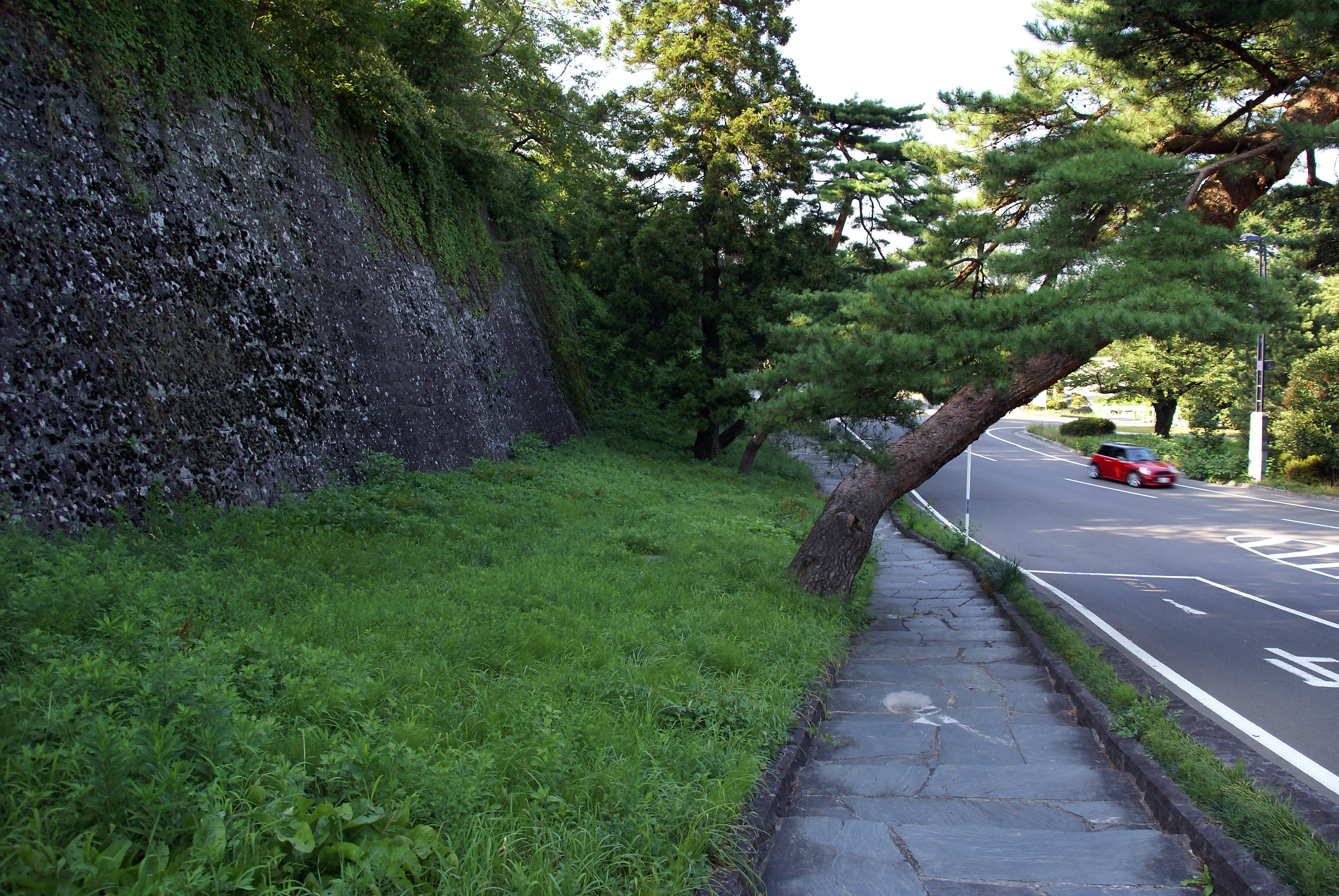
Aoba Castle
The bronze horseman sits motionless above the city, his crescent-moon helmet silhouetted against the sky, one eye forever fixed on the metropolis he founded. Date Masamune lost his right eye to smallpox as a child, and the moniker that followed him through history -- the One-Eyed Dragon of Oshu -- was coined not by contemporaries but by the Confucian scholar Rai San'yo nearly two centuries after the warlord's death. The statue overlooking Sendai from the ruins of Aoba Castle is itself a survivor: the original, erected in 1935, was melted down for wartime scrap metal in 1944, ironically sparing it from the firebombing that destroyed the castle's last remaining structures a year later. The current bronze was installed in 1964, gazing out over a city that has rebuilt itself as many times as the fortress beneath it.
A Fortress That Never Had a Keep
Aoba Castle occupies a plateau on the western edge of Sendai, its back pressed against forested hills, its face overlooking the Hirose River and the city sprawl beyond. The design was brilliantly defensive -- cliffs guard the south and east, a rare surviving virgin forest of Honshu protects the west, and the river wraps the north and east. The honmaru, or inner bailey, rises 115 meters above the plain, a roughly square area 250 meters across enclosed by stone walls that reach 15 meters high in places. Curiously, though foundations for a tenshu -- the towering main keep that defines most Japanese castles -- were laid, the keep was never built. Instead, four three-story yagura watchtowers guarded the perimeter. The daimyo's residence within was built in the flamboyant Momoyama style, and contemporaries compared it to Toyotomi Hideyoshi's legendary Jurakudai Palace in Kyoto.
The Dragon Builds His City
The hill called Mount Aoba had hosted fortified residences since the Kamakura period, first under a branch of the Shimazu clan, then the local Kokubun clan, who were eventually destroyed by the Date. After the decisive Battle of Sekigahara, Tokugawa Ieyasu himself visited the area and renamed Mount Aoba 'Sendai.' Date Masamune, awarded the domain as the first daimyo, began construction of the castle, and his son Date Tadamune completed the work in 1637 -- adding the san-no-maru bailey and numerous gates. For more than two centuries, the castle served as the administrative heart of the Date clan and their governance of Mutsu Province under the Tokugawa shogunate. The ni-no-maru, or second bailey, handled daily governmental functions, while the honmaru was reserved for ceremonial occasions.
Burned, Bombed, Occupied
Aoba Castle's history reads like a catalogue of destruction. Earthquakes and fires struck in 1616, 1648, 1668, and 1710. During the Boshin War in the 1860s, the castle became a nerve center of the pro-Tokugawa alliance led by Date Yoshikuni, and after Sendai's surrender, the Meiji government partially dismantled the fortress in the 1870s. The Imperial Japanese Army moved in, establishing the Sendai Garrison. A devastating fire in 1882 consumed many surviving structures. In 1931, two of the last original buildings -- the omotemon gate and the wakiyagura tower -- received designation as National Treasures. That recognition could not protect them: on July 10, 1945, American bombers destroyed both structures and everything else that remained during the Bombing of Sendai. The United States Army occupied the site after the war, razing any final Edo-period remnants before returning the grounds to Japan in 1957.
Stone Walls and Stubborn Memory
What remains today is a landscape of absence and imagination. The stone wall foundations trace the outline of a fortress that no longer exists. The Sendai City Museum, built in 1961 on the san-no-maru enclosure, tells the story the missing buildings cannot. Over the decades, the stone base, a few walls, and some wooden structures have been carefully rebuilt. In 2003, the ruins were designated a National Historic Site, and in 2006, Aoba Castle was named one of Japan's 100 Fine Castles. The 2011 Tohoku earthquake damaged the famous equestrian statue and the torii gate of nearby Aoba Shrine, adding yet another chapter to the site's long record of resilience. The forest that Tokugawa-era guards once patrolled is now managed as a botanical garden by Tohoku University -- a living link to the original landscape that Date Masamune would still recognize four centuries later.
From the Air
Located at 38.252N, 140.856E on a prominent wooded hilltop on the western edge of central Sendai. From the air, the castle ruins are identifiable by the large forested plateau above the Hirose River, distinct from the surrounding urban grid. Sendai Airport (RJSS) lies approximately 12 nautical miles to the south-southeast. The Matsushima coastline with its famous pine-clad islands is visible to the northeast. Best viewed at 3,000-5,000 feet, where the castle's hilltop position and the river gorge below become clearly distinguishable from the city fabric. The Zao mountain range forms the western horizon.