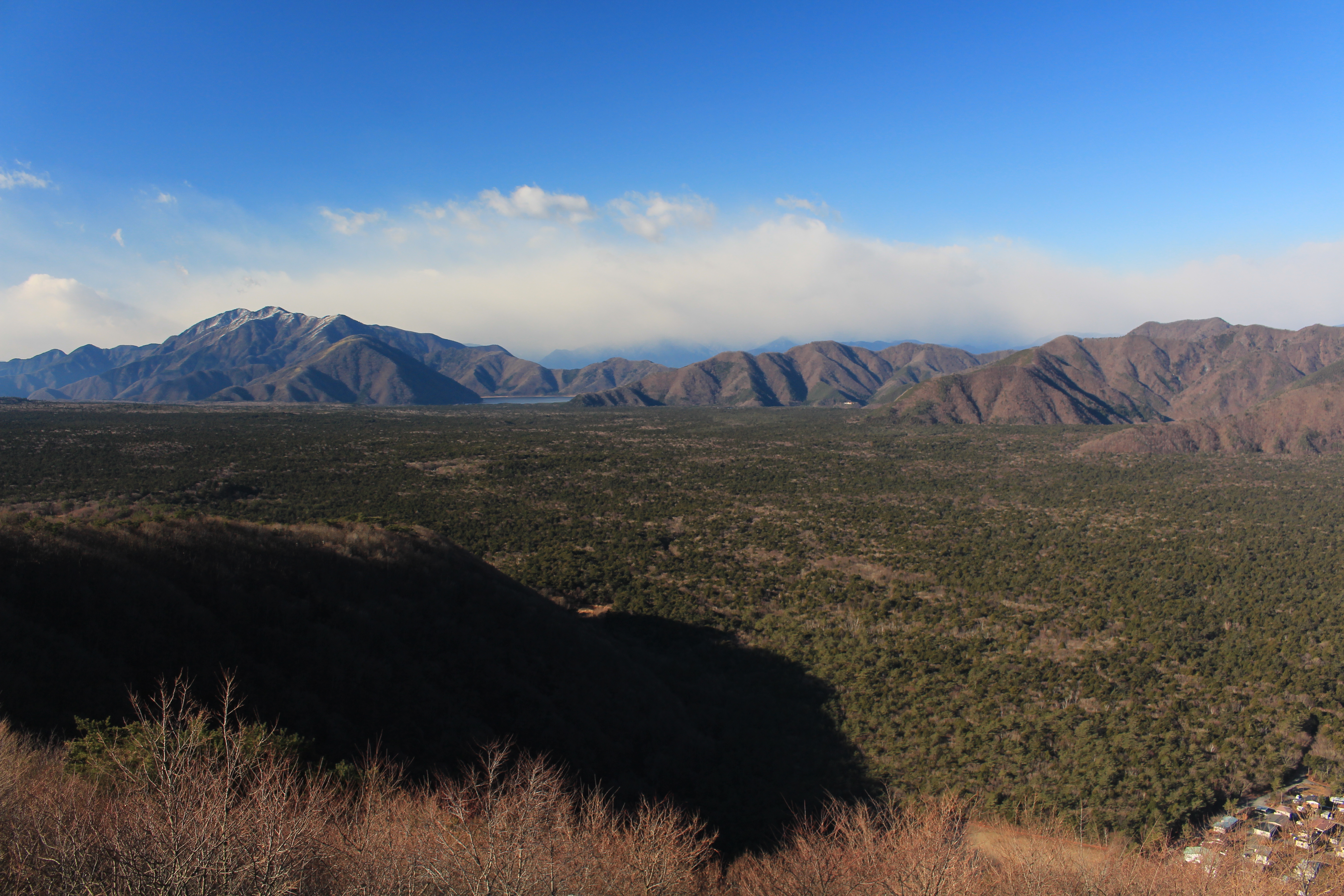
Aokigahara
Place a compass on the forest floor and watch the needle swing away from north, pulled sideways by the iron-rich lava underneath. Lift the compass to waist height and it behaves normally again. This small, disorienting trick captures something essential about Aokigahara: it is a place where the familiar rules seem to wobble. Growing on 30 square kilometers of hardened lava from Mount Fuji's catastrophic 864 CE eruption, this forest -- also called the Sea of Trees -- is only about 1,200 years old, geologically young, and it shows. The soil is thin to nonexistent. Tree roots cannot dig down, so they crawl sideways across bare rock in tangled, sculptural forms, gripping whatever they can find. The porous lava absorbs sound, muffling footsteps and birdsong alike, producing a silence so deep it has fueled legends for centuries.
A Landscape Rewritten in Lava
In the summer of 864 CE, during the sixth year of the Jogan era, Mount Fuji erupted from a vent called Nagaoyama on its northwestern flank. The eruption was both explosive and effusive, pouring enormous quantities of lava down the mountainside. The flows reshaped the geography permanently: an ancient body of water called Lake Senoumi was split in two, creating what are now Lake Saiko and Lake Shojiko, two of the Fuji Five Lakes. The lava field solidified into a vast, porous platform, and over the following centuries, a forest of cypress, hemlock, and other conifers took root in its cracks and hollows. Because so little soil has accumulated on the rock, the trees grow in strange, exposed configurations, their roots weaving across the surface like gnarled fingers.
Ice Caves and Living Canopy
The western edge of Aokigahara is the most visited, and for good reason. Here, the lava field's natural chambers and tunnels have become popular tourist destinations: the Narusawa Ice Cave stays frozen year-round, the Fugaku Wind Cave offers a different underground experience, and the Lake Sai Bat Cave rounds out a trio of accessible lava tubes. Above ground, Aokigahara sustains a surprisingly rich temperate ecosystem. Asiatic black bears den in the forest. Dsinezumi shrews and small Japanese moles navigate the root-laced floor. The canopy shelters great spotted and Japanese pygmy woodpeckers, Eurasian jays, Japanese grosbeaks, and Siberian thrushes. The dominant tree species shifts with altitude: Tsuga diversifolia hemlock prevails between 1,000 and 1,800 meters, giving way to Abies veitchii fir above that.
Ghosts, Legends, and Difficult Truths
Aokigahara has long carried a reputation as a haunted place. In Japanese folklore, the forest is said to be inhabited by yurei -- restless spirits of the dead. Some accounts link this belief to the practice of ubasute, in which elderly or infirm family members were allegedly abandoned in remote areas during times of famine, though the historical reality of this practice is debated. What is not debated is the forest's modern association with suicide, which has been documented since at least the 1960s. Signs posted at trailheads urge visitors to reconsider and provide contact information for crisis support services. The association intensified after Seicho Matsumoto's 1961 novel Nami no To (Tower of Waves) featured the forest, though the pattern clearly predates the book.
Beyond the Reputation
Aokigahara's notoriety has sometimes overshadowed its genuine ecological and geological significance. This is a forest that grew on a lava field in just over a millennium -- a vivid demonstration of how life reclaims even the most hostile terrain. School groups visit the ice caves. Hikers follow designated trails through cathedral-quiet stands of hemlock. Naturalists come for the birdwatching. The deeper reaches of the forest host herbaceous and flowering plants, including Artemisia princeps, thriving in the sheltered gaps between lava formations. From above, Aokigahara appears as a dark, unbroken canopy pressing against the northwestern base of Fuji, bordered by Lake Saiko to the north and Lake Shojiko to the west -- the same lakes that the eruption created, now framing the forest it left behind.
From the Air
Located at 35.47N, 138.62E on the northwestern flank of Mount Fuji, Yamanashi Prefecture. From the air, Aokigahara appears as a distinctive dark-green forest canopy covering a roughly rectangular area between Lake Saiko to the north and Lake Shojiko to the west. The contrast between the dense forest and the surrounding open terrain is visible from considerable altitude. Recommended viewing altitude: 5,000-8,000 feet for full forest context with Fuji and the Five Lakes visible. Nearest airports: Chofu Airport (RJTF) approximately 50nm east, Mt. Fuji Shizuoka Airport (RJNS) approximately 35nm south. Clear morning conditions provide the best views; afternoon cloud buildup around Fuji is common.