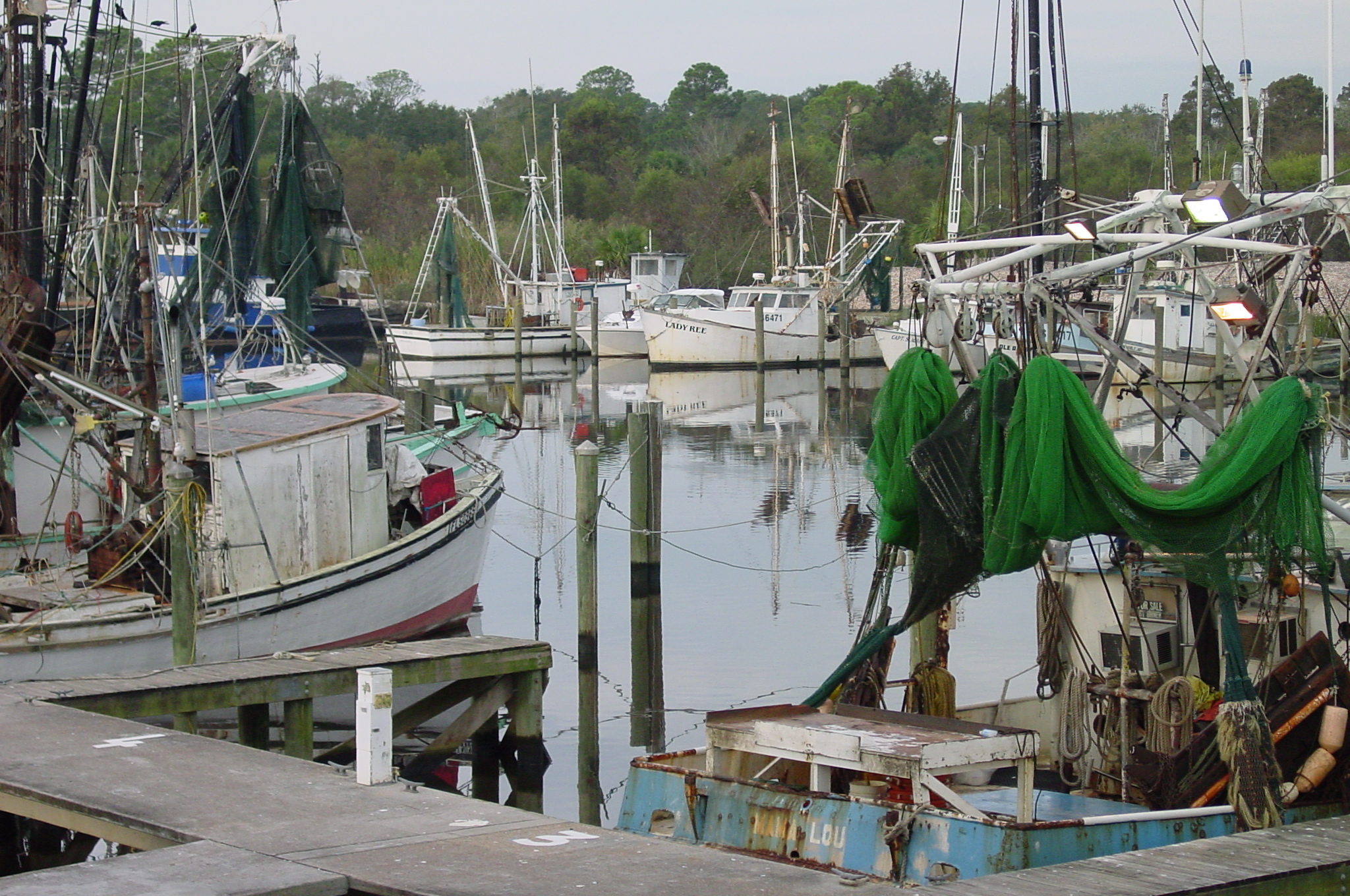
Apalachicola, Florida
The name means "people on the other side of the river," a Hitchiti phrase combining apalahchi and okli, and the town has always existed on the other side of something. On the other side of Florida's tourist economy, far from the theme parks and condo towers. On the other side of history, where a forgotten port once rivaled New Orleans in commerce. Tucked into a bend of the Apalachicola River where it spills into a shallow bay on the Florida Panhandle, this town of barely 2,300 souls holds more American history per square block than most cities a hundred times its size. This is where Dr. John Gorrie, desperate to save his yellow fever patients, invented mechanical cooling in the 1840s, laying the foundation for modern air conditioning and refrigeration. This is where 90% of Florida's oysters once grew in warm, brackish waters sheltered by a chain of barrier islands. And this is where the cotton that built the antebellum South once passed through grand three-story brick warehouses on its way to the world.
When Cotton Was King
Before the railroads connected Georgia's interior to Savannah and other Atlantic ports, the Apalachicola River was the highway. Cotton bales floated down from plantations along the Chattahoochee and Flint rivers, converging at Apalachicola for shipment across the Gulf and beyond. By 1836, fifty thousand bales were moving through the port annually, and by 1853, that number had swelled to 140,000. More than forty three-story brick and granite warehouses lined the waterfront. Apalachicola became the third-largest cotton port on the Gulf of Mexico, behind only New Orleans and Mobile. Incorporated as West Point in 1827, the town took its current name in 1831. Wealth poured in, building the Greek Revival homes and commercial blocks that still line the streets today. Then the railroads arrived, and the river trade died almost overnight.
The Doctor Who Cooled the World
In the sweltering summers of the 1840s, yellow fever ravaged Apalachicola. Dr. John Gorrie, the town's physician and postmaster, became obsessed with cooling his patients' sickrooms, convinced that lower temperatures could fight the disease. He began with buckets of ice shipped from northern lakes, but the supply was unreliable and ruinously expensive. So Gorrie did what no one had done before: he built a machine that manufactured cold. His device compressed air, cooled it with water, then expanded it rapidly, producing ice. He received U.S. Patent No. 8080 in 1851 for his ice-making machine, the first mechanical refrigeration system in American history. Gorrie died in 1855, impoverished and mocked by the northern ice trade, never knowing that his invention would transform human civilization. The John Gorrie Museum State Park in Apalachicola preserves a replica of his machine.
Oyster Capital of the World
Apalachicola Bay is a miracle of estuarine chemistry. Fresh water from the Apalachicola River mixes with salt water from the Gulf, creating the brackish conditions that oysters love. The bay is sheltered by a necklace of barrier islands, including St. Vincent Island, St. George Island, and Cape St. George Island, that protect the shallow waters from Gulf storms. For generations, more than 90% of Florida's oyster harvest came from these beds. Oystermen worked the bay in flat-bottomed boats, using long-handled tongs to haul up clusters from the muddy bottom. The town hosted the annual Florida Seafood Festival, drawing thousands to celebrate the harvest. Then the water stopped flowing. Upstream dams and diversions on the Chattahoochee and Flint rivers starved the Apalachicola of freshwater. Pollution crept in. In 2020, the Florida Fish and Wildlife Conservation Commission shut the fishery down for five years to allow populations to recover. The bay that once fed a town and defined an industry fell silent.
The Forgotten Coast
Locals call this stretch of the Florida Panhandle "the Forgotten Coast," and they mean it as a compliment. No high-rise condos crowd the shoreline. No chain restaurants line the main drag. Instead, Apalachicola has weathered into something authentic: a grid of historic streets shaded by live oaks, Victorian homes with wide porches, and the Dixie Theatre, a 1912 Equity playhouse renovated in the 1990s that still stages live performances. The town's notable residents reflect its outsized story. Besides Gorrie, Apalachicola produced Alvan Wentworth Chapman, the botanist who cataloged the flora of the southern United States, and Richard S. Heyser, the U-2 pilot whose reconnaissance photographs revealed Soviet missiles in Cuba in 1962. In 1979, Exxon relocated an experimental subsea production system here, creating the first artificial reef converted from an oil platform. Even the firsts in Apalachicola have a way of being forgotten by the wider world.
From the Air
Located at 29.73N, 85.00W on the Florida Panhandle where the Apalachicola River meets Apalachicola Bay. The town is visible as a small grid of streets at the river mouth, with the distinctive chain of barrier islands (St. Vincent, St. George, Cape St. George) sheltering the bay to the south. The Apalachicola River winds north through the dense Apalachicola National Forest. Nearest airport is Apalachicola Regional Airport (KAAF), 2nm west of town. Tyndall AFB (KPAM) is 35nm northwest. Northwest Florida Beaches International (KECP) is about 78nm northwest. Tallahassee Regional (KTLH) is approximately 79nm northeast. Expect warm, humid conditions with afternoon sea breezes; best VFR viewing in morning hours.