Apartheid Museum
You buy your ticket and discover you have been classified. Not by the color of your skin, but by a randomly generated designation on a slip of paper: white or non-white. You enter the Apartheid Museum through separate doors, each leading to a different initial experience. The arbitrariness is the point. Under apartheid, the classification system that sorted South Africans into categories -- native, white, coloured, Asian -- determined where you could live, whom you could marry, which beaches you could visit, and which entrance you could use. The museum, which opened in November 2001 as part of the Gold Reef City complex in southern Johannesburg, recreates that arbitrariness in its first moments, before a single exhibit panel has been read.
Seven Pillars in a Courtyard
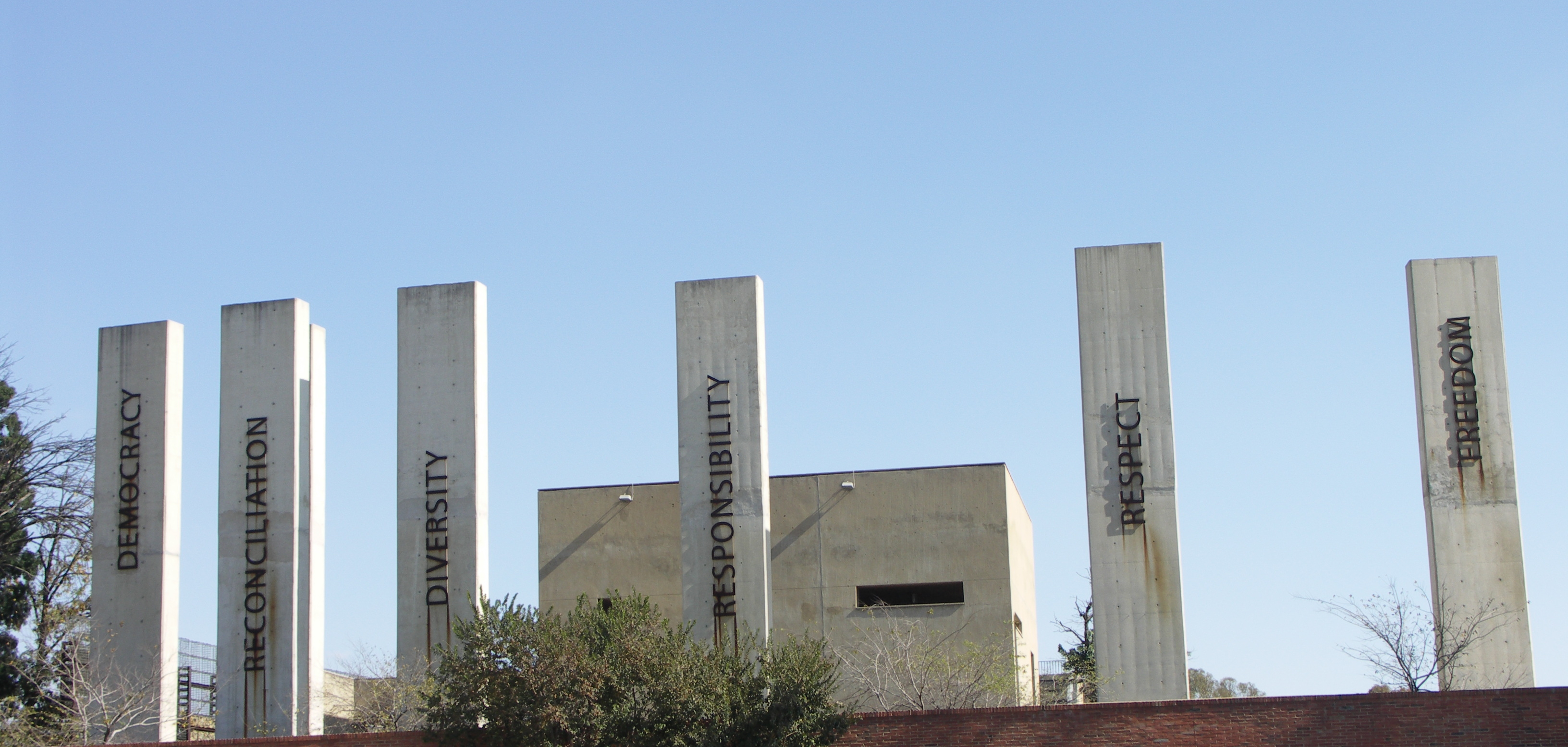
The first exhibit visitors encounter stands in the open air. Seven pillars rise from the museum's courtyard, each inscribed with one of the values enshrined in the South African Constitution: Democracy, Equality, Reconciliation, Diversity, Responsibility, Respect, and Freedom. These are not abstract principles to the people who wrote them. The Constitution was drafted in the aftermath of decades of institutionalized racial oppression, and each of these words represents a specific repudiation of something apartheid enforced. The pillars function as a kind of architectural preamble -- a statement of what South Africa aspired to become before the museum takes visitors through the history of what it was. Standing among them, you are caught between the promise overhead and the history ahead.
Walking Behind Strangers
After the constitutional pillars, the Journeys exhibit lines an outdoor path leading to the main museum building. Large photographic portraits show the descendants of people who came to Johannesburg after gold was discovered in 1886 -- the Witwatersrand Gold Rush that transformed a stretch of highveld into one of Africa's largest cities. The portraits represent the full racial diversity of those who arrived: Black miners, white fortune-seekers, Indian merchants, mixed-heritage families. But the photographs are mounted so that visitors approach them from behind. You walk alongside these figures as if sharing a path, seeing only their backs. Only by turning around after passing can you see their faces. The design is quietly devastating. Apartheid reduced people to categories visible from the outside -- skin color, hair texture, the shape of a nose. The exhibit forces the opposite experience: encounter someone as a fellow traveler first, and only then see who they are.
The Machinery of Segregation
Deeper inside, the Segregation exhibit traces the formal architecture of racial separation from the formation of the Union of South Africa in 1910 through the rise of apartheid under the National Party after 1948. Display cases hold the physical artifacts of the system: identity documents that stamped racial classification onto every citizen, the passbooks that controlled Black movement and labor, the signs that designated benches, drinking fountains, and entrances by race. Black South Africans and white women were excluded from voting under the Union. Apartheid intensified these exclusions into a comprehensive system of control that governed nearly every aspect of daily life. The exhibits do not editorialize. The documents, photographs, and objects speak with a clarity that requires no commentary. An expired identity card in a glass case -- its racial classification printed in bureaucratic typeface -- carries more weight than any wall text could.
A Museum Built on Gold
The museum's location is no accident. Gold Reef City sits on the site of a former gold mine, and Johannesburg itself exists because of the Witwatersrand goldfields. The wealth extracted from those mines built the city and funded the state that imposed apartheid. Black miners worked the deep shafts for wages that were a fraction of what white miners earned, under conditions that killed thousands. The museum stands, quite literally, on the ground where that extraction occurred. At least five times a year, the museum hosts events celebrating the end of apartheid and the advent of multiracial democracy. A pool of reflection offers a space for quiet contemplation among the museum's open-air memorial gardens.
From the Air
Located at 26.24S, 28.01E in southern Johannesburg, part of the Gold Reef City complex built on the site of a former gold mine. The museum is approximately 8 km south of Johannesburg city center, near the M1 motorway. The Gold Reef City amusement park and casino are adjacent and visible from the air. Nearest airport: OR Tambo International Airport (FAOR), approximately 25 km east. Lanseria International Airport (FALA) is roughly 40 km northwest. Best viewed from 2,000-3,000 feet AGL, where the museum complex, the Gold Reef City theme park, and the surrounding mining heritage landscape of southern Johannesburg are all visible.