Apollo 9
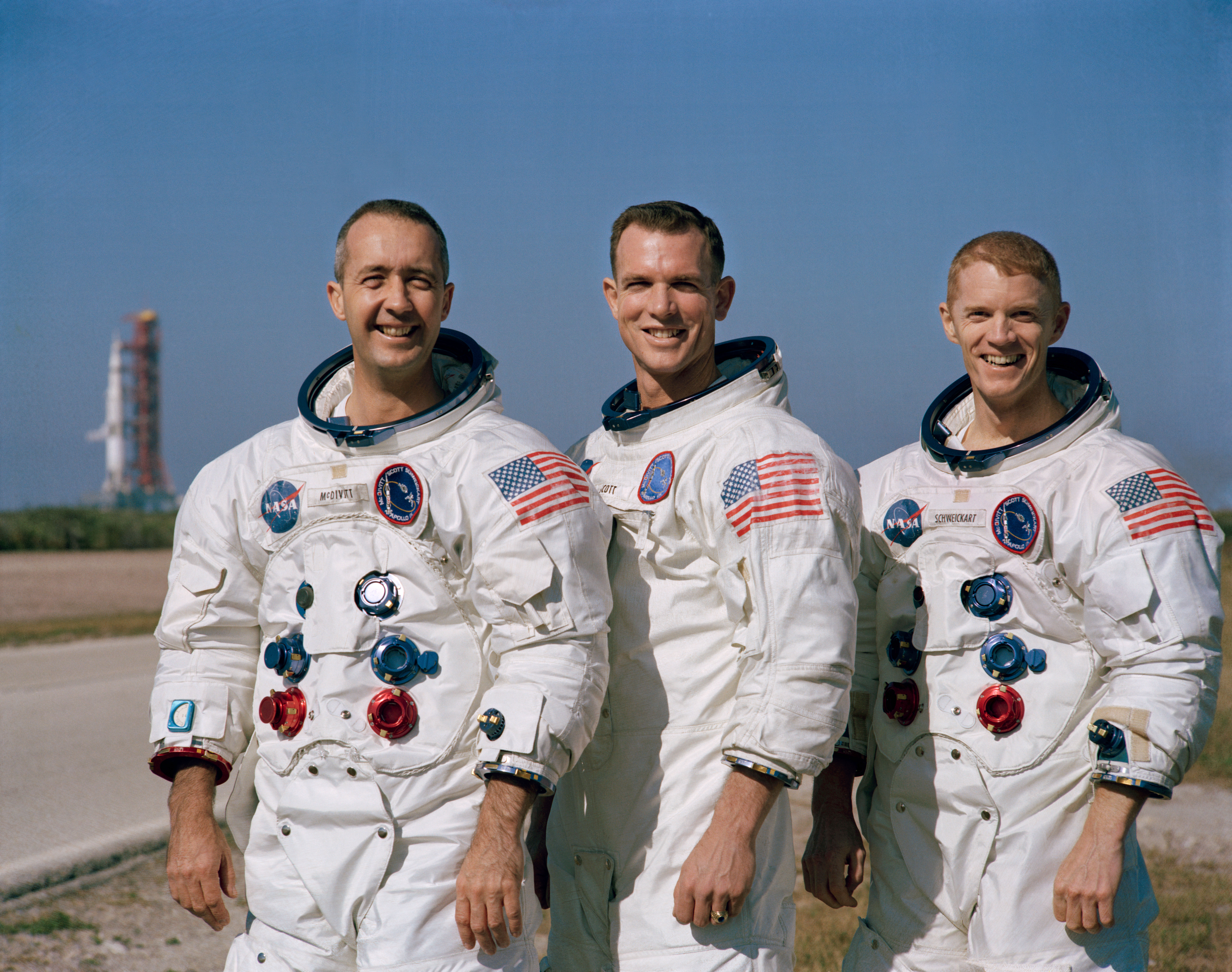
Three astronauts with head colds delayed a half-million-dollar launch, and nobody at NASA complained. Apollo 9 had been in preparation for three years, its crew the longest-trained in the program's history, and the stakes were too high to risk on stuffy sinuses. When the Saturn V finally lifted off from Kennedy Space Center on March 3, 1969, it carried something no rocket had taken into orbit before: a lunar module with astronauts who intended to fly it. James McDivitt, David Scott, and Rusty Schweickart spent the next ten days proving that the ungainly, spider-legged lander could separate from its mothership, maneuver independently, and dock again - the exact sequence required to land on the Moon and come home. Without Apollo 9, there would have been no Apollo 11.
The Crew Who Named Their Ships
NASA had banned spacecraft nicknames after Gus Grissom called Gemini 3 the Molly Brown. But Apollo 9 presented a problem: for the first time, the command module and lunar module would fly separately, and Mission Control needed distinct call signs to avoid confusion. McDivitt's crew pushed for a change. In simulations, they started calling the command module "Gumdrop" - inspired by the blue protective wrapping it arrived in from the factory - and the lunar module "Spider," for its insectile appearance with landing legs deployed. NASA's public relations staff thought the names were undignified. The astronauts used them anyway, and the names stuck. Future crews would be required to choose more formal call signs, starting with Apollo 11's Eagle and Columbia, but Gumdrop and Spider captured something the later names did not: the irreverent confidence of a crew that had trained together since January 1966 and knew their machines intimately.
Seven Hours for Every One in Space
McDivitt, Scott, and Schweickart logged 1,800 hours of mission-specific training - roughly seven hours of preparation for every hour they would spend in flight. Their training began the day before the Apollo 1 fire, in the very first Block II spacecraft in which they had originally been slated to fly. They checked out the command module at North American Rockwell's facility in Downey, California, and the lunar module at Grumman's plant in Bethpage, New York. They practiced zero-gravity maneuvers underwater and in the Vomit Comet, traveled to MIT in Cambridge, Massachusetts, to learn the Apollo Guidance Computer, and studied the 37 navigation stars at the Morehead and Griffith planetariums. Each astronaut spent more than 300 hours in command module and lunar module simulators at Kennedy Space Center and Houston, some sessions involving live participation from Mission Control. Flight Director Gene Kranz considered them the best-prepared crew he had ever worked with.
Red Rover Outside the Spider
Day four brought the mission's most dramatic test. Schweickart was supposed to exit the lunar module, climb along the spacecraft's exterior to the command module hatch, and demonstrate that astronauts could transfer between vehicles in an emergency. He would wear the Portable Life Support System backpack - the same unit that would sustain astronauts on the lunar surface - making this the only chance to test it in space before the actual Moon landing.
Schweickart had been battling nausea. McDivitt initially canceled the EVA, then relented when the lunar module pilot felt better, authorizing him to exit and move around the LM's exterior using handholds. Scott stood in the command module hatch while both men photographed each other and retrieved experiments from the outside of their spacecraft. Schweickart used the call sign "Red Rover," a nod to his hair color. He found moving in space easier than simulations had suggested, and both astronauts were confident the full exterior transfer could have been completed if needed. The PLSS worked flawlessly - a quiet triumph that would prove essential four months later when Neil Armstrong and Buzz Aldrin trusted their lives to the same system on the lunar surface.
Spider Flies Alone
The fifth day was the real test. McDivitt and Schweickart undocked Spider from Gumdrop, fired the lunar module's descent engine, and flew it independently for more than six hours. They traveled as far as 111 miles from Scott, who waited alone in the command module - a distance that would have been fatal for all three astronauts if the docking failed on return. The lunar module performed every maneuver the Moon mission would require: descent burns, staging, ascent engine firing, rendezvous, and docking. When Spider latched back onto Gumdrop, Buzz Aldrin was watching from Mission Control. According to Andrew Chaikin, at that moment Aldrin knew Apollo 10 would succeed and that he and Armstrong would attempt the landing. On March 24, NASA made it official. The crew also brought another first into orbit: music. Apollo 9 was the first mission where astronauts were allowed personal mixtapes, played on early portable cassette recorders. McDivitt and Scott chose easy listening and country. Schweickart's classical music cassette went mysteriously missing until the ninth day, when Scott produced it with a grin.
The Mission That Cleared the Path
Apollo 9 splashed down 160 nautical miles east of the Bahamas on March 13, 1969, after ten days, one hour, and 54 seconds in orbit. It landed about three miles from the recovery carrier USS Guadalcanal - the last crewed spacecraft to splash down in the Atlantic Ocean until Inspiration4 in 2021. NASA Associate Administrator George Mueller called it "as successful a flight as any of us could ever wish for." Gene Kranz said simply: "sheer exhilaration."
The success was so complete that NASA considered skipping Apollo 10 entirely and going straight to the landing attempt. They decided against it - the lunar module still needed testing in actual lunar orbit - but the fact that the option was discussed speaks to how thoroughly Apollo 9 had validated the hardware. McDivitt left the astronaut corps afterward to manage the Apollo Spacecraft Program. Scott went on to command Apollo 15, landing on the Moon in 1971. Schweickart, who had volunteered for medical study of his spacesickness, was never assigned to another prime crew. As Apollo 17 commander Eugene Cernan later said, when it came to understanding spacesickness, Schweickart "paid the price for them all." The Gumdrop command module is on display at the San Diego Air and Space Museum.
From the Air
Apollo 9's splashdown coordinates were approximately 23.25°N, 67.93°W, about 160 nautical miles east of the Bahamas in the Atlantic Ocean. The mission launched from Kennedy Space Center (ICAO: n/a, but near KTTS/Merritt Island) at Cape Canaveral, Florida. The recovery ship USS Guadalcanal waited in the Atlantic. From cruising altitude, the splashdown area lies in open ocean east of the Bahamas chain, roughly between Great Inagua Island and the Turks and Caicos. Nearby airports include Providenciales (MBPV) in the Turks and Caicos and Lynden Pindling International (MYNN) in Nassau. The Gumdrop command module is now displayed at the San Diego Air and Space Museum in California.