Apollo-Soyuz
On July 17, 1975, two hundred kilometers above the Atlantic Ocean, an Apollo command module nudged its docking probe into a Soyuz orbital module's receiving cone. Three hours later, American astronaut Thomas Stafford floated through the hatch and clasped hands with Soviet cosmonaut Alexei Leonov. The handshake was broadcast live to millions. For a few days, the Cold War had a seam running through it in low Earth orbit -- and sunlight was leaking in from both sides.
How Enemies Learned to Fly Together
The road to Apollo-Soyuz began not in space but in diplomacy. By the early 1970s, the policy of detente was thawing relations between the United States and the Soviet Union. In May 1972, President Richard Nixon and Soviet Premier Alexei Kosygin signed an agreement on cooperation in space exploration. The practical challenge was enormous: two nations with incompatible spacecraft, different engineering philosophies, and languages that shared almost no technical vocabulary had to build a system that let their capsules dock in orbit. American and Soviet engineers designed a special docking module -- an airlock and adapter that bridged the gap between Apollo's pure-oxygen atmosphere at 5 psi and Soyuz's nitrogen-oxygen mix at normal sea-level pressure. The module was built in the United States and launched aboard the Apollo spacecraft.
Five Men, Two Languages, One Orbit
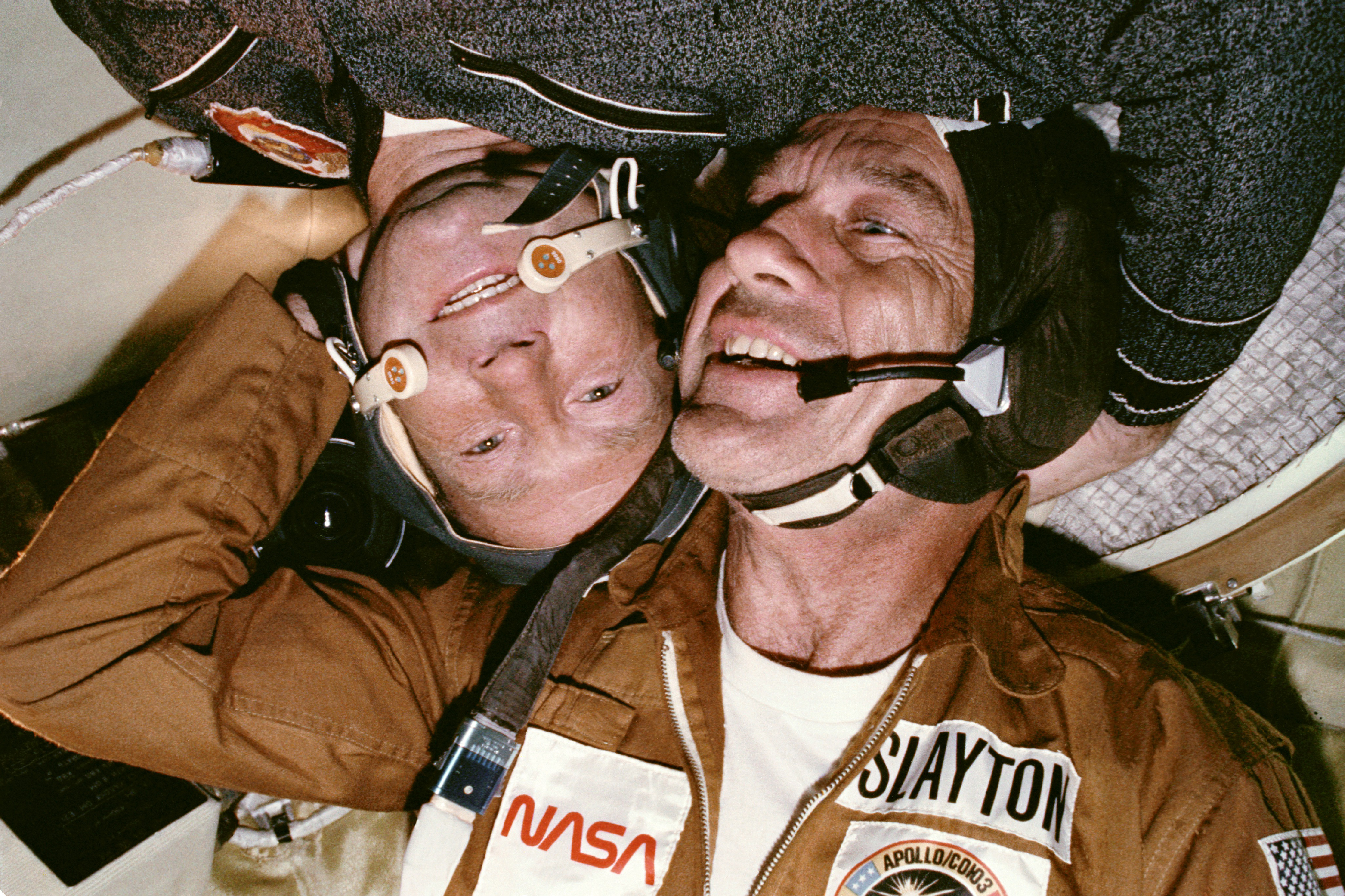
The American crew consisted of commander Thomas P. Stafford, a veteran of Gemini 6, Gemini 9, and Apollo 10; command module pilot Vance D. Brand, on his first spaceflight; and docking module pilot Deke Slayton, one of the original Mercury Seven astronauts who had been grounded for sixteen years due to a heart condition before being cleared to fly. The Soviet crew were commander Alexei Leonov, who in 1965 had become the first person to walk in space, and flight engineer Valery Kubasov. The crews trained together for months, learning each other's languages. During the mission, Stafford spoke Russian and Leonov spoke English -- a practice that helped prevent misunderstandings and became a model for later international missions aboard the Space Station.
Rendezvous Over the Atlantic
Soyuz 19 launched first, lifting off from the Baikonur Cosmodrome in Kazakhstan at 12:20 UTC on July 15, 1975. Seven and a half hours later, the Apollo spacecraft followed from Kennedy Space Center's Launch Complex 39B. It was the last Saturn rocket to fly -- a leftover IB variant from the canceled Apollo program -- and the final Apollo capsule to leave Earth. After two days of orbital maneuvering, the spacecraft docked on July 17 over the Atlantic. The crews visited each other's ships, shared meals, exchanged flags and gifts, and conducted joint scientific experiments. One experiment created an artificial solar eclipse: Apollo maneuvered to block the sun while Soyuz instruments photographed the solar corona. The spacecraft remained docked for nearly two days before separating on July 19.
A Near-Fatal Homecoming
Apollo splashed down in the Pacific Ocean on July 24, 1975, near Hawaii -- but the landing nearly killed its crew. During descent, the reaction control system was inadvertently left active, and when the capsule's parachutes deployed, toxic nitrogen tetroxide oxidizer fumes from the thrusters were drawn into the cabin through the pressure equalization valve. The crew breathed the fumes for several minutes before Brand, though losing consciousness, managed to activate the Earth landing system and deploy oxygen masks. All three astronauts were hospitalized after splashdown. Brand was unconscious upon recovery. Stafford and Slayton suffered chemical burns in their lungs. Slayton was later diagnosed with a small lesion on his lung, though the connection to the toxic exposure was never conclusively established.
The Last Apollo, and What Came After
Apollo-Soyuz was the final flight of the Apollo program and the last crewed American spaceflight for nearly six years, until the Space Shuttle Columbia launched on April 12, 1981. The mission's legacy extended far beyond its 9 days and 7 hours in space. The technical protocols developed for the docking module -- methods for bridging incompatible systems between two space agencies -- laid the groundwork for the Shuttle-Mir program of the 1990s and ultimately for the International Space Station, where American and Russian crews have lived and worked together continuously since the year 2000. The splashdown coordinates, roughly 21.8 degrees north and 162.7 degrees west, place the recovery site in the open Pacific northwest of Hawaii. The Apollo capsule is now displayed at the California Science Center in Los Angeles. What began as a political gesture became an engineering template for international cooperation in orbit -- one that has outlasted the Cold War by decades.
From the Air
The Apollo-Soyuz capsule splashed down at approximately 21.8N, 162.7W, in the Pacific Ocean northwest of Hawaii. The nearest major airport is Honolulu's Daniel K. Inouye International (PHNL), about 500 nautical miles to the east-southeast. Lihue Airport (PHLI) on Kauai is somewhat closer. At cruising altitude, the recovery site is open ocean with no visible landmarks. The Hawaiian island chain provides the nearest visual reference to the east.