Apollo Theater: Where Harlem Made America Listen
Every Wednesday night, the audience at 253 West 125th Street holds absolute power. If they clap, a performer's career ignites. If they boo, a stagehand appears with a broom and sweeps the hapless act into the wings. Amateur Night at the Apollo Theater has operated on this merciless democracy since the 1930s, and its verdicts have proven remarkably prescient. Ella Fitzgerald won Amateur Night in 1934, originally planning to dance but switching to singing at the last moment out of sheer stage fright. James Brown, Stevie Wonder, Lauryn Hill, and countless others stepped into the same spotlight on the same stage, facing the same unforgiving crowd. The Apollo did not just discover talent. It created a pipeline from Harlem to the world.
From Burlesque to Breakthrough
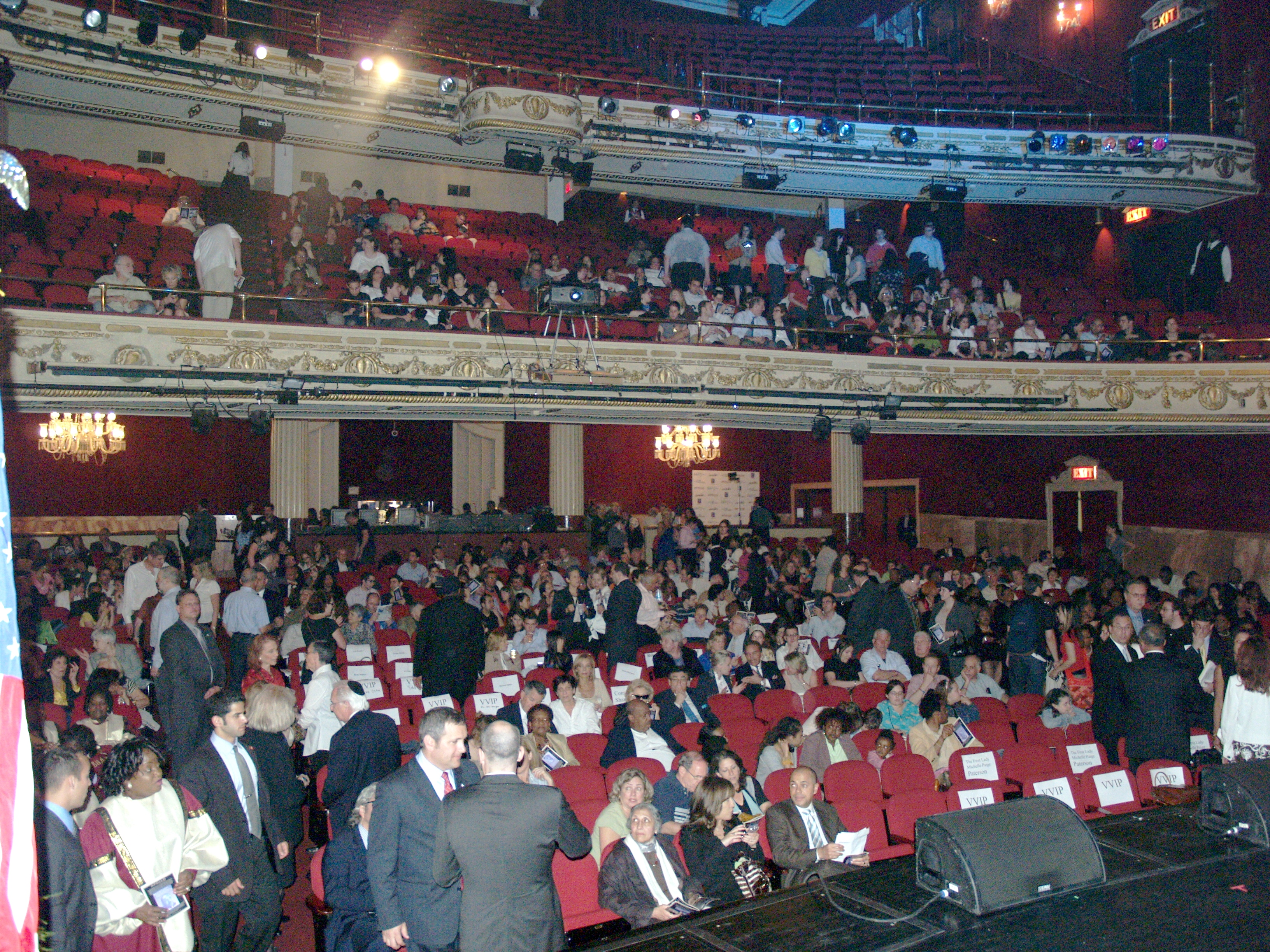
The building that would become the Apollo opened in 1913 as Hurtig and Seamon's New Burlesque Theater, designed by architect George Keister in the neoclassical style, with a domed ceiling, two balcony levels, and space for roughly 2,000 patrons. There was one strict rule: no Black audience members allowed. The theater changed hands several times through the 1920s, passing to the Minsky brothers in 1928, who renamed it the Apollo and staged burlesque shows for mixed-race crowds. But burlesque was fading. After the theater lost its burlesque license and sat dark for seven months, Sydney Cohen acquired it in 1934 and reopened it as a venue for Black performers. Frank Schiffman and his family took over management in 1935 and ran the theater for four decades, turning it into the nerve center of Black American entertainment. The irony was sharp: a hall built to exclude Black patrons became the most important stage in Black cultural history.
The Toughest Audience in Show Business
Amateur Night, which began under Schiffman's management, earned its fearsome reputation honestly. The Apollo audience was drawn largely from Harlem residents who had grown up immersed in music, knew quality intimately, and had no patience for mediocrity. Performers who failed to connect were booed offstage with a directness that terrified even seasoned professionals. Bessie Smith was among the earliest Black entertainers to perform at the Apollo, and by the late 1930s and 1940s the theater was hosting the most dynamic lineup in American music. The format was relentless: multiple acts shared a single bill, performing several shows daily. This grueling schedule demanded that artists be sharp, original, and capable of holding a room that had already seen three acts before intermission. The pressure forged performers of extraordinary caliber, and the Apollo's stamp of approval carried weight that no recording contract could match.
The Sound of 125th Street
The Apollo's influence on American music is difficult to overstate. During the mid-twentieth century, the theater functioned as a laboratory where jazz, blues, gospel, rhythm and blues, soul, and funk were tested, refined, and launched into the mainstream. The theater sat on 125th Street between Adam Clayton Powell Jr. Boulevard and Frederick Douglass Boulevard, in the heart of a neighborhood that had become the cultural capital of Black America. Harlem's concentration of Black musicians, writers, and intellectuals created an audience that was both sophisticated and passionate. The corridor around 125th Street and Seventh Avenue was known as "Harlem's 42nd Street" because of its density of theaters and performance venues. The Apollo was the crown jewel. A production studio built on top of an adjacent wing in the 1980s could record 24 tracks at once and later became the home of the television show Showtime at the Apollo, which broadcast the theater's energy to a national audience.
Dark Stages, Bright Revivals
The Apollo's story has not been one of uninterrupted glory. The Schiffman family operated the theater until 1976, after which it changed hands amid financial instability. A group of Black businessmen ran it briefly from 1978 to 1979 before it closed again. Former Manhattan borough president Percy Sutton purchased the theater at auction in 1981 and led a major renovation that preserved the original neoclassical interior while adding modern recording facilities. The Apollo reopened in 1985 with approximately 1,500 seats. In 1991, the New York State Urban Development Corporation purchased the building and assigned its management to the nonprofit Apollo Theater Foundation, which continues to operate it. The facade and interior are designated New York City landmarks and are listed on the National Register of Historic Places. Further renovations in the mid-2000s modernized the ground floor, and an expansion project launched in the 2020s promises to extend the Apollo's footprint. Through every closure and reopening, the vertical neon sign spelling "APOLLO" has remained a beacon on 125th Street.
A Living Monument
The Apollo Theater has hosted far more than music. Over the decades, its stage has been the site of speeches, political debates, tributes, film screenings, and comedy acts. The theater has commissioned original works and hosted educational programs aimed at nurturing the next generation of performers. The Apollo Legends Hall of Fame honors the artists who defined its stage. What makes the Apollo exceptional is not just its history but its continuity. Amateur Night still runs weekly, and the audience still wields its broom. The theater remains a working venue in a neighborhood that continues to evolve, a place where unknown performers can still walk through the stage door and, if the crowd decides, walk out famous. In a city of constant reinvention, the Apollo endures as proof that some stages earn their permanence not through architecture or wealth but through the sheer accumulation of transcendent moments witnessed within their walls.
From the Air
Apollo Theater (40.810N, 73.950W) is located at 253 West 125th Street in the Harlem neighborhood of Upper Manhattan, New York City. From the air, 125th Street is a major east-west corridor visible as a commercial strip cutting through upper Manhattan's residential grid. The theater sits between Adam Clayton Powell Jr. Boulevard (Seventh Avenue) and Frederick Douglass Boulevard (Eighth Avenue). Nearby airports: KJFK (John F. Kennedy, 27km SE), KLGA (LaGuardia, 11km NE), KEWR (Newark Liberty, 18km W). Best viewed at 2,000-3,000 feet AGL. The theater is approximately 30 blocks north of Central Park's northern boundary at 110th Street.