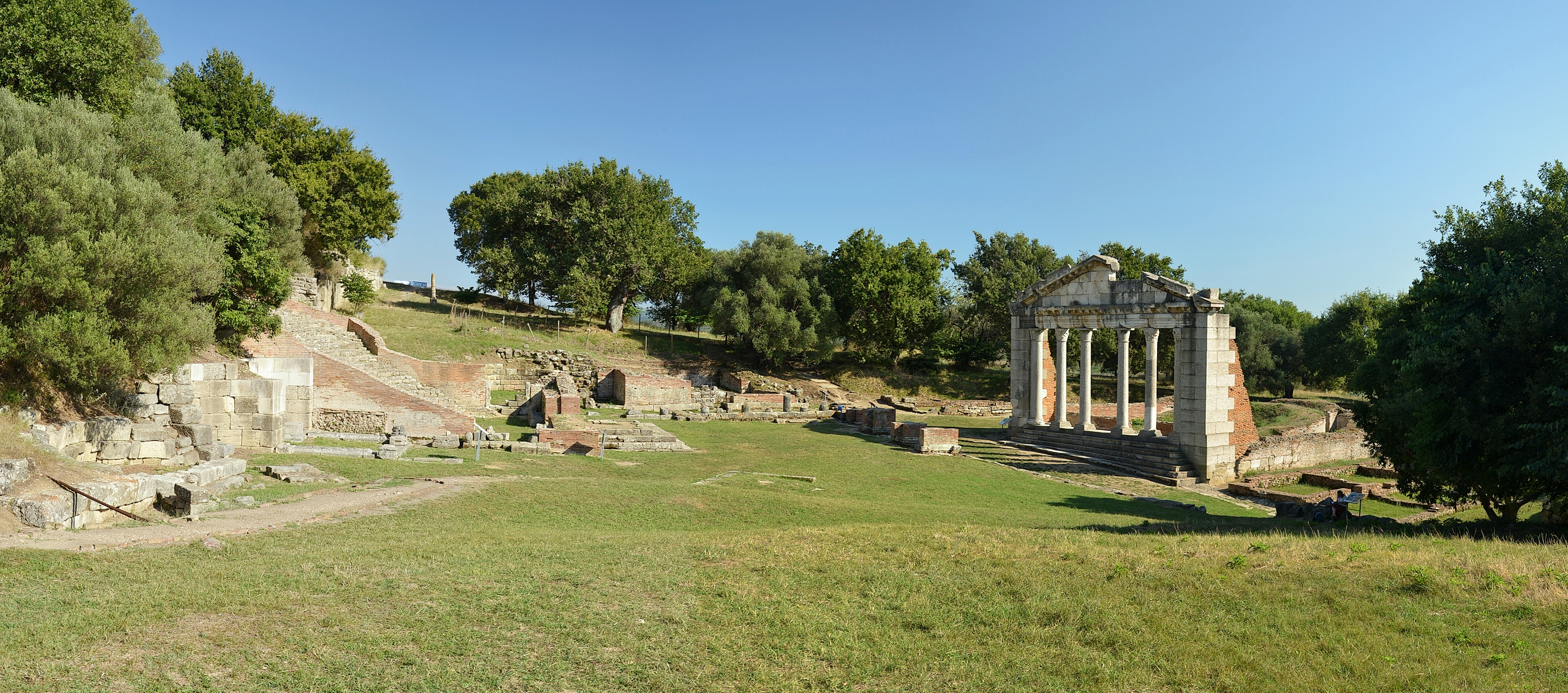
Apollonia (Illyria)
The young man who would become Augustus Caesar was studying rhetoric at Apollonia when word reached him that his great-uncle Julius had been assassinated in Rome. He left immediately, and the city that had educated the future emperor faded into the centuries. By the time Albanian archaeologists began excavating in earnest, Apollonia had been buried under farmland near the village of Pojan in Fier County, its columns toppled, its agora silted over, its population of perhaps 60,000 reduced to fragments of pottery and the stumps of walls. What they uncovered was one of the most important Greek colonial cities on the Adriatic, a place where Corinthian ambition, Illyrian resilience, and Roman pragmatism left overlapping marks in the same soil.
A Colony Built on Compromise
Around 600 BC, a group of 200 Corinthians led by an oikist named Gylax established a settlement on the right bank of the Aoos River, roughly ten kilometers from the Adriatic coast. The site was not empty. Illyrian burial mounds in Apollonia's necropolis date back to the Early Bronze Age, with the earliest tumulus carbon-dated to approximately 2679 BCE. The colonists arrived, in other words, to a place where people had been living and dying for two thousand years. What followed was not conquest but negotiation. Corinthian colonial policy favored resource extraction over the displacement of local populations, and the small number of colonists made confrontation impractical. Aristotle later described Apollonia's political system as an oligarchy in which a small Greek elite, descended from the original colonists, governed a largely Illyrian population. Additional settlers arrived from Corcyra, but the arrangement held: Greeks administered, Illyrians remained, and trade flowed.
Crossroads of the Ancient World
Apollonia's wealth came from its position. The city sat at the intersection of two prehistoric trade routes: one linking the eastern Adriatic coast with the interior, and another connecting the northern Adriatic with the Aegean. The inland route was the more valuable because it enabled overland travel across the region, and it later became the Roman Via Egnatia, the highway that connected Rome's western and eastern territories. As a river port on the Aoos, Apollonia controlled access to both the sea and the interior. The city minted its own coins, maintained its own fleet, and grew into one of the most important poleis on the Adriatic. At its peak during the Hellenistic period, the city's population reached an estimated 60,000. Apollonia pursued xenelasia, the expulsion of foreigners deemed harmful to public welfare, a practice borrowed from Spartan law, suggesting a society confident enough in its prosperity to be selective about who shared it.
School for an Emperor
By the second century BC, Apollonia had allied itself with Rome, which maintained a military base there. The alliance proved durable and profitable. The city flourished under Roman patronage, and its school of Greek philosophy and rhetoric gained a reputation that reached across the Mediterranean. Cicero praised Apollonia as a great and important city, a magna urbs et gravis. The school attracted the Roman elite, and its most famous student arrived in the first century BC: Gaius Octavius Thurinus, the great-nephew and adopted heir of Julius Caesar. He was eighteen and studying in Apollonia when he learned of Caesar's assassination on the Ides of March, 44 BC. He departed immediately for Rome, where he would eventually become Augustus, the first Roman emperor. The city that shaped his education in rhetoric and philosophy would, ironically, begin its long decline under the empire he built, as shifting river courses and the rise of the nearby port of Vlora drew commerce elsewhere.
Monuments in the Trojan Tradition
Apollonia's cultural identity was distinctive. Around 450 BC, the city defeated the neighboring settlement of Thronion and commemorated the victory with a monument at Olympia. Pausanias, visiting centuries later, described the arrangement: five Trojan and five Achaean heroes facing each other, observed by Zeus at the center, flanked by Eos and Thetis, with Apollo and the Trojan-supporting gods placed at his right hand. The monument's preference for the Trojan side reflected a tradition that had developed in Epirus and southern Illyria, where mythological constructions linked local settlements to Trojan migration. The Agonothetes monument, built in the second century BC with a ten-tier cavea, served as the city's municipal center. A 2006 excavation uncovered a Greek temple just outside the city dating to the sixth century BC. These discoveries continue to reshape understanding of how deeply Greek culture penetrated Illyrian territory and how fluidly the two traditions blended.
Ruins and Recovery
The archaeological site occupies a hillside near Pojan, its columns and wall fragments scattered across terrain that was farmland within living memory. A monastery on the site houses the Archaeological Museum of Apollonia, opened in 1958, displaying artifacts from decades of excavation. The museum's history mirrors Albania's own turbulence: after the collapse of the communist government in 1990, the collection was plundered and the museum temporarily closed. Looters dug through the ruins for relics to sell abroad. A new museum opened in December 2011, funded through a UNESCO program, under the directorship of Marin Haxhimihali. French-Albanian archaeological teams continue to work the site, and in August 2010 they unearthed a bust of a Roman magistrate that added another layer to the city's long record. From the air, the site reads as a faint grid of foundations on a green hillside, the ghost of a city that once rivaled any on the Adriatic.
From the Air
Located at 40.72N, 19.47E in Fier County, Albania, approximately 10 km inland from the Adriatic coast. The archaeological site appears from altitude as foundation outlines and scattered columns on a hillside near the village of Pojan. The Vjose River (ancient Aoos) runs nearby. Nearest airport: Tirana International (LATI) approximately 100 km north. The port city of Vlore lies to the south. Recommended viewing altitude: 2,000-4,000 feet to distinguish the archaeological outlines from surrounding farmland.