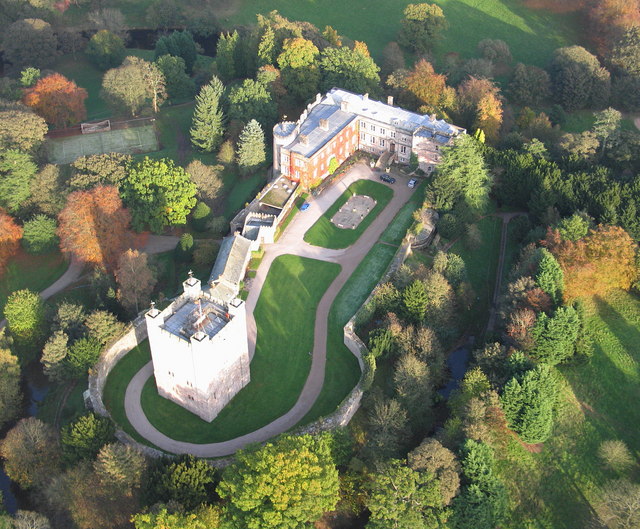
Appleby Castle
When the Scottish king William the Lion invaded the Eden Valley in 1174, the constable of Appleby Castle surrendered without a fight. It was not the castle's finest hour, but it was far from its last. The fortress overlooking the River Eden in Westmorland has been fought over, besieged, partly demolished, lovingly restored, converted into a mansion, turned into a corporate training centre, and put up for sale at 9.5 million pounds before being reduced to 5.5 million in 2025. Through all of it, Caesar's Tower -- the square stone keep built around 1170 -- has stood watching over the small town of Appleby-in-Westmorland.
Norman Foundations
Ranulf le Meschin founded the castle at the beginning of the 12th century, establishing a stronghold at the head of Appleby's main street above the Eden. The stone keep known as Caesar's Tower was built around 1170, replacing whatever timber structures came before. In 1203, King John granted the castle to Robert de Vieuxpont, and in 1264 it passed through marriage to Roger de Clifford. The Clifford family would hold Appleby for nearly 400 years, making it one of their principal seats alongside Skipton and Brougham. Robert de Clifford, who inherited in 1282, was the same Lord Clifford who improved Skipton's defenses and served as Guardian of Craven -- a powerful border lord whose castles formed a chain of defense across northern England.
Lady Anne's Castle
The most remarkable chapter in Appleby's story belongs to Lady Anne Clifford. In the mid-17th century, after decades of legal battles to reclaim her family's northern estates, Anne made the castle her home. The Civil War had not been kind to it: Parliamentarian forces besieged and partly dismantled Appleby in 1648 during the Second English Civil War. Lady Anne restored the castle between 1651 and 1653, rebuilding what Cromwell's men had torn down. She also built Lady Anne's Beehouse in the castle grounds, a distinctive square stone structure with a pyramid roof and pointed arched windows that still stands as a Grade I listed building. Anne commissioned The Great Picture, a massive triptych measuring over eight feet high and sixteen feet wide, attributed to the artist Jan van Belcamp, which depicted her family history and once hung in the castle.
From Mansion to Market
After Lady Anne's death in 1676, the castle passed to the Earls of Thanet, who transformed the hall block into a classical mansion house -- a shift from fortress to gentleman's residence that reflected the changing needs of English aristocracy. The 12th-century keep received considerable improvements even as the castle's military function became irrelevant. In more recent decades, Appleby Castle served as the headquarters and training centre for FIH PLC and hosted a conservation centre. Christopher Nightingale bought it in 1998. The keep now houses the Norman Centre, a museum and interactive experience. The castle was featured in Susannah White's 1998 BBC documentary The Gypsies Are Coming, about the famous Appleby Horse Fair that still draws thousands of Romani and Traveller families to the town each June.
Caesar's Tower Endures
Caesar's Tower is built in grey stone rubble and ashlar, and it anchors the castle complex with the solidity of something that has watched nine centuries pass from the same hilltop. The curtain walls, dating mostly from the 18th and 19th centuries, enclose grounds listed at Grade II*. The battlemented North Lodge guards the entrance. From the keep, the view extends across the River Eden and into the fells of the old county of Westmorland -- a landscape of rolling green farmland backed by the Pennines. The castle and its grounds remain open to visitors, though its future shifted again when it went to market in 2024, its 23 bedrooms and medieval keep seeking a new owner willing to take on nearly a millennium of English history.
From the Air
Located at 54.57°N, 2.49°W on the east bank of the River Eden in Appleby-in-Westmorland, Cumbria. Caesar's Tower and the castle complex are visible from lower altitudes above the town. The Pennines rise to the east, and the Eden Valley extends north and south. Nearest airport: no major airports nearby; Carlisle Lake District (EGNC) approximately 25 nm north. The A66 passes south of the town.