Appleton Museum of Art
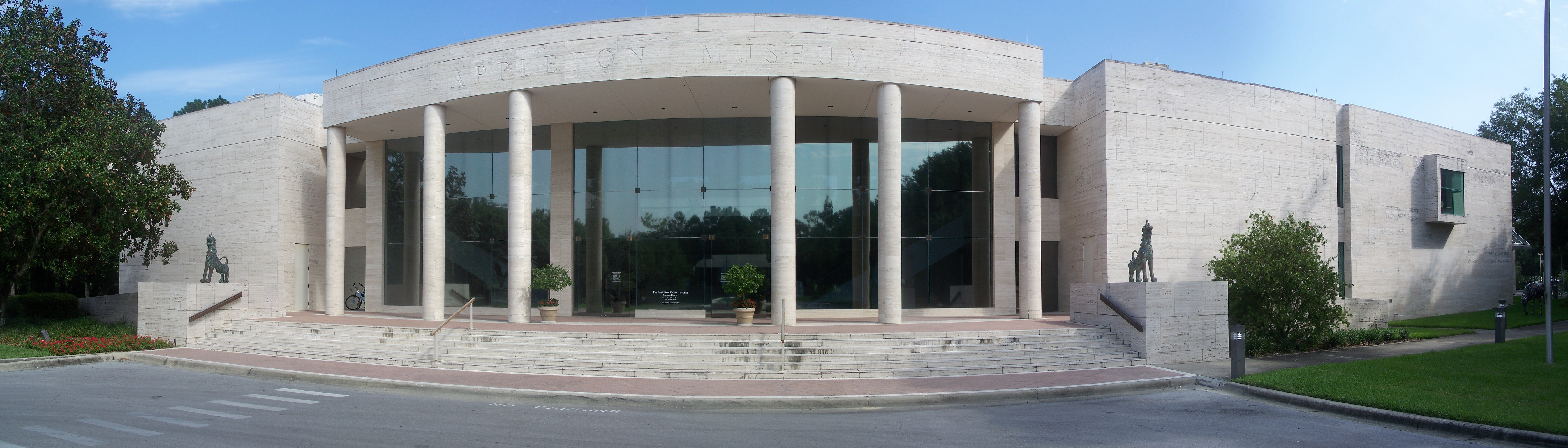
Eighty thousand square feet of Italian travertine marble have no business standing in a Florida horse town. Yet there it is on East Silver Springs Boulevard in Ocala: the Appleton Museum of Art, a two-story building so lavishly clad in stone that it looks transplanted from Rome. A long reflecting pool mirrors its pale facade. Fountains play across 11.3 landscaped acres. Inside, more than 24,000 works of art span continents and millennia, from pre-Columbian jade to Rodin bronzes to Andy Warhol prints. The museum exists because a business magnate and a former Hollywood actress fell in love with Florida's horse country and decided it deserved a world-class art collection.
The Magnate and the Actress
Arthur I. Appleton made his fortune in business and spent it on art, racehorses, and marble. In the mid-1970s, he and his wife, the former film actress Martha O'Driscoll, bought land in the Ocala area and established Bridlewood Farm, a thoroughbred breeding and training facility. Ocala styles itself the Horse Capital of the World, and the Appletons fit right in. But Arthur had grander ambitions for the region. The City of Ocala donated a 44-acre site, and construction began in 1984. Working with Tampa architect Dwight Holmes, Appleton specified travertine marble imported from Italy for the exterior and Bolivian Capao Bonito granite for the floors. More than 300 tradesmen from 130 companies assembled the building, with glass from Pilkington of England and stonework by Antagon/Paleni of Montreal. When it opened to the public in 1987, rural Florida had a museum that could rival institutions ten times its city's size.
From Bridle Bits to Kimonos
The permanent collection sprawls across seven major areas, each reflecting a different thread of Appleton's eclectic taste. The Equine collection honors Ocala's horse heritage with artifacts spanning over 3,000 years, from Eurasian Steppe Bronze Age bridle bits to contemporary equestrian art. European galleries cover the 17th through 19th centuries, with paintings and sculpture from the Romantic, Realist, and pre-Raphaelite movements. The Asian collection is one of the museum's largest, holding Tang Dynasty ceramic horse figures, rare celadon funerary vases, Chinese Export porcelain, Japanese netsuke miniatures, Meiji-era bronzes, and embroidered kimonos. Pre-Columbian galleries display ceramics, gold work, and jade from Maya, Wari, Moche, and Chimu cultures. The breadth is staggering for a museum in a city of 65,000 people.
Africa, Collected Firsthand
The African art collection carries a provenance story rarer than most. Arthur Appleton purchased much of it from the estate of Dr. Victor David DuBois, who assembled it during years of government work across the continent. DuBois acquired many pieces directly from the artists and communities that created and used them, lending the collection an authenticity that auction-house purchases cannot match. Among the standout works is a 20th-century Dance Headdress with Hare Crest, called a Sibondel, created by the Baga people of Guinea. A full set of Maiden Spirit Dance Regalia from the Agbogho Mmuo tradition of the Igbo people of Nigeria commands its own display. These are not decorative curios; they are sacred objects of living cultures, and the museum treats them accordingly.
Maritime Dreams and Modern Visions
Arthur Appleton served in the United States Navy during World War II, and his Maritime Art collection reflects a sailor's eye for the sea. Paintings of historic sailing ships by British artists William Adolphus Knell, Richard Brydges Beechey, and Montague Dawson line the walls alongside detailed ship models. The Modern and Contemporary galleries pivot sharply forward in time, featuring works by Salvador Dali, Andy Warhol, Robert Rauschenberg, James Rosenquist, and Alexander Calder. Auguste Rodin's sculpture shares space with Whistler, Bouguereau, and Louis Comfort Tiffany. In 1996, the Edith-Marie Appleton Wing, funded by Arthur's sister, expanded the museum, and a dedicated art storage facility followed in 2009, bringing the total footprint to just under 82,000 square feet. Since 2004, the College of Central Florida has governed the museum, ensuring that Appleton's unlikely gift to horse country endures.
From the Air
The Appleton Museum of Art is located at 29.205N, 82.077W on East Silver Springs Boulevard in Ocala, Florida. From the air, the museum's pale travertine marble building and surrounding reflecting pools are visible within the Appleton Cultural Center complex, which it shares with the Ocala Civic Theatre. The site sits east of downtown Ocala amid forested grounds. Ocala International Airport (KOCF) is approximately 8 miles to the southwest. Gainesville Regional Airport (KGNV) lies about 40 miles to the northwest. The area is flat central Florida terrain. Best viewed at 1,500-2,500 feet AGL to appreciate the contrast between the marble building and the surrounding green landscape.