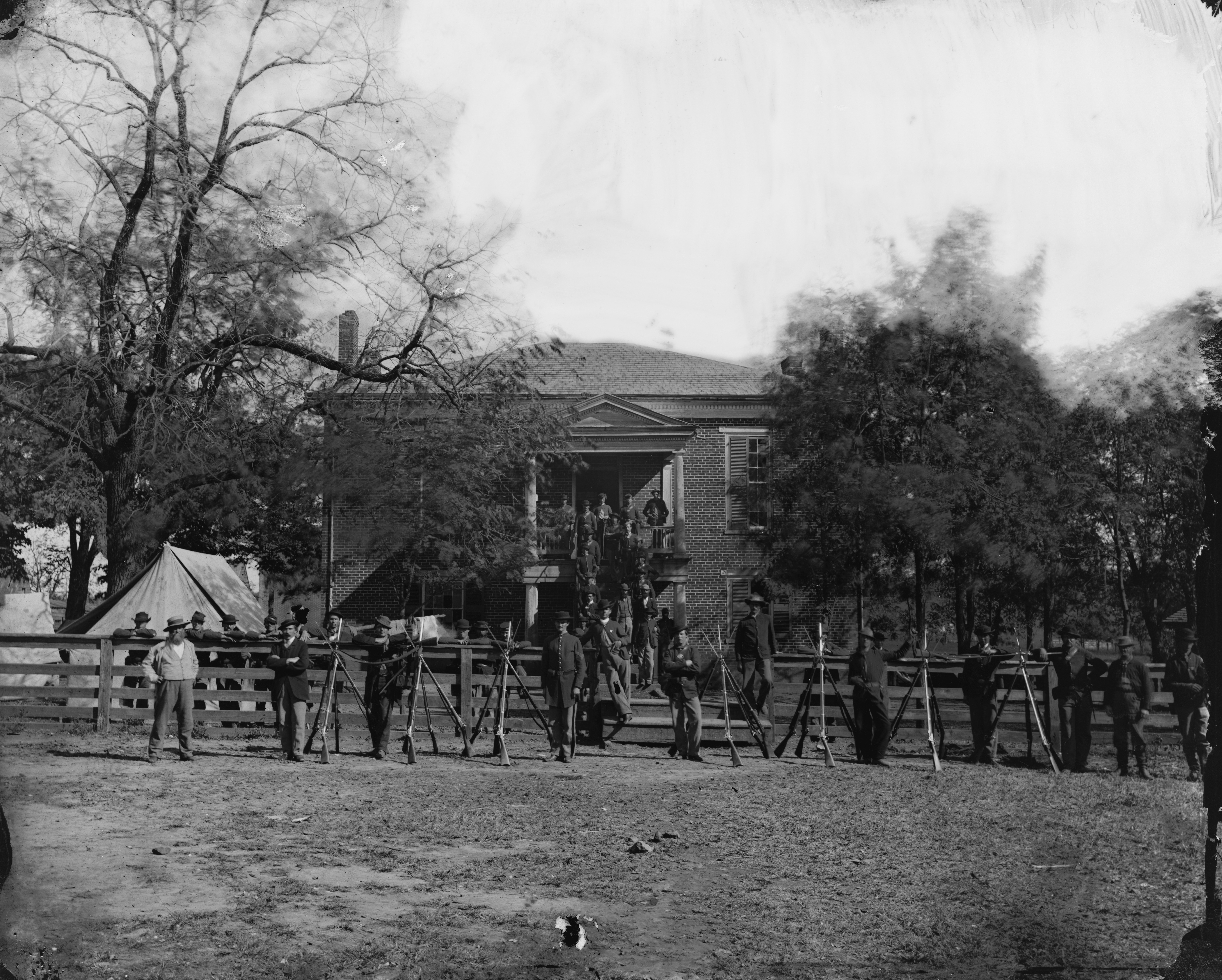
Appomattox Court House
The Civil War effectively ended not on a battlefield but in a Virginia parlor. On April 9, 1865, Robert E. Lee, commander of the Army of Northern Virginia, surrendered to Ulysses S. Grant in the home of Wilmer McLean at Appomattox Court House, a tiny village whose only distinction was serving as the county seat. Lee's army, exhausted and surrounded after a week of retreat from Petersburg, had tried one final breakout that morning and failed. By early afternoon, Lee was dressed in his finest uniform, carrying his finest sword, prepared to offer his personal defeat with dignity. Grant arrived in a mud-splattered private's coat. The terms they negotiated - allowing Confederate soldiers to return home with their horses and without prosecution - set the tone for reconciliation. When Lee mounted his horse to ride away, Union soldiers began cheering. Grant ordered them to stop: 'The war is over. The rebels are our countrymen again.'
The End Approaches
In early April 1865, Lee's Army of Northern Virginia abandoned the Richmond-Petersburg defenses that had protected the Confederate capital for nine months. Grant's Army of the Potomac and Army of the James pursued relentlessly, fighting running battles at Sayler's Creek and other crossroads. Lee hoped to reach Lynchburg and resupply, then turn south to join Joseph Johnston's army in North Carolina. But Union cavalry under Philip Sheridan consistently blocked his route, forcing detours that consumed precious time and energy. On April 8, Sheridan's troopers captured supply trains Lee desperately needed at Appomattox Station. By dawn on April 9, Union infantry had joined the cavalry blocking Lee's advance. Behind him, more Union forces closed the trap. Lee had approximately 28,000 men left from an army that had numbered over 50,000 a week earlier. He sent a flag of truce.
The Meeting
Wilmer McLean had moved to Appomattox Court House specifically to escape the war - his previous home at Manassas had been used as Confederate headquarters during First Bull Run, and a shell had fallen through his kitchen during the battle. Now the war followed him. When Lee needed a suitable location for the surrender conference, an aide knocked on McLean's door. Grant arrived around 1:30 PM, accompanied by his staff. Lee waited in McLean's parlor. The two generals had last met during the Mexican-American War, and Grant recalled the encounter while Lee apparently did not remember. They exchanged pleasantries before turning to business. Lee asked for the terms. Grant wrote them out in pencil: officers could keep their side arms; all men would be paroled and allowed to return home, immune from prosecution as long as they respected their paroles. Lee requested that enlisted men with their own horses be allowed to keep them. Grant agreed - 'they will need them for the spring plowing.'
After the Surrender
Lee signed the terms at approximately 3:00 PM. Grant introduced his staff, including his military secretary Ely Parker, a Seneca chief. Lee reportedly said to Parker, 'I am glad to see one real American here.' Parker replied, 'We are all Americans.' As Lee departed, Union batteries began firing salutes. Grant ordered them stopped immediately. The formal surrender ceremony occurred three days later on April 12. Confederate soldiers marched forward, stacked their weapons, and furled their battle flags. Union General Joshua Chamberlain, commanding the surrender ceremony, ordered his men to shoulder arms - a salute of honor. Confederate General John Gordon responded by dropping his sword and ordering his men to match the salute. It was a moment of mutual respect that would be cited for generations as evidence that the war had ended with honor on both sides.
McLean's Parlor
The moment the surrender was signed, Union officers began purchasing furniture from McLean's parlor as souvenirs. Some didn't wait for negotiations - General Edward Ord simply carried off the table on which Lee had signed. General Sheridan bought the table Grant had used and later presented it to Custer's wife. Within hours, the parlor was stripped bare. The chairs, tables, and other items were scattered to private collections and eventually museums across the country. McLean, who had only wanted to escape the war, found himself ruined by it. He never received full payment for the furniture. The house itself deteriorated, was eventually dismantled for its bricks, and was finally reconstructed by the National Park Service in the 1940s using original materials recovered from across the region.
The Site Today
Appomattox Court House National Historical Park preserves the village as it appeared in 1865. The reconstructed McLean House stands furnished with period pieces, though most original items remain in other collections. The Clover Hill Tavern, courthouse, and several other buildings have been restored. The park encompasses about 1,800 acres including the surrounding battlefield where Lee's final attack occurred. Walking trails connect the village to outlying positions. The visitor center, located in the reconstructed courthouse, offers exhibits and a film explaining the events. Park rangers present talks and living history demonstrations, particularly around the April anniversary. The village lies approximately 25 miles east of Lynchburg, Virginia. Lodging is available in Lynchburg and Appomattox. The anniversary of the surrender, April 9, draws substantial crowds. Spring and fall offer the best conditions for exploring the walking trails.
From the Air
Located at 37.38°N, 78.80°W in Appomattox County, central Virginia. The village appears from altitude as a cluster of restored buildings in rolling Piedmont countryside. The park boundaries encompass farmland and forest around the village core. Lynchburg Regional Airport (LYH) is 25 miles west. Richmond is 95 miles east.