Appomattox Court House National Historical Park
On the morning of April 9, 1865, a Confederate officer rode toward Union lines carrying a white towel. Within hours, Robert E. Lee and Ulysses S. Grant sat across from each other in the parlor of Wilmer McLean's brick farmhouse, and the bloodiest war in American history was, for all practical purposes, over. The village where this happened was already fading. Bypassed by the railroad a decade earlier, Appomattox Court House had been losing residents and businesses since 1854. History chose this quiet, declining crossroads in central Virginia to stage one of the nation's most consequential moments -- a place whose very name, borrowed from the Apumetec tribe and the river whose headwaters rise nearby, would become synonymous with the end of the Confederacy.
From Clover Hill to County Seat
Before it became a word every American schoolchild learns, Appomattox Court House was simply Clover Hill -- a small stop along the Richmond-to-Lynchburg stagecoach road. When Appomattox County was carved from parts of four neighboring counties and established on February 8, 1845, Clover Hill became its seat of government. Hugh Raine, who owned most of the surrounding land, saw it divided into town lots. A courthouse rose across the Stage Road from the Clover Hill Tavern's stable, with a jail erected behind it. But the village's growth was brief. In 1854, a new railroad bypassed Appomattox Court House entirely, routing through nearby Appomattox Depot instead. Businesses packed up and followed the tracks. The stagecoach route was discontinued. By the time the Civil War reached its doorstep, Appomattox Court House was already a village in decline.
Nine Days in April
In early April 1865, Lee's Army of Northern Virginia was in retreat, pursued relentlessly by Grant's forces. Exhausted, outnumbered, and cut off from supplies, Lee's troops made a final desperate attack at Appomattox Court House on the morning of April 9 -- and failed. That afternoon, Lee, in a crisp dress uniform with a jeweled sword at his side, met Grant, who arrived in a mud-spattered field coat, at the McLean House. The terms Grant offered were generous: Confederate soldiers could go home, officers could keep their sidearms, and any man who claimed a horse or mule could take it for the spring planting. Lee signed. Three days later, on April 12, the Army of Northern Virginia formally laid down its arms and marched away. Though fighting continued elsewhere for weeks, the surrender at Appomattox became the enduring symbol of the war's conclusion.
A Village Preserved in Amber
The war's end brought no revival to Appomattox Court House. The village continued its slow decline. When an 1892 courthouse fire destroyed the county records, officials moved the county seat to the railroad town that had stolen its commerce, now called simply Appomattox. The old village might have vanished entirely had Congress not intervened in 1930, authorizing the War Department to acquire a site for a monument. The National Park Service took over in 1933, and by 1935 the site was enlarged and renamed. Plans to reconstruct the McLean House were delayed by World War II, but in 1949 the restored building opened to visitors. Today the park preserves the village much as it appeared in 1865, with original structures like the Clover Hill Tavern, built in 1819, standing alongside careful reconstructions including the courthouse that now serves as the visitor center.
Walking the Ground
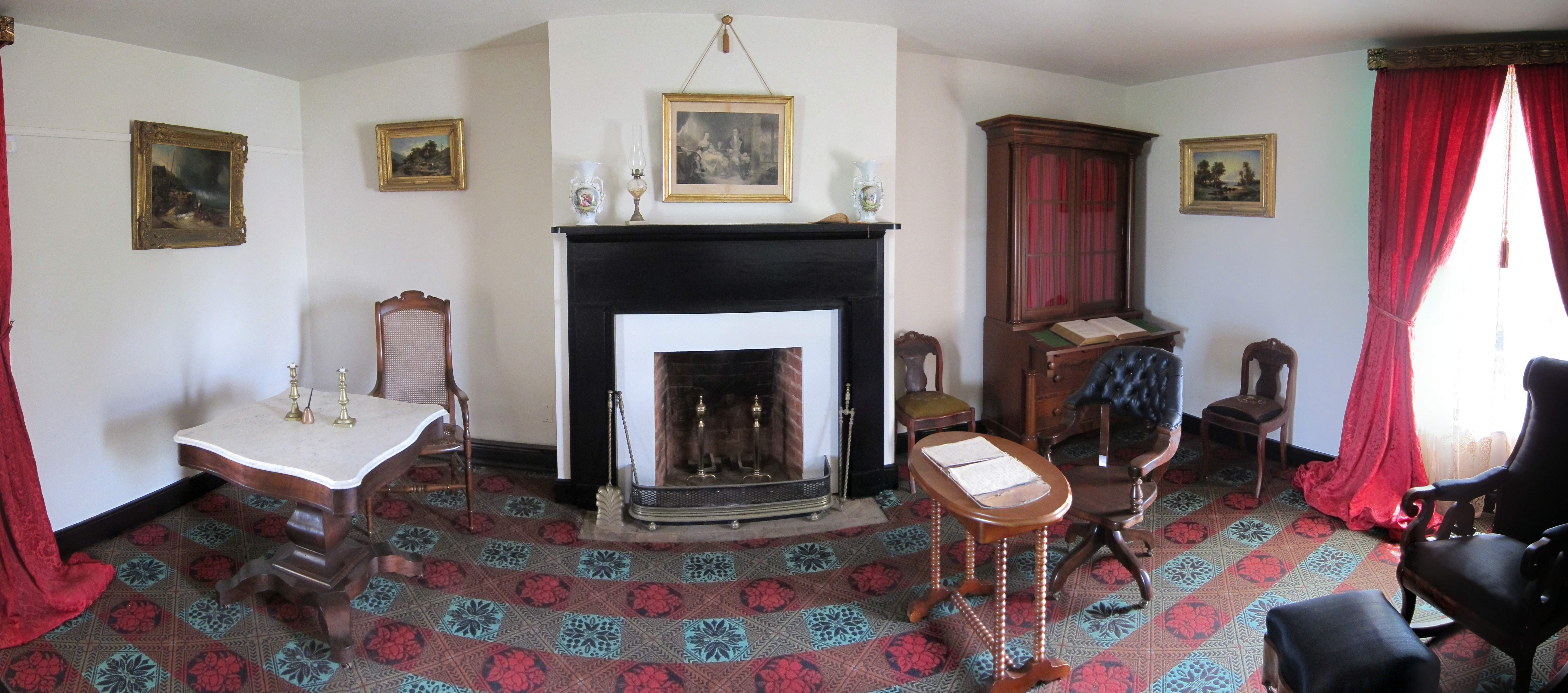
The park offers both a driving tour and hiking trails that wind through the landscape where the final act of the Civil War played out. Interpretive signs mark the site of Lee's headquarters and the positions of the last artillery pieces fired by Confederate guns. A Confederate cemetery holds the remains of soldiers who fell in those final hours. The rebuilt McLean House parlor has been furnished to evoke that April afternoon -- the small table where Grant drafted his terms, the larger one where Lee reviewed them. Cannons stand in an artillery park along the trail, silent witnesses arranged on ground that once shook with their fire. The park was listed on the National Register of Historic Places on October 15, 1966, recognizing a place where a nation's fracture began to mend.
From the Air
Located at 37.38N, 78.80W in Appomattox County, Virginia. The park sits in the rolling Piedmont landscape east of the Blue Ridge Mountains. From altitude, look for the cluster of restored 19th-century buildings along the old Stage Road corridor. Nearest airport: Lynchburg Regional Airport (KLYH), approximately 25 nm to the west. The terrain is gently hilly with mixed hardwood forest. Best viewed at 3,000-5,000 ft AGL for context of the surrounding countryside.