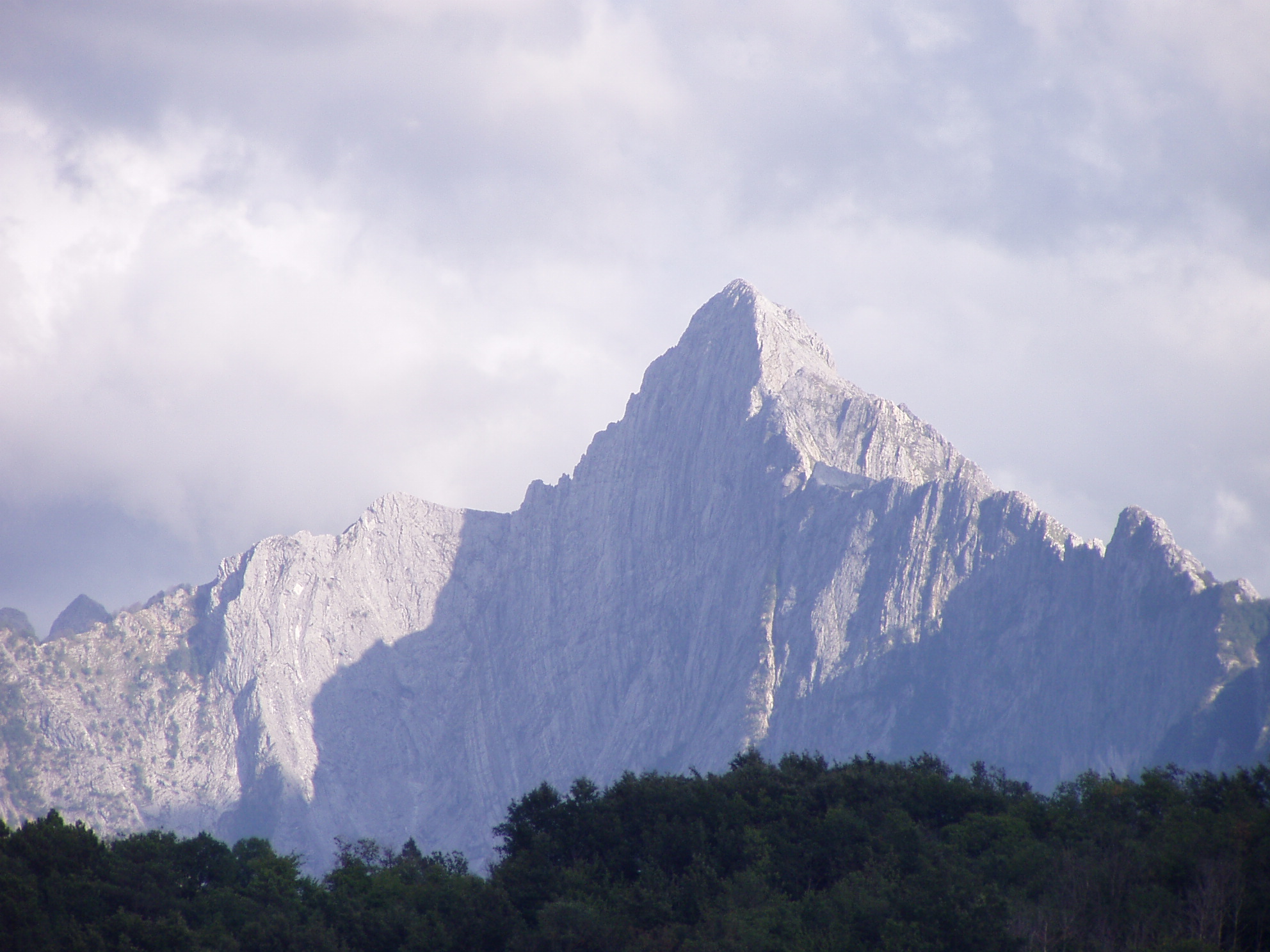
Apuan Alps
From a distance, the white patches on the Apuan Alps look like snow. They are not. Those brilliant scars are marble quarries -- the same quarries that supplied stone for the Pantheon in Rome, Michelangelo's David in Florence, and countless buildings across the centuries. The Apuan Alps stretch 55 kilometers across northern Tuscany between the Serchio and Magra river valleys, a compact mountain range that packs alpine drama into a relatively modest footprint. Their highest peak, Monte Pisanino, reaches only 1,946 meters, yet the mountains feel far taller than they are, their jagged profiles rising abruptly from the coastal plain. The range takes its name from the Apuani, a Ligurian tribe that inhabited these peaks in antiquity. Their successors have been quarrying the stone ever since.
Older Than the Apennines
The geology sets the Apuan Alps apart from every other mountain range in the region. While the Apennines formed from sediments compressed during more recent tectonic events, the Apuan Alps emerged from sea sediments deposited during the middle Triassic period -- making them geologically older than the main Apennine chain on a distinctly different structural foundation. This different origin explains why the rock here is so unlike anything in the neighboring mountains: the metamorphic processes that created the marble transformed ancient limestone into the crystalline stone that sculptors prize. The range includes dramatic karst features, deep caves, and sheer rock faces that create an alpine character unusual for mountains at this latitude. Hikers ascending Pizzo d'Uccello, at 1,781 meters, encounter a north face so steep and forbidding that it has been compared to Dolomite walls, though the Apuan Alps lie hundreds of kilometers south of those peaks.
The Weight of Extraction
Carrara marble has been quarried here for over two millennia, but the scale of modern extraction has transformed the debate around these mountains. Industrial quarrying has reshaped entire peaks, creating vast amphitheaters of white stone visible from the Ligurian coast. The No Cav movement -- a grassroots environmental campaign -- has organized significant opposition to continued quarrying, arguing that the environmental damage is unsustainable. Roads carved into mountainsides for heavy truck transport contribute to erosion and habitat destruction. Marble dust clouds waterways. The economic counterargument is equally stark: the marble industry employs thousands and has defined the regional economy for centuries. What makes the debate especially difficult is that the marble is genuinely irreplaceable. No other source produces stone of exactly this quality and character. The mountains themselves are being slowly consumed to supply a material that people have valued since before the Roman Republic.
A Mountain Ark
Despite the quarrying, the Apuan Alps harbor extraordinary biodiversity. The range supports over 300 species of birds, including red-billed choughs, golden eagles, peregrine falcons, and barn owls. Migrant species -- common nightingales, wallcreepers, alpine swallows -- pass through seasonally, while great spotted woodpeckers and green woodpeckers remain year-round. On the ground, red squirrels, hazel dormice, foxes, hares, beech martens, weasels, European badgers, and European polecats inhabit the forested slopes. The variety reflects the range's position at the intersection of Mediterranean and continental European ecosystems, compressed into an area small enough that alpine species and coastal species can exist within a few kilometers of each other. The Apuan Alps Regional Park was established to protect this biodiversity, though its boundaries do not extend to all the active quarry zones, creating an ongoing tension between conservation and extraction that mirrors the larger Italian conversation about how to balance heritage with livelihood.
Peaks and Pathways
Monte Pisanino tops the range at 1,946 meters, followed closely by Monte Tambura at 1,890 meters and Monte Cavallo at 1,888 meters. Pania della Croce, at 1,858 meters, is the most popular hiking destination and offers views that stretch from the Tyrrhenian Sea to the Apennine ridge on clear days. Monte Sagro, at 1,749 meters, rises directly above the Carrara quarries, its summit providing a vertigo-inducing view down into the white bowls where marble is extracted hundreds of meters below. Monte Procinto, a modest 1,177 meters, compensates with dramatic vertical walls that make it a favorite with rock climbers. A network of marked trails connects the major peaks, and rifugi -- mountain huts -- provide shelter along the longer routes. Walking here you pass from chestnut forest to bare marble in the space of an hour, the transition between living mountain and extracted mountain visible in a single panorama.
From the Air
Located at 43.950N, 10.217E in northern Tuscany between the coast and the Garfagnana valley. The range extends roughly 55 km northwest to southeast. The white marble quarries are unmistakable from the air -- bright white scars on the mountainsides that contrast sharply with the surrounding green. Monte Pisanino (1,946m / 6,385 ft) is the highest point. Maintain adequate terrain clearance -- peaks rise steeply from the coastal plain. Nearest airports: Pisa International (LIRP) to the south, Marina di Massa airfield to the west. Weather can change rapidly; mountain wave turbulence is possible in strong northwest winds.