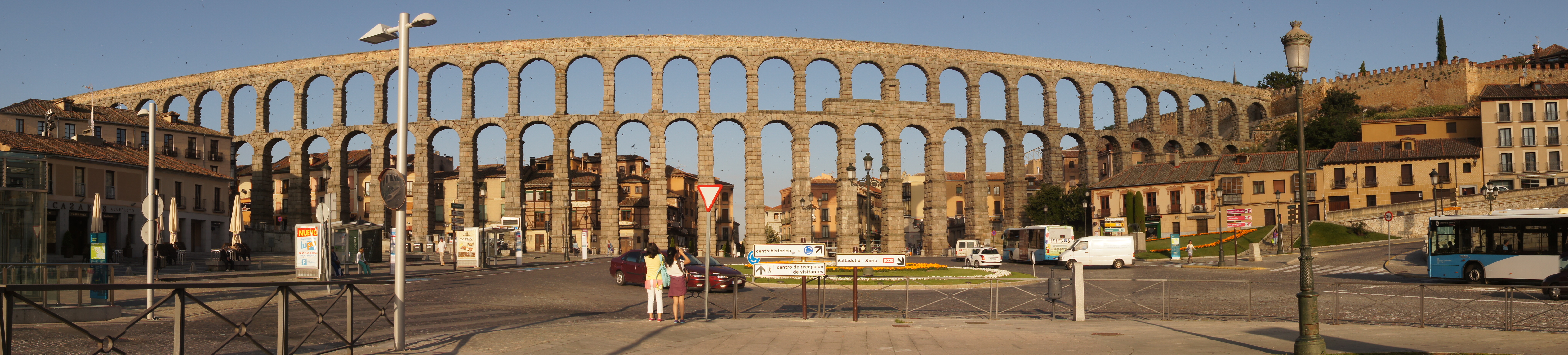
Aqueduct of Segovia
It delivered water to Segovia until 1973. Not a reconstructed ruin, not a museum piece preserved behind ropes, but a working piece of infrastructure that served its original purpose for roughly nineteen centuries. The Aqueduct of Segovia -- 167 granite arches rising to 28.5 meters at their tallest point, assembled without a drop of mortar -- is one of the most complete Roman aqueduct bridges surviving anywhere on earth, and it earned its place on Segovia's coat of arms by doing something rare for ancient monuments: it kept being useful.
The Mystery of Its Birthday
For centuries, nobody knew exactly when the aqueduct was built. The bronze letters that once spelled out the builder's name and the construction date were long gone, leaving only the anchor holes in the stone. In the late twentieth century, the epigrapher Geza Alfoldy studied those anchor patterns and determined that Emperor Domitian likely ordered the construction, proposing 98 AD as the completion date. Then, in 2016, archaeologists published evidence pointing to a slightly later date -- after 112 AD, during the reign of Trajan or possibly the early years of Hadrian. The aqueduct predates certainty about its own origins, which seems fitting for a structure that has outlived every government that ever claimed it.
Water from the Mountains
The system begins at the Rio Frio, 17 kilometers away in the mountains of the La Acebeda region. Water was first gathered in a collection tank called El Caseron, then channeled to a second structure, the Casa de Aguas, where sand and sediment settled out naturally. From there, it traveled 728 meters on a gentle one-percent grade toward the rocky promontory where Segovia's walled old city sits, crowned by its Alcazar. The engineering follows principles laid out by Vitruvius in De Architectura, published in the mid-first century BC -- a textbook the builders apparently knew well. At Plaza Azoguejo, where the aqueduct reaches its full height, the double-tiered arches create a procession of stone that manages to be both monumental and elegant, each pillar tapering slightly from a base of 2.4 by 3 meters to a top cross-section of 1.8 by 2.5 meters.
Destroyed, Rebuilt, Enduring
The Moors destroyed 36 arches in 1072. Four centuries later, during the reign of Ferdinand and Isabella, the prior of the nearby Jeronimos del Parral monastery led a painstaking reconstruction, rebuilding every one of those arches while taking great care to match the original style. In the sixteenth century, niches were added to the structure -- one once held an image of Hercules, the legendary founder of Segovia, now replaced by the Virgin Mary. Cadets from the local military academy still drape the image of the Virgen de la Fuencisla in a flag each December 4, the feast day of Saint Barbara, patron saint of artillery. The aqueduct's granite blocks, unmortared and precisely cut, held together through gravity and geometry alone for all those centuries.
A Monument That Still Stands Watch
When the water finally stopped flowing in 1973, the aqueduct's second life as a pure monument began -- though in some ways it had always been one. Segovia's old town and the aqueduct together received UNESCO World Heritage status in 1985. But time and pollution have taken their toll. Differential stone decay, water leakage, and cracking in the granite ashlar prompted the World Monuments Fund to list the site on its 2006 Watch. A collaboration between Spain's Ministry of Culture, the regional government of Castilla y Leon, and WMF Spain, supported by American Express, launched conservation efforts. Today, one of Segovia's former mint buildings -- the Real Casa de Moneda -- houses an interpretation center dedicated to the aqueduct, funded by European Economic Area grants. Stand beneath the arches at Plaza Azoguejo and look up: the blocks fit together with the precision of a puzzle, each one holding its neighbor in place through sheer engineering conviction, as they have for nearly two thousand years.
From the Air
Located at 40.95N, 4.12W in the city of Segovia, at the foot of the Sierra de Guadarrama. The aqueduct is unmistakable from the air -- a long line of double-tiered arches cutting through the urban fabric toward the walled old city and its Alcazar. Nearest airport is Segovia (no major commercial airport; Madrid-Barajas LEMD is approximately 90 km southeast). The city sits at roughly 1,000 m elevation. Best viewed at 3,000-5,000 ft AGL to appreciate the full length of the aqueduct against the cityscape.