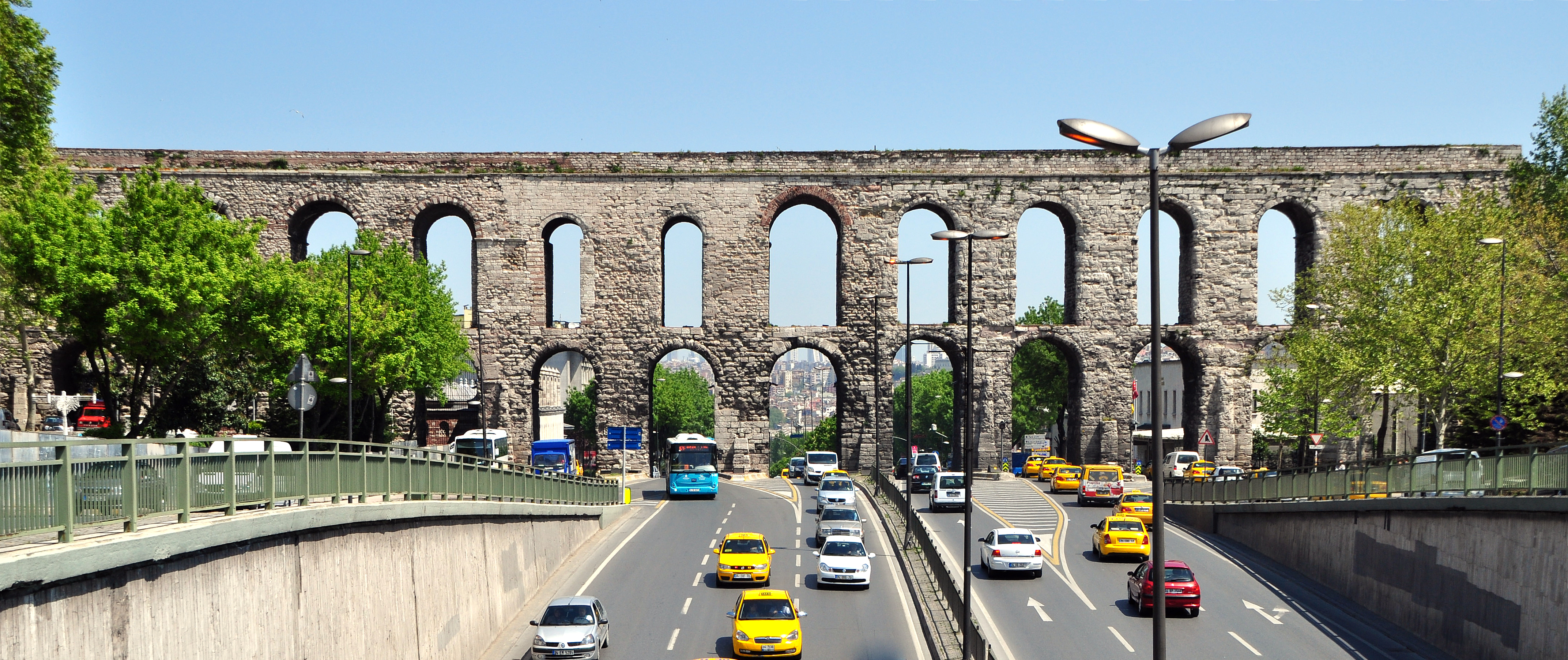
Aqueduct of Valens
The traffic on Atatürk Boulevard moves under arches older than most countries. The Bozdoğan Kemeri - 'the aqueduct of the gray falcon' as the Ottomans renamed it - rises above the Fatih district of Istanbul as a long, double-tiered span of brick and ashlar that does not quite belong in a modern city and yet is unmistakably part of one. Nine hundred and twenty-one meters of it survive. The original was about fifty meters longer. Construction began under the Roman emperor Constantius II and was completed in 373 by his successor Valens, the emperor whose name has stuck to the structure for sixteen and a half centuries. From above, on a clear morning, the aqueduct draws a thin pale line across the rooftops between the hill of Istanbul University and the hill where the Fatih Mosque now stands - and where the Church of the Holy Apostles, lost burial place of Constantine the Great, once rose.
Water for a New Rome
When Constantine the Great refounded the Greek city of Byzantium in 330 as Constantinople, the new imperial capital had a problem its old Greek seed had never needed to solve: it was vastly bigger than the available water. The first emperor to start fixing this had been Hadrian, two centuries earlier, but Constantine's expansion outran what existed. The full system the late Roman emperors built around the Aqueduct of Valens eventually stretched more than 250 kilometers through the hill country of Thrace, the longest aqueduct system of antiquity. The first phase, finished in 373, drew water from springs at Danımandere and Pınarca and ran 268 kilometers to the city. A fifth-century second phase added another 451 kilometers of conduits reaching all the way to Vize, 120 kilometers out. Once inside Constantinople, the water filled three open reservoirs and over a hundred underground cisterns - including, eventually, the famous Basilica Cistern with its forest of recycled columns. Combined capacity ran into the millions of cubic meters.
Built from a Punished City
There is a darker thread in the story of how the bridge itself was built. According to a tradition recorded by ancient writers, the stones came from the walls of Chalcedon, the city directly across the Bosphorus from Constantinople. Chalcedon had backed the wrong man - a usurper named Procopius, who briefly contested Valens for the throne. After the revolt collapsed in 366, Valens ordered the city's walls torn down as collective punishment, and the dressed stones, instead of being abandoned, were ferried across the strait and recycled into the imperial water system rising in Constantinople. Whether literally true in every block or partly mythic, the story captures something real about late Roman power: walls of one city pulled apart to lift a bridge in another, the stone itself made an instrument of imperial will. The mason who set those blocks in 373 might have recognized them. Some of them are probably still in place above the boulevard today.
Surviving the Centuries
The aqueduct's working life was extraordinarily long. The Avars cut it during their siege of Constantinople in 626 - a calculated act of pressure on a thirsty city - and water did not flow again until Emperor Constantine V repaired the system after the great drought of 758. By 1075, it was being administered by an official named Basil Maleses, who had been captured by the Seljuk Turks at the catastrophic Battle of Manzikert four years earlier and somehow returned to Constantinople to take up his duties as keeper of its water. Crusaders passing through in 1096 saw it running. So did Odo of Deuil during the Second Crusade. After 1453, the Ottomans inherited the aqueduct along with the city, kept it in service, called it Bozdoğan Kemeri, and continued to draw water through its arches. As late as the 1950s, modern surveys recorded daily discharge of more than six thousand cubic meters - well over a millennium and a half after the legions of Valens cut the ribbon.
Living Among Ancient Stones
Today the aqueduct does the unspoken work of any beloved old monument in a working city: it is a landmark, a backdrop, a point of orientation. Drivers on Atatürk Boulevard pass beneath the arches without thinking about Procopius or the walls of Chalcedon. Tourists pause for photographs. Cats sleep on the lower courses where the brick has weathered to a soft russet. The 18 to 73 numbered arches have a double order; the others a single order. The masonry is irregular - ashlar blocks mixed with brick, the work of generations of repair across many empires - and that irregularity is part of why it has survived. A Roman aqueduct made into a Byzantine aqueduct made into an Ottoman aqueduct, kept alive because each new occupant of the city needed water, and the simplest way to keep getting water was to keep the bridge in working order. Sometimes the great achievements of antiquity are great precisely because we never stopped using them.
From the Air
The visible surviving section of the Aqueduct of Valens runs across the Fatih district of Istanbul at 41.02°N, 28.96°E, between the hills now occupied by Istanbul University to the east and the Fatih Mosque complex to the west. From the air it appears as a long pale ribbon of stonework crossing a saddle of low ground, with Atatürk Boulevard threading beneath it. Best viewed at 5,000-10,000 feet on clear days. Nearest airports are Istanbul Airport (LTFM) and Sabiha Gökçen (LTFJ); the historic peninsula and Hagia Sophia lie a few kilometers east.