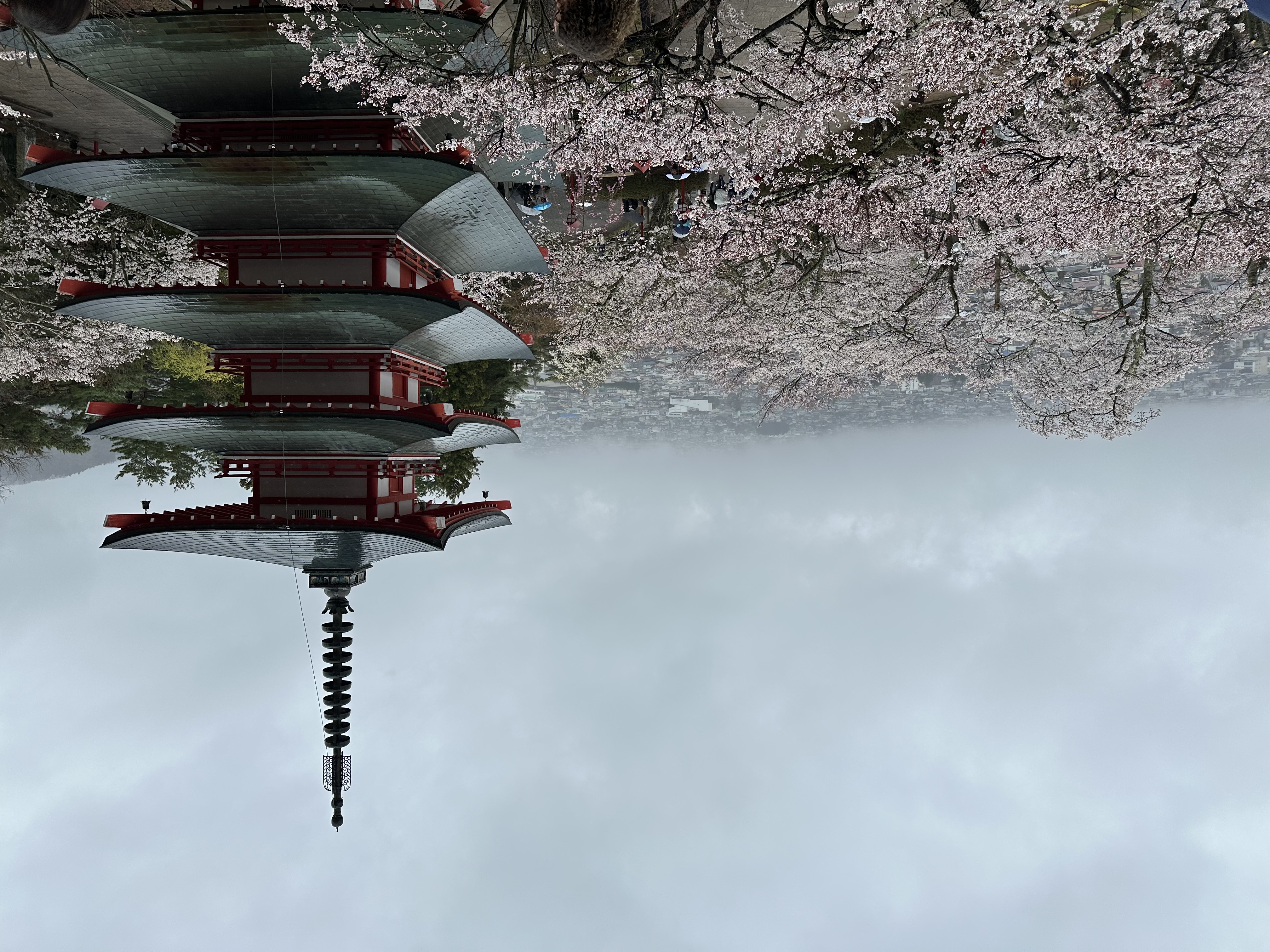
Arakurayama Sengen Park
You have almost certainly seen this view before. A crimson five-story pagoda standing against a canopy of pale pink cherry blossoms, and behind it all, the unmistakable symmetry of Mount Fuji filling the sky. The image has appeared on the cover of the Michelin Green Guide Japan, in Lufthansa's in-flight magazine, and in Thai school textbooks. It has become one of the most reproduced photographs in modern Japan. And yet the place itself is not some grand national monument. It is a modest 4.3-hectare hillside park in Fujiyoshida, Yamanashi Prefecture, perched on the slopes of Mount Arakura, where a war memorial pagoda and approximately 650 cherry trees conspire with geography to produce a scene so perfectly composed it barely looks real.
Three Hundred and Ninety-Eight Steps to the Shot
Reaching the famous viewpoint requires climbing the Sakuya-hime Stairs, a steep ascent of 398 stone steps stretching roughly 200 meters up the mountainside. The climb takes ten to twenty minutes depending on pace, and along the way the city of Fujiyoshida drops away below while the air grows cooler and the forest thickens. At the top stands the Chureito Pagoda, a 19.5-meter reinforced concrete memorial tower built in 1962 to honor Japan's war dead. A memorial service is held here every September. Despite its solemn origins, the pagoda has become one of the most visited photography spots in the country, particularly after Yamanashi Prefecture promoted it to Thai tourism companies in 2011. Thai visitors began describing it as a place where you can see Kyoto and Fuji at the same time, and the phrase stuck.
Sacred Ground, Tourist Boom
The park is part of the grounds of Sangoku Daiichisan Arakura Fuji Sengen Shrine, and Mount Arakura itself is considered sacred land. That spiritual weight contrasts sharply with the modern reality of international tourism. After Mount Fuji's registration as a UNESCO World Heritage Site and the park's growing fame through social media and travel publications, foreign visitors surged. The prime photography spot turned out to be on private land adjacent to the park, separated by a five-meter cliff. Safety concerns mounted, and between September and December 2015, Fujiyoshida City constructed fences and a proper observation deck to protect visitors from the drop. The tension between preservation and popularity is ongoing, a familiar story at Japan's most photogenic locations.
The Old Trees and the Tree Doctor
The approximately 650 Yoshino cherry trees that make the park's springtime views possible are aging. Their vigor has been declining for years, and since 2018 the city of Fujiyoshida has employed Toshihito Arai, a certified tree doctor affiliated with the Flower Association of Japan, to carry out restoration work on the ailing grove. In 2019, the city launched a crowdfunding campaign to support the effort, and the Fuji Kyuko railway company donated one million yen. The cherry trees are not decorations here; they are load-bearing members of an ecosystem that draws visitors from across the globe. Lose the blossoms, and the famous view loses its middle layer. Beyond cherry season, the park offers irises on the slopes above the pagoda around June, celebrated during the Ayame Matsuri festival, and panoramic autumn foliage views over Fujiyoshida city.
A Park With a Panoramic Stage
Established in October 1959, Arakurayama Sengen Park sits on the hillside of Mount Arakura with the entire city of Fujiyoshida spread out below and the massive cone of Mount Fuji dominating the horizon to the south. The park is accessible by a ten-minute walk from Shimoyoshida Station on the Fujikyuko Line, with parking for 87 cars at the base. The red pagoda at its heart is technically not a stupa but a true pagoda, a distinction that matters in Japanese architectural tradition. What makes the park extraordinary is not any single element but the alignment of all of them: the vertical thrust of the pagoda, the horizontal spread of blossoms, and the volcanic pyramid beyond, layered in a single frame that compresses centuries of Japanese aesthetics into one glance.
From the Air
Located at 35.50N, 138.80E on the slopes of Mount Arakura, directly northwest of the massive cone of Mount Fuji. From the air, the park appears as a green patch on the hillside above the grid of Fujiyoshida city. The red Chureito Pagoda may be visible at low altitude. Nearest airport is RJAH (Ibaraki Airport) approximately 180 km northeast, though the Mount Fuji area is more commonly accessed overland from Tokyo. Best viewed at 3,000-5,000 feet AGL for context of the pagoda's relationship to Mount Fuji. The Fuji Five Lakes region stretches to the north and west.