Arashi Beach
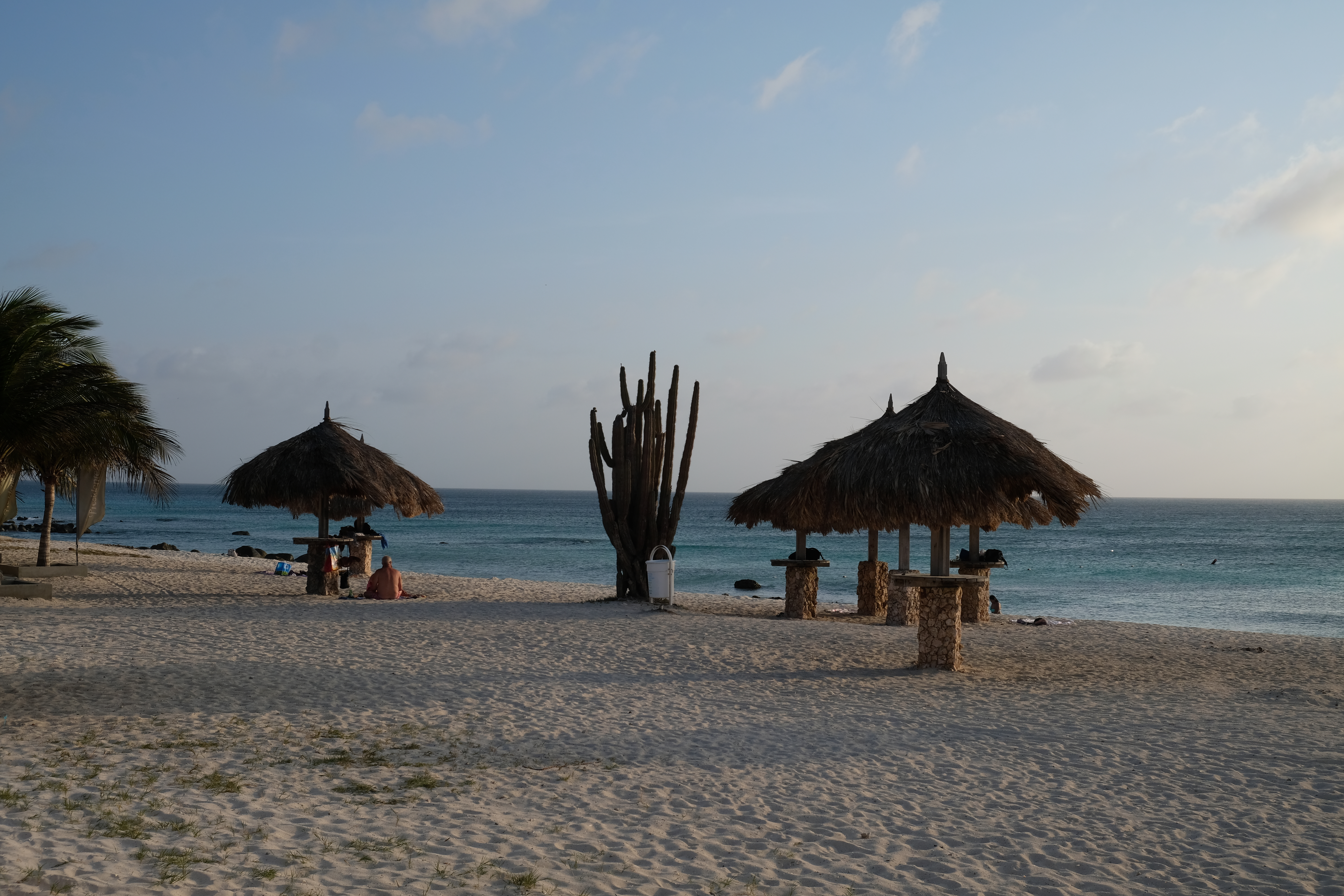
The name is a puzzle with two possible answers, and both of them fit. Arashi may come from the Papiamento word warashi, meaning bonefish - the silvery, elusive fish that the Caquetio people once pulled from these same shallows. Or it may derive from arasi, a compound of ara and ci: "people" and "head." Head of the people. Either way, the Caquetio who named this beach understood what it was - a place where the island comes to a point and the water turns generous. Arashi Beach sits on the extreme northwestern tip of Aruba, a crescent of white sand where the Caribbean laps rather than crashes, where pelicans fold their wings and plunge headlong after fish as the sun drops behind them, and where the thatched-roof palapas cast long shadows across sand so pale it nearly glows. It is the kind of beach that travel brochures promise but rarely deliver.
Words the Caquetio Left Behind
The Caquetio were Aruba's indigenous people, an Arawak-speaking group who inhabited the island long before the Spanish arrived. Their language mostly vanished, absorbed into Papiamento - the creole tongue that blends Portuguese, Spanish, Dutch, and African languages into something uniquely Antillean. But place names survive where empires could not erase them. Arashi is one such name, a toponym of indigenous origin whose precise meaning scholars still debate. The bonefish theory holds water: Arashi remains one of the best locations on Aruba to catch bonefish, and the species was an important part of the Caquetio diet. The alternative - "head of the people" - would describe the beach's geography perfectly, a headland where the land juts out and the community gathered. Both etymologies suggest the same truth. This beach was not a discovery. It was a destination long before anyone arrived to discover it.
The Gold Coast at Dusk
Aruba's northern coastline has earned the nickname "the Gold Coast," and Arashi Beach is where the name makes the most sense. Evenings here are a performance. The sun drops toward the flat Caribbean horizon, and the sky cycles through golds, oranges, and deep reds that reflect off the calm water and light up the wet sand. Pelicans work the shallows, riding thermal currents before folding into their improbable dive - a bird that looks ungainly in every other context becoming, for two seconds of free-fall, an arrow. Visitors settle into the palapas, the thatched beach huts that the municipality provides free of charge, and watch the show. There is no admission, no velvet rope, no VIP section. Arashi's sunsets belong to whoever shows up, which on any given evening includes families from Noord, snorkelers toweling off after a reef session, and tourists who wandered north from the hotel strip and found something better than what they paid for.
Below the Surface
The reef off Arashi's southern edge draws snorkelers for the same reason the Caquetio fished here: the water is calm, clear, and full of life. The beach faces west, sheltered from the trade winds that batter Aruba's eastern coast into rocky cliffs and rough surf. That sheltering effect creates conditions where coral thrives and visibility stretches well beyond what most Caribbean beaches can offer. Parrotfish graze on the reef. Sea fans wave in the gentle current. The rocky areas nearby attract fishermen who cast lines into water that transitions from turquoise shallows to deep blue within a few dozen meters. Arashi participates in the Aruba Reef Care Project, an annual campaign to clean reefs, shallow waters, and public beaches across the island. The Foundation for Environmental Education has awarded the beach its Blue Flag certification, recognizing that it meets international standards for water quality, safety, and environmental education - a formal acknowledgment of what anyone who has floated face-down above the reef already knows.
The Lighthouse at the Edge
Walk south from Arashi Beach and within minutes you reach the California Lighthouse, the stone tower that marks Aruba's northwestern tip. Named not for the American state but for the SS California, a steamship that wrecked nearby in 1891, the lighthouse has watched over this coastline since its completion around 1916, though delayed by World War I, it first became fully operational in 1919. From its base, the view sweeps across Arashi Beach to the north, the rocky coast to the east, and the hotel strip running south along Palm Beach. The settlement of Malmok sits between, a quiet residential area that feels worlds away from the resort corridor. Arashi occupies a transitional zone - north of the tourism infrastructure, south of the wild northeastern coast, accessible by car or Arubus Route L10 but still possessing the unhurried quality of a beach that has not been packaged. A parking lot sits adjacent, which is about as commercial as it gets. The palapas are free. The reef is free. The sunset is free. Arashi's economy runs on showing up.
From the Air
Located at 12.60°N, 70.05°W on Aruba's northwestern tip. The California Lighthouse nearby is the primary visual landmark - a stone tower at the island's northernmost point. Queen Beatrix International Airport (TNCA) is approximately 12 km to the southeast in Oranjestad. From altitude, look for the white sand crescent on the west-facing coast just south of the lighthouse, contrasting with the rockier eastern shoreline. Aruba is 27 km north of Venezuela. Best viewed at 1,000-2,000 feet AGL - the beach's white sand and turquoise shallows are distinctive against the darker deep water. The reef system is visible as lighter patches in the water off the southern edge of the beach.