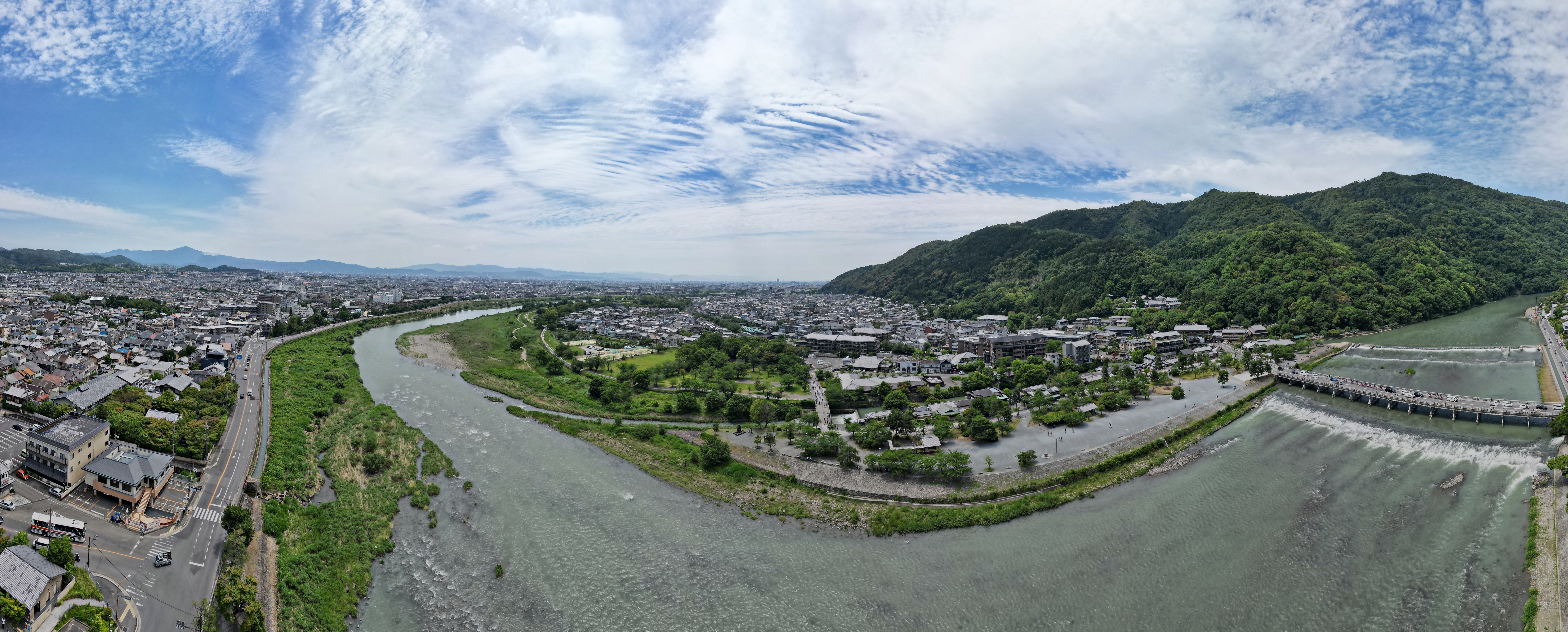
Arashiyama: Where the Moon Crosses the Bridge
During a boating party sometime in the Kamakura period, Emperor Kameyama watched the full moon drift across the night sky above a wooden bridge spanning the Oi River. "It is as if the moon is crossing without hindrance," he remarked, and the bridge became Togetsukyo -- the Moon Crossing Bridge. That kind of moment defines Arashiyama. This mountainous district on the western edge of Kyoto has been a place where powerful people come to be moved by beauty since the Heian aristocracy first built their country villas here in the eighth century. The mountain across the river, the bamboo climbing its slopes, the cherry blossoms reflecting in the current below the bridge -- Arashiyama exists at the exact point where the natural and the cultivated become indistinguishable from each other.
A Playground for Emperors and Monks
Arashiyama's history as a retreat begins with the Heian aristocracy, who chose these western hills for their country estates starting in the late 700s. The mountain -- Arashiyama itself, meaning "Storm Mountain" -- provided a dramatic backdrop of forested slopes that turned fiery in autumn and cloud-pink with cherry blossoms each spring. Nobles held poetry competitions and moon-viewing parties along the river. But alongside the pleasure seekers came the monks. Tenryuji, founded in 1339 by the shogun Takauji Ashikaga, became the main temple of one of the fifteen branches of the Rinzai school of Zen Buddhism and ranks first among the Five Great Zen Temples of Kyoto. It is a UNESCO World Heritage Site. Just up the slopes, smaller temples and shrines accumulated over the centuries, including the ancient Matsunoo Taisha, one of the oldest shrines in the Kyoto area, founded in 701 and long associated with a sacred spring believed to bless sake and miso production.
The Bridge That Carries the Moon
The Togetsukyo Bridge is Arashiyama's visual anchor -- a 155-meter span across the Katsura River, framed by mountains on every side. The original bridge dates to the Jowa era of the early Heian period, between 834 and 848, when the monk Dosho built a wooden crossing called Horinji Bridge to provide access to Horinji Temple on the opposite bank. The bridge was rebuilt many times over the centuries, and the current structure dates to 1934 -- steel-reinforced concrete beneath wooden railings designed to harmonize with the surrounding landscape. It is the subject of one of the ukiyo-e woodblock prints in the Famous Views of the Sixty-odd Provinces series. The river itself carries three different names along its course: the upper stretch, the middle stretch near the bridge where it becomes the Oi River, and the lower course where it is known as the Katsura. The bridge remains the center of gravity for the entire district, the place where the view of mountain, river, and sky comes together.
Wild Monkeys on the Mountain
On the slopes of Arashiyama mountain, above the temples and the tourist paths, around 120 Japanese macaques live in the Iwatayama Monkey Park. The monkeys are wild -- they are not caged or captive -- but they have grown accustomed to human visitors over decades of coexistence. The park sits on a small mountain not far from the Saga-Arashiyama rail station, and the climb to the summit takes about twenty minutes on a steep forest trail. At the top, visitors can observe and photograph the macaques at close range. A fenced enclosure at the summit allows visitors to feed the monkeys through a wire mesh -- a reversal of the usual zoo arrangement, where it is the humans who are inside the cage. The monkeys groom each other on the rocks, chase each other through the trees, and largely ignore the tourists unless food is involved.
Gardens, Graves, and a Chinese Premier's Poem
Arashiyama layers the unexpected alongside the famous. Okochi Sanso, the Japanese-style estate and gardens of silent-film actor Denjiro Okochi, opens its manicured grounds to visitors -- a private world of moss, stone, and pruned pines with views across the city. The tombstone of Kogo, a courtesan of the Heike clan, lies quietly in Sagano, a reminder that Arashiyama has always attracted those seeking refuge from political turmoil. Perhaps the most surprising monument sits in Kameyama Park: a stone engraved with four poems by Zhou Enlai, China's future premier, who visited Arashiyama as a student and was so moved by the cherry blossoms and mountain greenery that he composed a series of verses titled "Arashiyama in the Rain." The stone stands as a small, unlikely bridge between two nations.
The Seasons Turn the Mountain
Arashiyama is, above all, a place transformed by the calendar. In spring, cherry trees explode along the riverbanks and the mountain slopes, their blossoms reflected in the current below the Togetsukyo Bridge. In autumn, the same slopes burn with red and gold maple foliage, drawing crowds who come simply to stand on the bridge and look. Arashiyama is a nationally designated historic site and place of scenic beauty -- a formal recognition by the Japanese government that this landscape is worth protecting. The district remains walkable and accessible, served by three rail lines from central Kyoto and Osaka. But the real access point is the bridge itself. Stand on its wooden railings at dusk, when the last light catches the mountain across the river, and you understand why an emperor once saw the moon walk across.
From the Air
Located at 35.015°N, 135.671°E on the western outskirts of Kyoto. From altitude, the Arashiyama district is identifiable by the forested mountain slopes meeting the curve of the Katsura/Oi River, with the Togetsukyo Bridge visible as a distinctive crossing point. The bamboo forest appears as a dense green patch on the mountain's lower slopes. Best viewed at 2,000-4,000 feet AGL from the east for the classic view of the bridge with mountains behind. Osaka Itami Airport (RJOO) lies approximately 25 nautical miles southwest. Kansai International Airport (RJBB) is roughly 55 nautical miles south. The Kyoto city grid is visible to the east, providing easy orientation.