Arboretum d'Antsokay
Herman Petignat arrived in southern Madagascar with a botanist's eye and a conservationist's urgency. The spiny forests around Toliara were vanishing -- consumed by slash-and-burn agriculture, bush fires, and illegal harvesting. In 1980, the Swiss-born Petignat began planting. Forty hectares of limestone and red sand, hedged with living fences, became a refuge for the plants that were losing ground everywhere else. Today the Arboretum d'Antsokay holds roughly 900 species, 90% of them endemic to Madagascar. Both Lonely Planet and Rough Guides list it as the top attraction in Toliara. What began as one man's rescue mission has become an internationally recognized conservation site, collaborating with the Royal Botanic Gardens at Kew, the WWF, and the Critical Ecosystem Partnership Fund.
A Chalk Garden at the Edge of the Desert
The arboretum sits just off Route Nationale 7, about 12 kilometres southeast of Toliara and only 6 kilometres from the airport. It occupies a patch of the Madagascar spiny forest ecoregion, a habitat found nowhere else on Earth. The name of the surrounding area, Antsokaha, means "chalk" in Malagasy, a reference to the limestone geology underlying the red, low-calcium sand. The Tropic of Capricorn runs just 2 kilometres to the south. The Mozambique Channel lies 3 kilometres to the west. Between the chalk, the desert, and the sea, the arboretum preserves an ecosystem that looks alien even by Madagascar's standards -- a landscape of swollen bottle-shaped trunks, thorned succulents, and octopus-like trees reaching skyward.
Euphorbia, Baobab, and the Names That Remember
Among the 900 species growing here, the stars include baobabs, the spiny Didierea madagascariensis, fleshy Pachypodium, and the towering Alluaudia procera. Petignat's collaboration with the German botanist Werner Rauh led to the discovery of several species new to science: Euphorbia spinicapsula, Euphorbia kamponii, and Euphorbia suzannae-marnierae among them. Rauh returned the honour by naming two species after Petignat himself -- Ceropegia petignatii and Cynanchum petignatii. Eighty percent of the arboretum's plants are considered to have medicinal value, and many face extinction in the wild. The arboretum has also played a role in conservation efforts for the radiated tortoise, a critically endangered species in Madagascar's southern deserts whose geometric shell pattern makes it a target for the illegal pet trade.
Lemurs After Dark
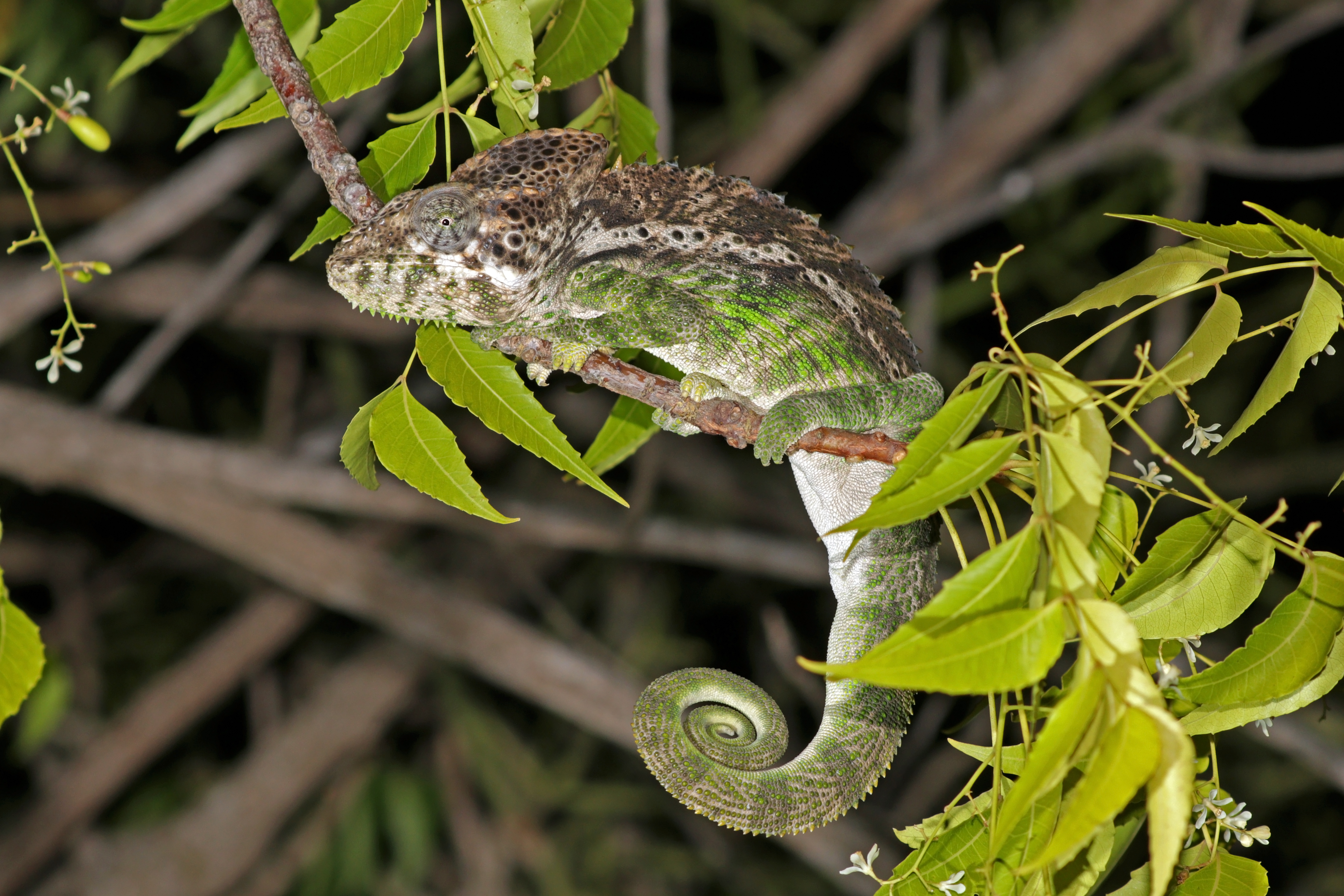
The arboretum is alive with more than plants. Mouse lemurs -- among the smallest primates on Earth, small enough to fit in a cupped hand -- inhabit the grounds and can be spotted on guided night walks. Thirty-four bird species have been recorded here, including the red-capped coua, a ground-dwelling bird endemic to Madagascar, and the Madagascar kestrel. Twenty-five species of reptiles live among the spiny vegetation, including the warty chameleon, which changes colour more slowly and subtly than its rainforest relatives. A small museum on site displays rocks, fossils, and the egg of an Aepyornis -- the elephant bird, a flightless giant that stood over 3 metres tall and went extinct roughly 1,000 years ago. Holding that egg in your imagination while standing among the living forest is the arboretum's quiet lesson: what survives here now once shared the island with creatures of almost mythological scale.
A Family Legacy in the Spiny Forest
Herman Petignat ran the arboretum for over two decades before his son Andry took over management in 2003. The generational handoff matters in a place where conservation is measured in decades, not seasons. According to Botanic Gardens Conservation International, Petignat "exerted himself to have the most threatened plants species reproduced and multiplied either by seeding, cutting or transplantation process in order to preserve most of them from constant deforestation, bush fire and looters." The arboretum operates daily from 7:30 to 17:30, closed only during the rainy month of February. Visitors can take guided tours in English, eat at a restaurant on the grounds, or stay overnight at the Auberge de la Table, named for a small mountain nearby. It is a modest operation by global botanical garden standards, but in a region where the native forest is disappearing at an alarming rate, those 40 hedged hectares carry an outsized weight.
From the Air
Located at 23.41S, 43.76E, approximately 12 km southeast of Toliara on Madagascar's southwest coast. From altitude, the arboretum appears as a conspicuous green rectangle amid the scrubby brown of the surrounding spiny desert, just off the RN7 highway. The small mountain La Table is a nearby visual landmark. Nearest airport is Toliara (FMST), only 6 km away. The Mozambique Channel coastline is visible to the west. The Tropic of Capricorn crosses just south of the site.