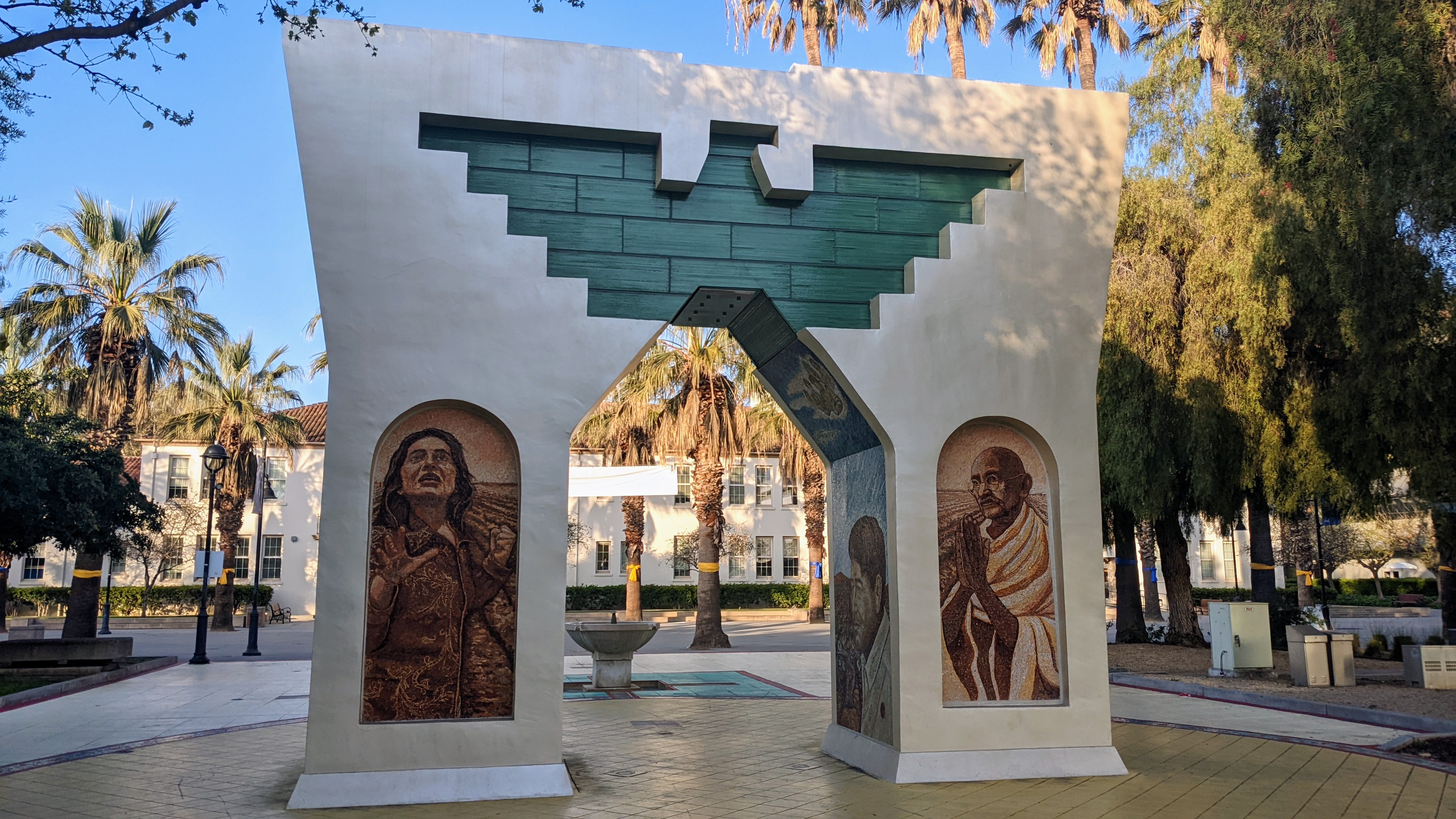
Arch of Dignity, Equality, and Justice
The arch rises in pearlescent plaster, its form drawn from Mayan architecture, its meaning drawn from the fields of the Santa Clara Valley. The Arch of Dignity, Equality, and Justice, commonly known as the Cesar Chavez Arch, stands in downtown San Jose as a monument to the labor leader who organized farmworkers across California and whose movement had deep roots in the agricultural communities of the South Bay. The arch's Mayan styling honors the indigenous heritage of the workers whose labor fed the valley before technology became its primary crop.
The Farmworker's Monument
Cesar Chavez and the United Farm Workers organized agricultural laborers across California, fighting for basic workplace protections in an industry that had long relied on cheap, exploitable labor. The Santa Clara Valley, before it became Silicon Valley, was one of the most productive agricultural regions in the world, and its farmworkers, many of them Mexican and Filipino immigrants, endured the conditions that Chavez fought to change. The arch honors not just Chavez himself but the broader movement for dignity in labor that he represented.
Mayan Forms, Modern Meaning
The arch's design draws on Mayan architectural traditions, connecting the monument to the pre-Columbian civilizations of Mesoamerica and to the indigenous roots of many of the farmworkers Chavez organized. The pearlescent plaster gives the structure a luminous quality that changes with the light, shifting from cool white in shadow to warm gold in direct sun. The arch stands in a plaza that serves as a public gathering space, a place where the memory of the farmworkers' struggle is embedded in the physical landscape of a city that has largely moved beyond agriculture.
From the Air
Located at 37.34°N, 121.88°W in downtown San Jose. Norman Y. Mineta San Jose International Airport (KSJC) is approximately 3 miles northwest. The arch is in the civic center area near the intersection of East Santa Clara Street and Market Street.