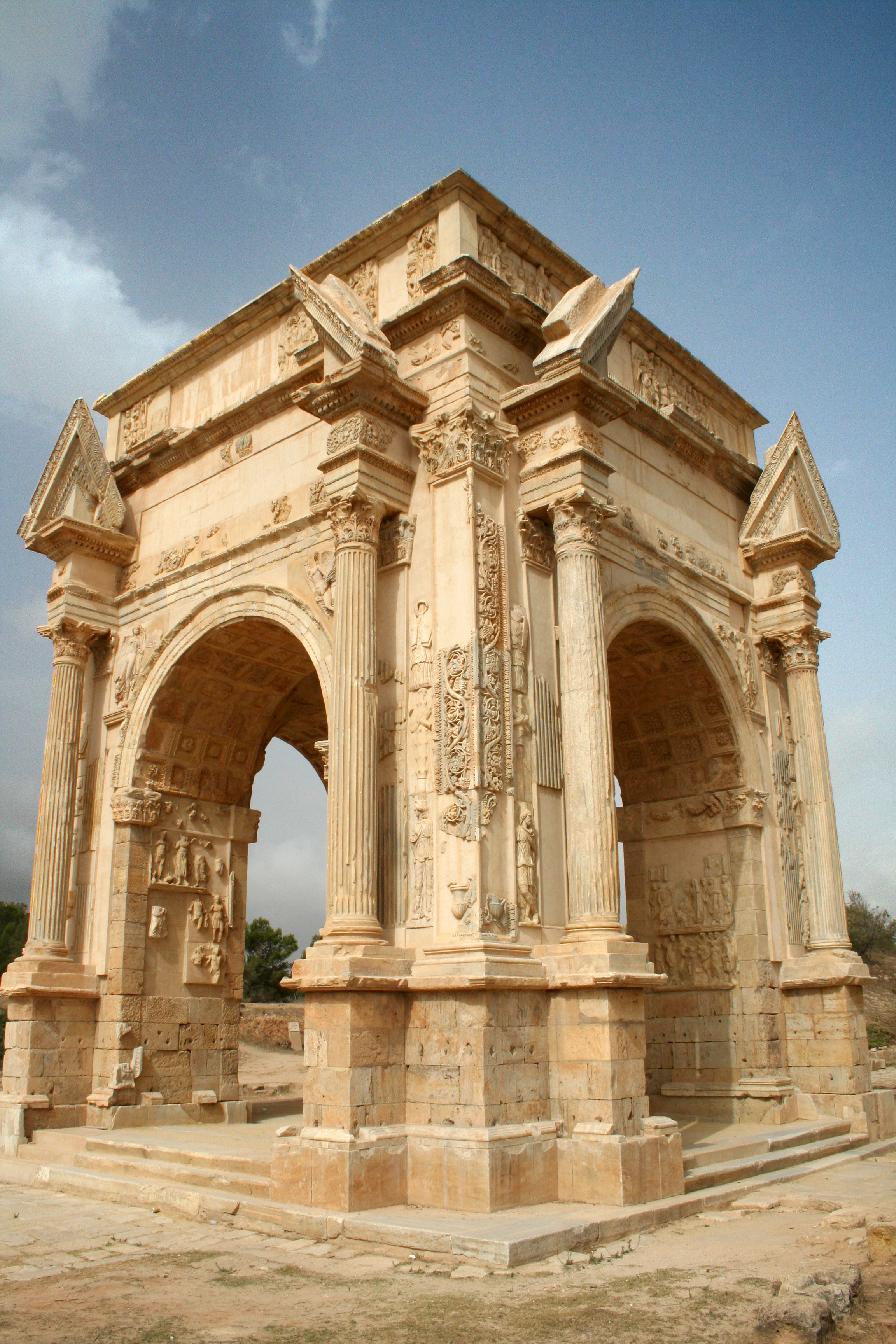
Arch of Septimius Severus (Leptis Magna)
In 1928, Italian archaeologist Giacomo Guidi brushed sand away from a stone fragment in the Libyan desert and found himself looking at the face of a Roman emperor. Beneath the dunes lay the shattered remains of a monumental four-way arch, completely fragmented, with only its base structure still recognizable. It would take years of excavation and reconstruction to reassemble what Guidi had found: a triumphal arch commissioned 1,700 years earlier by Septimius Severus, the first Roman emperor born in Africa, erected at the very crossroads of the city where he grew up.
A Hometown Emperor
Septimius Severus was not the kind of emperor Rome was accustomed to. Born in Leptis Magna around AD 145, he was the first emperor from the provinces since Hadrian and Trajan -- and the first from Africa. Declared emperor by his own troops, he proved himself through military conquest, particularly his victories over the Parthian Empire between 194 and 198. Those victories triggered an ambitious building program: triumphal arches in Rome itself, and one in his birthplace. The arch at Leptis Magna was erected around AD 203, during Severus's grand tour of his African homeland. It was both a celebration of military triumph and a personal homecoming -- a native son announcing to the world, in stone and marble, that he had reached the pinnacle of power.
Where Two Roads Cross
Built as a tetrapylon -- a four-way arch, open on all sides -- the structure stood at the intersection of the city's two most important streets: the cardo, running north to south, and the Decumanus Maximus, the main east-west thoroughfare. This was no ordinary triumphal arch meant to be walked through and admired from one angle. It was designed to dominate the central crossroads of one of Roman Africa's most prominent port cities, visible from every direction, asserting Severan authority to anyone who passed. The placement was strategic as well as symbolic: the northeast frieze faced toward Oea, Leptis Magna's rival city, a deliberate gesture that would not have been lost on contemporaries.
Stone Propaganda in Deep Relief
The arch's decoration represents some of the most elaborate sculptural work surviving from the Severan period. Eight Corinthian columns frame the openings, supporting a broken pediment -- an unusual architectural choice that drew not from Roman tradition but from eastern styles extending from Asia to Palestine. Four primary frieze panels depict the imperial family in scenes of triumph, procession, sacrifice, and Concordia Augustorum, the harmony of the emperors. On the northeast frieze, a quadriga carries three central figures: Septimius Severus flanked by his sons Caracalla and Geta, an explicit statement of dynastic succession. Where tradition called for a slave or Victory holding a crown above the emperor, the Severan arch substituted images of Cybele, Hercules, and Venus -- aligning the ruling family with both Roman and eastern deities. The deeply drilled costume folds, the vine scrolls on the pilasters, the captured barbarians supporting trophies between the columns: every surface carried a message about power, legitimacy, and divine favor.
Buried and Reborn
Leptis Magna and its arch survived for centuries after Severus's death in AD 211, but the city's fortunes declined. Barbarian invasions in the late 5th century left it in ruins. The Byzantine emperor Justinian appropriated sculpture from the arch for his basilica, scavenging imperial art for imperial purposes. Eventually the sand took over. The entire city disappeared beneath dunes, which paradoxically preserved it. When Guidi's team began excavating in 1928, during Italy's occupation of Libya, they found the arch in fragments so complete that reconstruction was possible. The painstaking reassembly restored a monument that had not been seen in over a millennium. Today, the Arch of Septimius Severus stands again at its ancient crossroads, part of a UNESCO World Heritage Site -- though one designated as in danger due to Libya's ongoing instability.
An Emperor's Legacy in Sand
The arch at Leptis Magna tells a story that Rome's own versions do not. Severus built arches in the capital as well, but the one in his hometown reveals something more personal: a provincial boy made good, advertising his success to the people who knew him before the purple. The blend of Roman and eastern architectural elements reflects the multicultural world Severus inhabited, a world where an African could become the most powerful person alive. The deeply carved reliefs have weathered better than most surviving Roman sculpture, protected for centuries by the sand that buried them. Standing at that crossroads today, with the Mediterranean visible to the north and the Sahara stretching to the south, the arch marks a boundary between worlds -- Roman and African, ancient and modern, buried and recovered.
From the Air
Located at 32.64N, 14.29E on Libya's Mediterranean coast near the modern town of Al Khums, approximately 120 km east of Tripoli. The archaeological site of Leptis Magna spreads along the coast at the mouth of Wadi Lebda. The ruins are visible from the air as a large complex of stone structures contrasting with the surrounding sand. Nearest airport is Mitiga International Airport (HLLM) in Tripoli. Best viewed at 2,000-5,000 feet for detail of the arch and surrounding Roman ruins.