Archaeological Museum of Delos
The lions still face east, the way they have since the seventh century BC, watching nothing in particular. The originals are inside now, sheltered behind glass after one too many centuries of Aegean salt; copies stand watch on the terrace where Naxian sculptors first set them. This is Delos, an island so sacred to ancient Greeks that they forbade anyone to be born or to die on it. The museum tucked beside the ruins exists for a single reason: to keep what could no longer be left to the weather.
An Island Built on Belief
Delos is roughly three square miles of dry rock between Mykonos and Rinia, and for most of antiquity it was the religious center of the Aegean. Greeks believed Leto gave birth to Apollo and Artemis here, and pilgrims came across open water to leave offerings at sanctuaries that grew steadily wealthier. The Athenians eventually purified the island twice, removing graves and forbidding birth, so that nothing mortal would taint the god's home. By the time Romans turned Delos into a free port in 166 BC, its sanctuaries had absorbed centuries of dedications. When the island was sacked twice in the first century BC and abandoned, the offerings stayed where they fell, slowly buried by wind and dust. That is what the French School at Athens began uncovering in 1872, and what they continue to uncover.
A Museum Built Out of Necessity
The Archaeological Society of Athens put up the building in 1904, when the early excavation had already pulled more from the soil than any seasonal expedition could safely carry away. Five rooms at first; then nine, after expansions in 1931 and 1972. The design is functional rather than grand, which fits the island. There are no cafes nearby, no village, no place to stay overnight; visitors arrive by boat from Mykonos and leave again before dusk, the way the ancients required. The museum sits a short walk from the Sacred Harbor, close enough that you can see the ruins through the doorway as you study what came out of them. Many of the most spectacular finds were carried off to Athens long ago, and live now in the National Archaeological Museum. What stays on Delos belongs to Delos.
Faces in Marble, Words on Stone
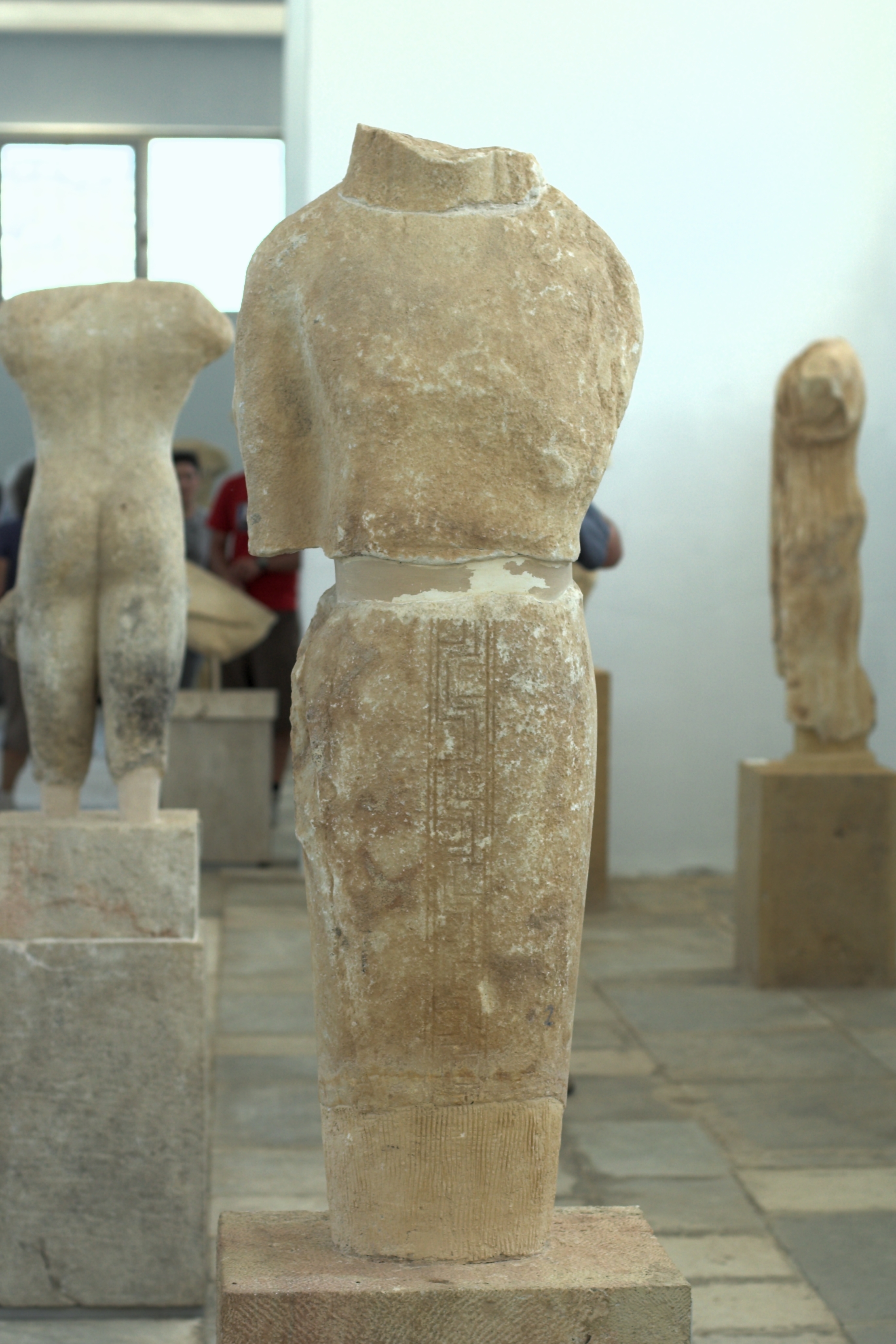
The kouros torso from the sixth century BC is the kind of object that quietly anchors a collection. So is the inscribed triangular base of an even older kouros, which still carries the words "Euthycartides the Naxian made me and dedicated me" - one of the earliest signed sculptures in Greek art. There is a Corinthian alabastron, a small perfume jar from around 620 BC, painted with Potnia Theron, the lady of the beasts, flanked by swans. The kore in peplos from 580 BC, found at the Temple of Apollo, smiles the small archaic smile that turns up everywhere in Greek sculpture once you start looking. A fresco lifted from a house in the Skardana Quarter shows Heracles, two boxers, and a man with a flute or trumpet; an inscription names Kalamodrya, who was apparently a famous boxer in the first century BC. The display rooms hold pottery from the twenty-fifth century BC down to the first - which is to say, a span of human time so long it stops feeling like history and starts feeling like geology.
The Lion Terrace
The lion statues are the souvenir most visitors carry away in their memory. Naxian sculptors carved them around 620 to 600 BC and lined them up along a terrace facing the Sacred Lake, where Leto was supposed to have given birth. There were originally at least nine, possibly twelve. Five originals remain - one was carted to Venice in the seventeenth century and now flanks the Arsenal there, missing its head and looking more like a heraldic beast than the alert guardians on Delos. The originals here are weathered to the bone, manes simplified by centuries of wind, but you can still feel what the sculptor wanted: not portraits of lions but the idea of vigilance, multiplied.
From the Air
37.40 N, 25.27 E. Delos sits two nautical miles west of Mykonos in the Cyclades, at the geographic and historic heart of the Aegean. From cruising altitudes around FL350 you can pick out the bright triangle of the island in clear weather, with Mykonos to the east and the larger mass of Rinia hugging it from the west. Nearest airport is Mikonos (LGMK), 2 nm east; Naxos (LGNX) sits 25 nm south, and Athens (LGAV) 95 nm west-northwest. Best visibility comes mid-morning before the afternoon meltemi kicks up haze.