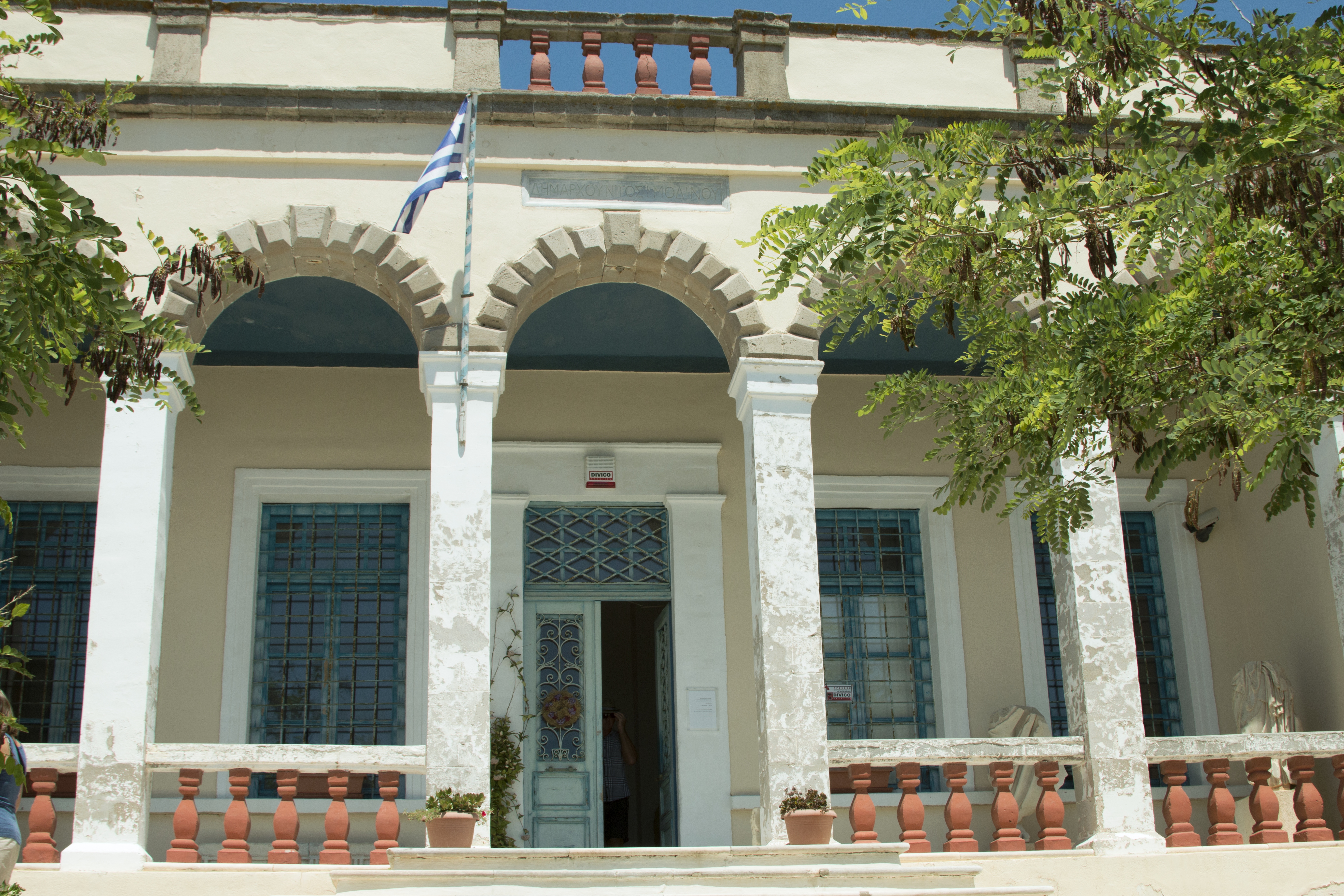
Archaeological Museum of Milos
Milos is famous for one statue, and the statue is not on the island. The Venus de Milo, found in a peasant's field in 1820, sailed to Paris within a year and has not come back. The Archaeological Museum of Milos has a copy in its first room - a polite, slightly apologetic reproduction. The real story is in the rest of the building. For five thousand years, before any Greek god needed depicting, Milos was an island that mattered because of a single black volcanic glass.
An Obsidian Economy
Volcanic Milos produced obsidian of unusually high quality, and prehistoric people in the Aegean knew it. They paddled across open water to fetch it - some of the oldest evidence of seafaring in the Mediterranean involves Melian obsidian found at Franchthi Cave on the mainland, more than a hundred kilometers away across rough water, dating to before 9000 BC. The first room of the museum displays the tools cut from this glass: blades you could still shave with, scrapers used to clean hides, a backed bladelet small enough to fit on a fingertip. These are the artifacts of a Neolithic and early Bronze Age trade network that reached as far as Crete and the Peloponnese, run by people whose names we will never know.
The City Called Phylakopi
The second room is the museum's heart, and it belongs to one site: Phylakopi, a Bronze Age city on the north coast that was built, rebuilt, and rebuilt again from around 3300 BC to about 1100 BC. Archaeologists divide its life into four phases (Phylakopi I through IV), and you can see them stacked in the case work like geological strata. The earliest material is purely Cycladic: pyxides, those small lidded boxes; little tufa house models that look like architect's gifts; pottery kernoi from Rivari with multiple cups joined into a single ring. By Phylakopi III, around 1600 BC, Minoan influence from Crete is everywhere - a clay bath-tub (an asaminthos) decorated with octopuses, an offering table fragment, imported pottery painted with nautilus shells and seaweed. By Phylakopi IV, in the twelfth century BC, the Mycenaeans from the mainland had taken over, and the figurines turn into bird goddesses and bovine offerings from a small shrine on the west side of town. The best Phylakopi finds are in Oxford and London and Athens, but enough remained to tell the story.
The Lady of Phylakopi
Among the Mycenaean figurines is one that catches everyone who walks past. The Lady of Phylakopi, from a shrine of the fourteenth century BC, stands maybe a foot tall - a hollow ceramic figure with raised arms, a long elegant face, eyes wide. She is goddess or worshipper or both; nobody is sure. She was found among many other figurines in the West Shrine, a small cult building that had been refurbished repeatedly across the late Bronze Age. Whatever she meant to the people who made her, she has the quality that ancient art occasionally manages: she looks alive, three thousand four hundred years after her hands were shaped.
Greek and Roman Afterlife
The third and fourth rooms cover what came later. There is a geometric amphora from the eighth century BC, when post-collapse Greece was rebuilding its visual language out of squares and triangles. There are Corinthian pots and a Black-figure lekythos from the sixth century. There are Hellenistic and Roman sculptures, a portrait herm of Marios Trofimos who was a priest of Dionysos in the second century AD, and a Roman portrait of an unknown man from the third. The building itself is part of the exhibit: a neoclassical structure from 1870 that stands on the main square in Plaka, the hilltop village where the road from the harbor finally runs out of switchbacks. The lapidary in the porch, with its torsos from late antiquity, would be a museum on its own anywhere else.
Why the Venus Lives in Paris
A farmer named Yorgos Kentrotas dug up the statue near the village of Tripiti in April 1820. He was looking for building stones. Within months, French naval officers arrived, negotiated her purchase from local authorities (with diplomatic pressure that pre-empted Ottoman counter-claims), and shipped her to Paris, where she became Louis XVIII's gift to the Louvre. She has been there ever since. The Milos museum's copy is honest about this: it is a copy, in the first room, where you can stand in front of it and read the small label that explains where the original lives. The hostility you sometimes hear in Greek museums about the Elgin Marbles is muted here, but the absence is felt. Most of what made Phylakopi famous left the island a century before the Venus did, when Phylakopi was first systematically excavated in the 1890s. The museum is what was left behind, and what was left behind is enough.
From the Air
36.74 N, 24.42 E. Milos sits in the southwest corner of the Cyclades, a roughly horseshoe-shaped volcanic island wrapped around a deep inland bay. The museum is in Plaka, the hilltop village above Adamas harbor on the north coast. Milos National Airport (LGML) is 4 km southeast of Plaka, on the south side of the bay; nearest alternate is Santorini (LGSR), 65 nm east-southeast. The volcanic geology shows clearly from altitude - bands of red, white, and yellow rock around the bay, and the unmistakable lunar quality of the island's south coast. Best viewing in late morning when shadows define the cliffs.