Archaeological Museum of Nafplion
On a tomb floor at Dendra, in 1960, a Swedish archaeologist lifted away a sheet of crumbling earth and saw a man-shaped emptiness made of bronze. Fifteen plates of beaten metal, held together by leather thongs that had long since rotted, encased the place where a Mycenaean warrior had once stood. The Dendra Panoply is the centerpiece of the Archaeological Museum of Nafplion, displayed in a Venetian barracks on the central square of one of the prettiest harbor towns in Greece. The story it tells is older than Homer.
A Venetian Barracks Full of Time
Nafplio has been the harbor of Argos for as long as harbors have mattered. The town wraps around the rocky base of the Akronafplia headland, with the Venetian fortress of Palamidi rising 216 meters behind it, and the postage-stamp islet of Bourtzi guarding the bay. The museum occupies two floors of a barracks the Venetians built around 1713, when this was their last footing in Greece before the Ottomans took it back. The building is plain, square, with thick walls and an arcade on the ground floor where soldiers once gathered. It is exactly the sort of building that survives, and now it holds 32,000 years of southern Argolid - from the Paleolithic hearths of Kleisoura Gorge to a Roman portrait.
Franchthi Cave
The oldest material in the museum comes from a cave on the Argolic Gulf coast called Franchthi. Excavated between 1967 and 1976, Franchthi gave up an unbroken sequence of human occupation from about 20,000 BC down to 3000 BC - the longest continuous archaeological record from any single site in Greece. The flint tools, the bone awls, the shells used as jewelry, the seasonal hearth ash: each layer tracks a small change in how people lived. Hunter-gatherers in winter became seasonal foragers, then settled farmers, then potters. The transition from hunting to agriculture is rarely visible as a single line on a chart; here, in the case across from the entrance, it is visible as a stack of objects.
The Mycenaean Rooms
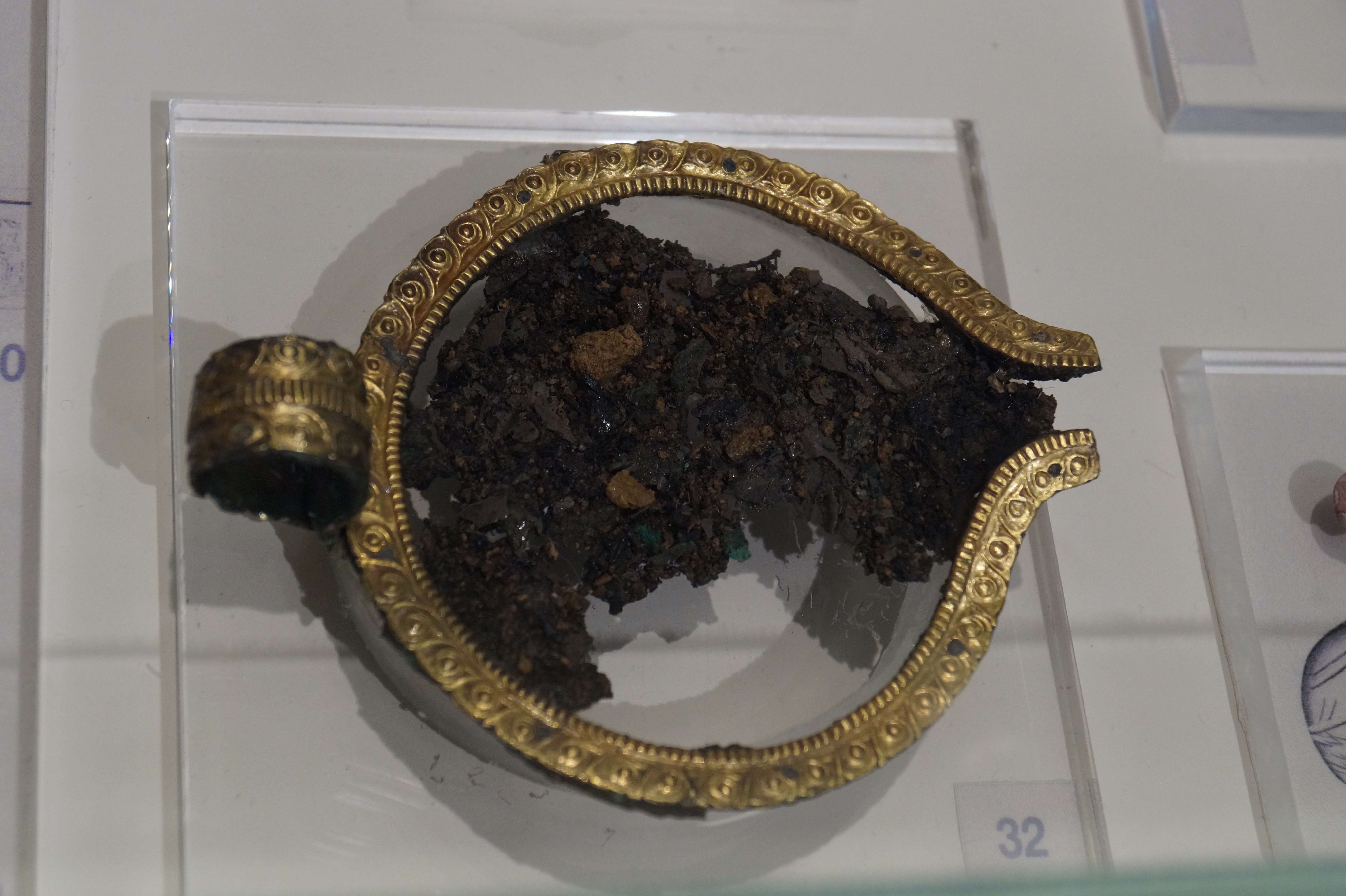
Upstairs, the case work tells the story of the Argolid in the late Bronze Age - the world Homer was trying to describe a thousand years after it ended. There is the Lady of Asine, a terracotta head from the twelfth century BC with a face still recognizable as a face. There are wheel-made female figurines from Tiryns and Midea, Linear B tablets in their unreadable angular script, Mittanian cylinder seals brought from northern Syria, an octopus-jug from Berbati, a bronze mirror with an ivory handle from Dendra. The grave goods come from cemeteries scattered across the region: cist graves and chamber tombs at Evangelistria, Asine, Palaia Epidauros, the tholos at Kazarma. Gold beads from Asine; glass and amethyst and carnelian beads from another tomb in the same cemetery; a silver cup with a gold rim, found in a pit grave at Kazarma in the fifteenth century BC.
The Armor That Nobody Could Run In
The Dendra Panoply is the most complete suit of Bronze Age armor known. Fifteen pieces of beaten bronze, dating to the late fifteenth century BC, encase the wearer from neck to knees. The high collar is borrowed from Near Eastern designs; the boar's tusk slivers found alongside it once made up a helmet of the kind Homer describes Odysseus wearing in the Iliad. Modern reconstructions have been built and tested, and the verdict is what you would expect: the armor is heavy, hot, hard to fight in for long, and almost impossible to run in. It was probably made for a chariot warrior, or for ceremonial purposes, or for someone wealthy enough that running was somebody else's job. Whatever the purpose, somebody wore it; somebody died in it; somebody buried it carefully in Chamber Tomb 12 at Dendra. The armor was found with another grave good - boar tusks - and later excavations turned up Bronze Age tumulus burials with sacrificed horses.
The Cities That Vanished
The lower cases tell stories of cities the Argolid lost. Hermione, founded according to myth by the Dryopes who fled Mount Oeta when Heracles attacked them, sent three ships to the Battle of Salamis in 480 BC and three hundred men to the Battle of Plataea the following year. Halieis, on the Argolic Gulf, was a port town that took in refugees from Tiryns when the Argives expelled them, then was repeatedly ravaged by the Athenians during the Peloponnesian War. Both cities were abandoned by the second century AD. The museum holds their last objects: bronze keys from the temple at Halieis, a bronze caryatid mirror from Hermione, votive figurines, miniature helmets, terracotta shields. Hermione had a sanctuary of Clymenus - a name for Hades - where locals believed an opening in the earth led directly to the underworld, so they did not put coins in their dead's mouths to pay Charon. Their dead, they figured, would not need the ferry.
From the Air
37.57 N, 22.80 E. Nafplio occupies the head of the Argolic Gulf in the eastern Peloponnese, at the foot of the steep limestone Palamidi headland. The town's compact harbor and the small fortress islet of Bourtzi are unmistakable from altitude. Nearest airport is Kalamata (LGKL), 75 nm west; Athens (LGAV) is 60 nm northeast across the Saronic Gulf. The Argolic plain stretches inland from the coast - greener and flatter than most of the Peloponnese - with the citadel of Mycenae 12 km north and the theater of Epidaurus 25 km east. Best clarity is morning before maritime haze settles over the gulf.