Archaeological Museum of Thessaloniki
Walk into the Archaeological Museum of Thessaloniki and the first thing you notice is the light. Patroklos Karantinos designed the 1962 building as a deliberate break from the heavy neoclassicism that Greek museums had inherited from the nineteenth century. His galleries are low, modernist, and bright, and the architecture itself was a kind of statement: that what these rooms held was not a national mausoleum but a working civic space, where the deep past of Macedonia could be looked at directly. Then you start to see what is inside. A bronze krater inlaid with figures of Pentheus dressed for the hunt. Gold diadems shaped into eight lyres of acanthus and palmettes. A papyrus pulled from a funeral pyre, somehow still legible. The building was renovated in 2001 and 2004 ahead of the Athens Olympics, and the curators used that occasion to reorganize everything: the central rooms now trace Thessaloniki and Macedonia from prehistoric villages on the Thermaic Gulf to the late Roman city Galerius rebuilt as a tetrarchic capital.
The Gold Below the Earth
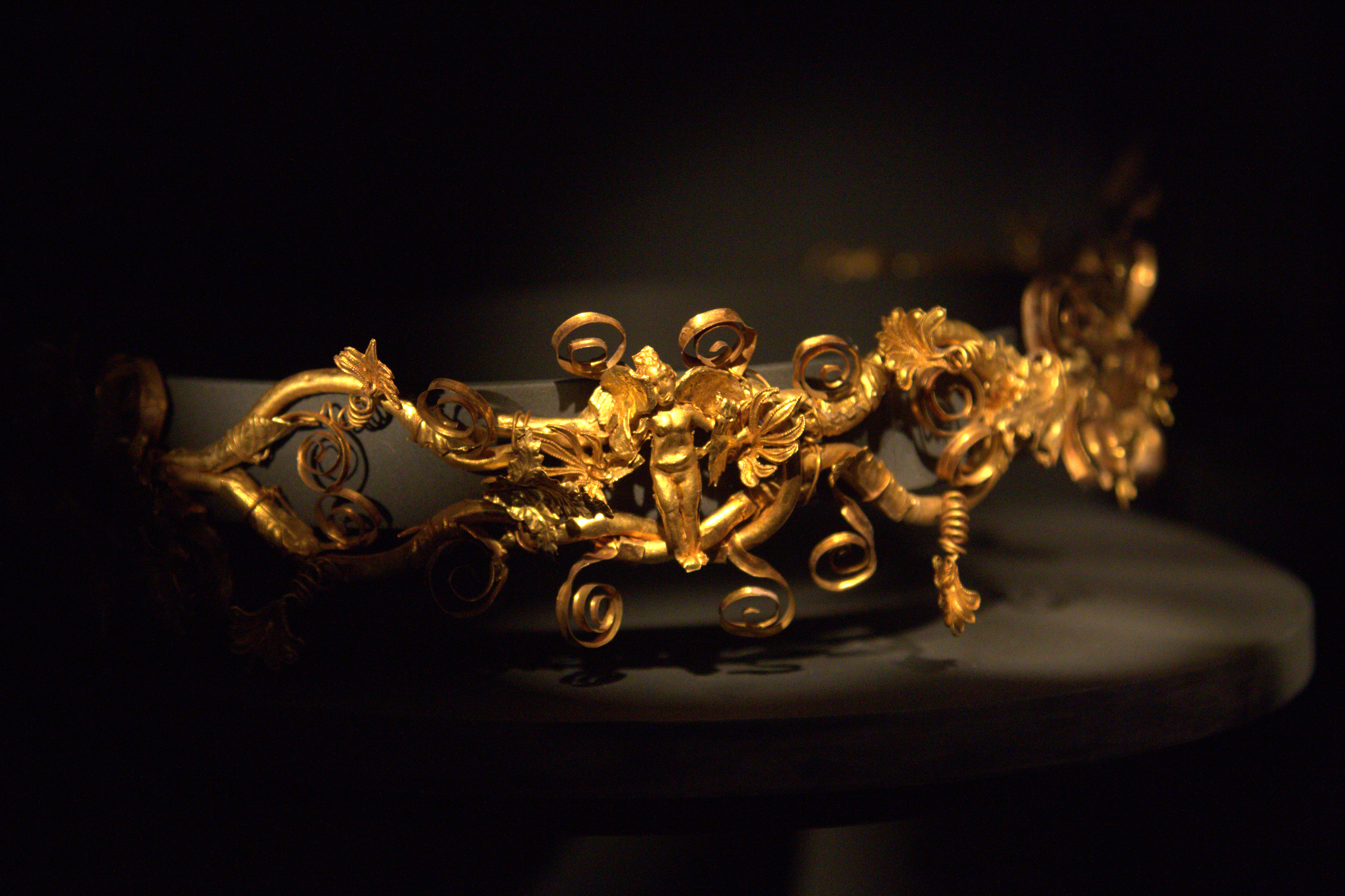
Most cultures bury their dead with what they value, and Macedonians valued gold. The Gold of Macedon exhibition in the museum's new wing pulls together finds from cemeteries across central Macedonia: Sindos, Agia Paraskevi, Nea Filadelfia, Derveni, Lete, Serres. The Sindos burials alone yielded bronze helmets, gold masks, and grave goods so rich that the cemetery rewrote our understanding of Archaic Macedonian culture. A gold diadem of eight lyre-shaped sections, dated 320 to 300 BC, is so finely worked that the acanthus tendrils seem to grow from the metal. There are gold disks, gold Medusa heads, golden wreaths shaped from individual leaves and berries. The exhibition does not just show the objects: it walks visitors through how the gold was mined, smelted, and fashioned, and how burial customs across the kingdom shaped what ended up in the ground. These were not pharaohs. These were Macedonian aristocrats, and they took their wealth with them.
What the Krater Held
The Derveni Krater is the museum's most famous single object, and looking at it explains why. Recovered from a tomb at Derveni in 1962, the bronze and tin vase stands about ninety centimeters tall and is covered in repousse figures of Dionysus and Ariadne, satyrs, maenads, and at the center a young man identified as Pentheus dressed as an armed hunter, the king who would soon be torn apart by his own mother in a Bacchic frenzy. It dates to the late fourth century BC. From the same tomb came the Derveni Papyrus, the oldest surviving European book, a philosophical commentary on an Orphic poem that survived because it had been thrown on a funeral pyre and the carbonized fragments were preserved by fire. Most papyrus from this period survived only in Egyptian sand. Derveni gave us a different miracle: a Greek philosophical text that should have been impossible to read, scorched in a tomb in northern Greece and recovered in legible pieces.
Faces of a City That Kept Changing
Thessaloniki was founded in 315 BC by Cassander, who named it for his wife, the half-sister of Alexander the Great. An inscription in the museum reads simply: To Queen Thessalonike, Daughter of Philip. The city kept reinventing itself. The central sculpture rooms hold architectural members from a sixth-century BC Ionic temple, marble portraits from the Hellenistic period, and an entire reconstruction of the facade of the Macedonian tomb at Agia Paraskevi. Then come the Roman rooms: a marble Augustus, a head of Serapis from the second century BC, the Celtic horse goddess Epona introduced to Thessaloniki probably by Galerius. There are portraits of philosophers, family relief panels showing parents and children, the head of an old man rendered with such weathered specificity that you wonder who he was. The mosaic depicting Winter, third century AD, is from the floor of a wealthy Roman house. Each of these objects belonged to someone.
A Statue in Police Custody
The museum's strangest recent acquisition arrived through a police raid. On 26 February 2010, Greek authorities arrested two men holding a cache of looted antiquities, including a bronze statue of Alexander the Great that experts thought might be an original work of Lysippos, the only sculptor Alexander permitted to portray him in bronze. If authentic, it would be the first Lysippos original ever recovered. The piece is being studied at the museum's laboratory. The story is a reminder that Macedonian gold did not stop circulating when the kingdom fell. It is still being dug up, still being looted, still being argued over. The museum is one of the places that argument happens, with care, behind closed doors, with a statue that may or may not be the most important Greek bronze ever found.
From the Air
Located at 40.625N, 22.954E in central Thessaloniki, near the seafront on Stratou Avenue. Recommended viewing altitude 4,000 to 6,000 feet for a clear sense of the city wrapping the Thermaic Gulf and the foothills of Mount Hortiatis to the east. The White Tower, the Rotunda of Galerius, and the Roman Forum are all within walking distance and visible from above as a connected line of monuments. Nearest airport is Thessaloniki Makedonia (LGTS), about 17 kilometers southeast on the coast. Mount Olympus is visible to the southwest in clear weather across the gulf, about 80 kilometers away.