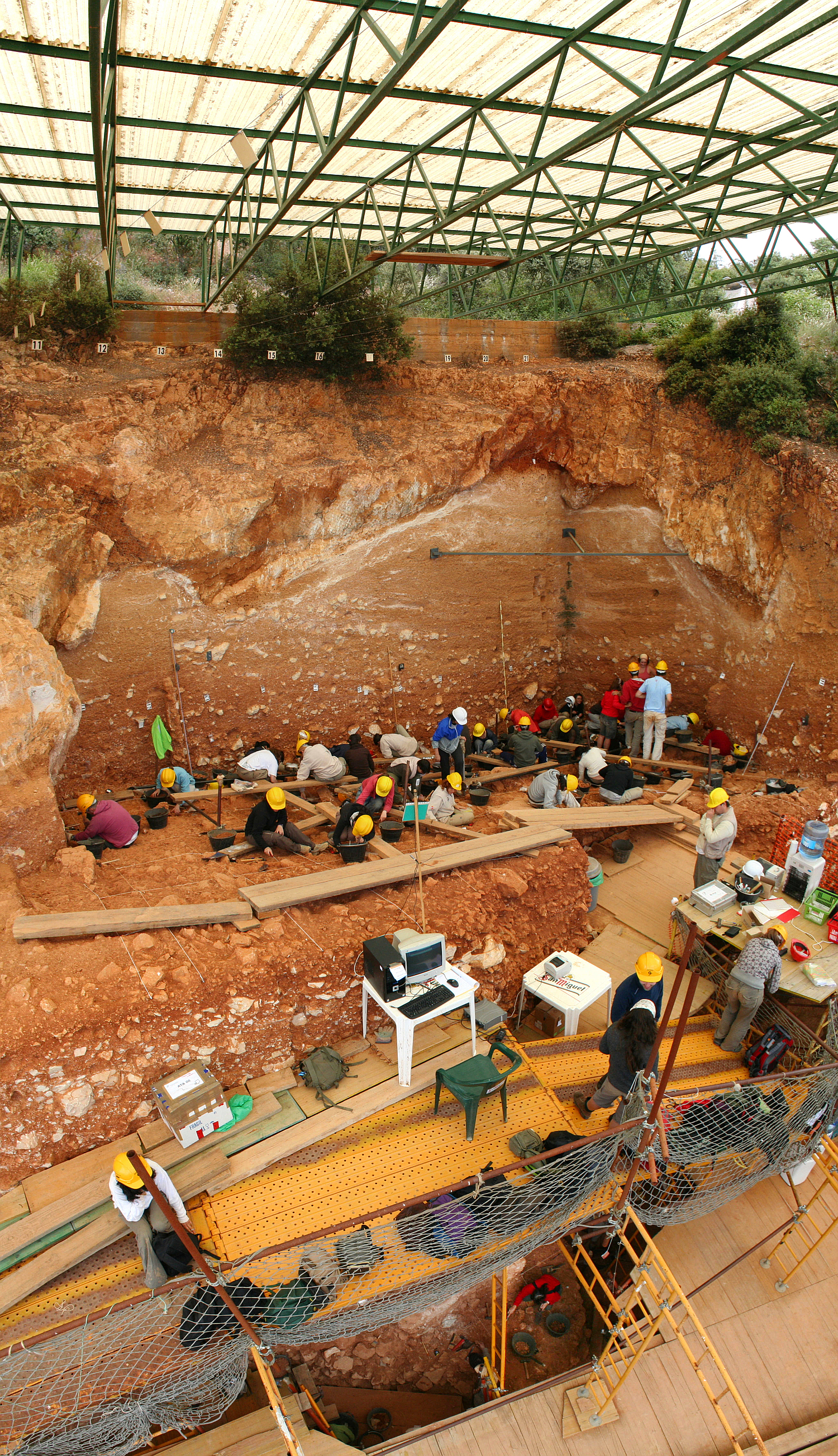
Archaeological Site of Atapuerca
It took a railway to reveal what lay beneath the Sierra de Atapuerca. When engineers in the early twentieth century blasted a narrow-gauge line through these low hills near Burgos, their cuttings sliced through layers of sediment that recorded more than a million years of human habitation. Bones, tools, and the unmistakable marks of butchering -- on human bones, by human hands -- emerged from the exposed rock. Atapuerca is now a UNESCO World Heritage Site and arguably the most important paleoanthropological complex in Europe, a place where the story of who we are keeps getting longer and stranger with every summer's dig.
The Pit of Bones
The Sima de los Huesos -- the Pit of Bones -- lies deep within the cave system, accessible only through a narrow shaft. Since 1997, excavators have recovered more than 5,500 skeletal fragments from at least 28 individuals of Homo heidelbergensis, deposited there at least 350,000 years ago. This single site contains roughly ninety percent of the entire known fossil record for the species. The finds include Skull 5, nicknamed Miguelon, one of the most complete early human crania ever discovered. A pelvis found nearby was dubbed Elvis. The remains of a child with craniosynostosis, a skull deformity, dated to 530,000 years ago, provides evidence that early humans cared for individuals with disabilities -- a finding that reshapes assumptions about compassion in deep prehistory.
The Oldest Cannibals
Level TD-6 of the Gran Dolina cavern, known as the Aurora stratum, has yielded over 160 bone fragments from at least eleven hominids, dated between 850,000 and 780,000 years ago. These are at least 250,000 years older than any other hominid remains found in Western Europe. More than thirty percent of the bones show manipulation marks -- cut marks, scraping, deliberate breakage -- identical to the processing marks found on animal bones in the same layer. The evidence for cannibalism is unmistakable. Whether it was ritual, nutritional, or something else entirely remains debated. The hominids themselves are classified provisionally as Homo antecessor, a species that may be ancestral to both Homo heidelbergensis and the Neanderthals.
The Oldest Face in Europe
In July 2022, archaeologists announced the discovery of a 1.4-million-year-old jawbone -- a maxilla with a tooth -- from the Sima del Elefante excavation site. Over two years of study, an interdisciplinary team restored the fossil and dated it to between 1.4 and 1.1 million years ago. It represents the oldest human face identified in Western Europe. Paleoanthropologist Eudald Carbonell, co-director of the excavations, has proposed assigning the remains to Homo aff. erectus, a designation indicating a species closely related to but potentially distinct from Homo erectus. This discovery, along with a 1.2-million-year-old jawbone and tooth found in 2007 and 2008, confirms that hominids were making and using tools in this part of Europe more than a million years ago.
DNA from the Deep Past
Atapuerca has pushed the boundaries of ancient DNA research. In 2013, mitochondrial DNA was extracted from a 400,000-year-old femur found in the Sima de los Huesos -- the oldest hominin mtDNA recovered at the time. The results were baffling: the DNA was closer to that of Denisovans, a mysterious hominin group known primarily from a cave in Siberia, than to Neanderthals. Nuclear DNA analysis in 2016 clarified the picture, confirming the Sima hominins were indeed Neanderthals and that the Neanderthal-Denisovan split occurred before 430,000 years ago. In 2019, analysis of Neanderthal teeth from the site suggested that modern humans and Neanderthals diverged from a common ancestor more than 800,000 years ago -- far earlier than previously estimated.
From Railway Cut to World Heritage
Today, the finds from Atapuerca are displayed at the Museum of Human Evolution in Burgos, roughly 16 kilometers to the west. The site itself is managed through a network of visitor centers and research facilities, including the CAYAC access center in Ibeas de Juarros and the CAREX experimental archaeology center in the village of Atapuerca. From the air, the Sierra de Atapuerca is unassuming -- a line of low, scrub-covered hills that give no hint of what they contain. The old railway cutting, now disused, is visible as a pale scar through the vegetation. It is a reminder that the most consequential discoveries sometimes come from the most mundane activities: building a railway, moving dirt, and paying attention to what the earth gives up.
From the Air
Located at 42.35°N, 3.52°W in the Sierra de Atapuerca, approximately 16 km east of Burgos in northern Spain. The site is in low hills -- terrain is not mountainous. Best viewed at 3,000-5,000 ft AGL. The old railway cutting may be visible as a linear feature through the hills. Nearest airport: Burgos (LEBG). The city of Burgos and its cathedral are prominent landmarks to the west.