Archaeological Site of Carthage
"We know nothing about Carthage," Gustave Flaubert complained in 1858, and the novelist had a point. For over a millennium after the Arab conquest of 698, the ruins of one of antiquity's greatest cities served as little more than a marble quarry. Columns were stripped for the Zitouna Mosque in Tunis. Building stone traveled as far as the Cathedral of Pisa. Lime kilns consumed what could not be hauled away whole. When archaeologists finally arrived in the late 19th century, they found fragments -- magnificent fragments, but fragments nonetheless -- scattered across a modern suburb where Roman villas sit beneath apartment buildings and Punic tombs lie under parking lots.
A Ship at Anchor
The ancient geographer Strabo compared Carthage to a ship at anchor, and the metaphor holds when you see the site from above. The ancient city occupied a triangular peninsula at the bottom of the Gulf of Tunis, sheltered by the promontory of Sidi Bou Said and flanked by the Lake of Tunis and the Sebkha Ariana. Hills provided natural defense, and the sea offered escape. At its center rose Byrsa, the hill where Queen Dido supposedly staked her ox-hide claim, which became the site of the Punic citadel and later the Roman forum. Today Byrsa is crowned by the massive silhouette of the Acropolium, a former cathedral built in the 1890s on the presumed site where the French King Louis IX died during the Eighth Crusade in 1270.
Layers Upon Layers
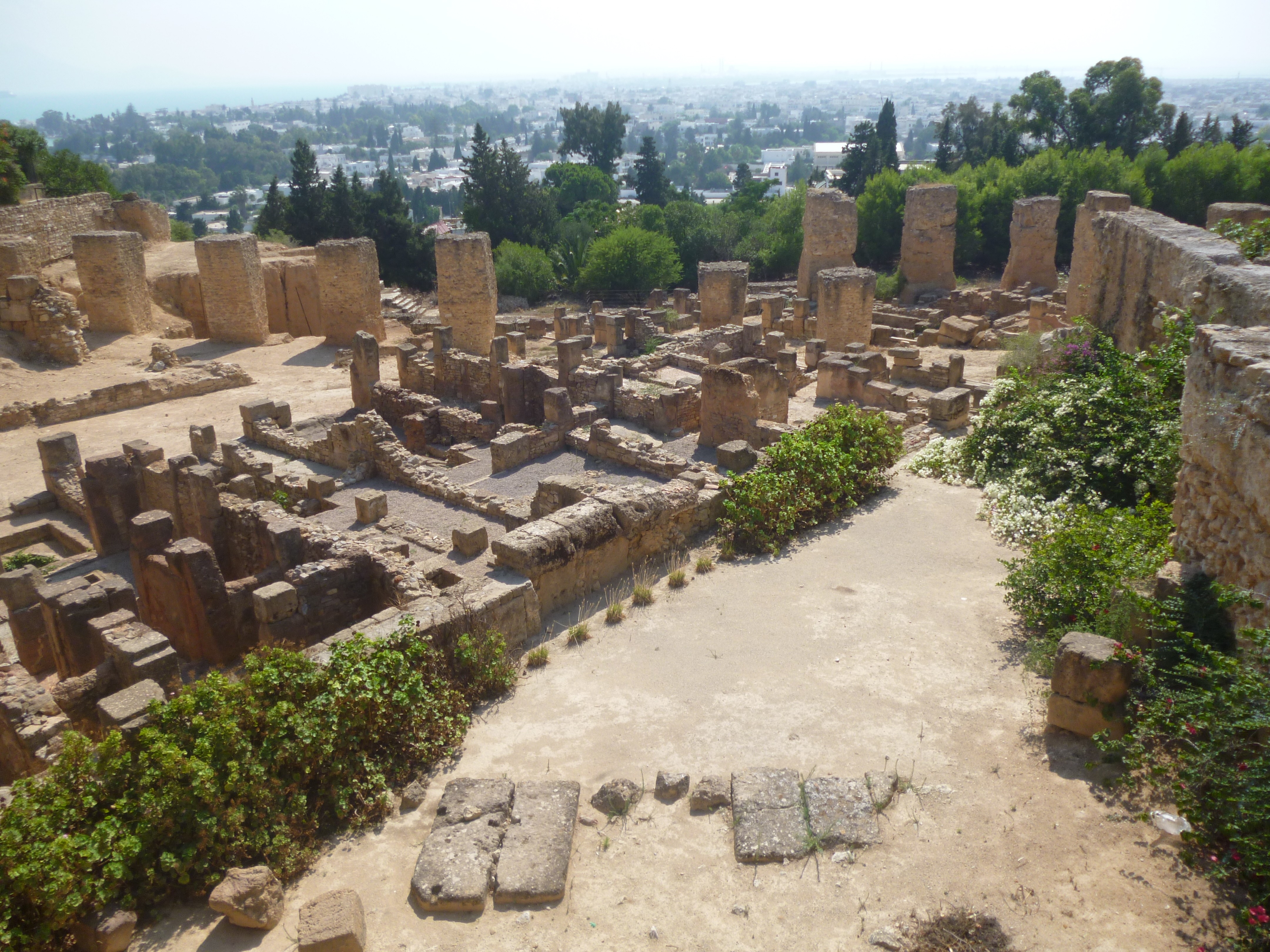
The archaeological site encompasses remains from every period of Carthage's history, and the challenge for visitors is their extreme dispersion across a modern residential city. On the southern flank of Byrsa, French archaeologist Serge Lancel uncovered a Punic residential quarter from the early 2nd century BC -- the last century before Rome destroyed the city. The houses follow a stereotyped plan: a shop on the street, a cistern in the basement, a long corridor leading to a courtyard with small rooms arranged around it. Some floors retain their original pavimenta punica -- mosaic patterns in characteristic red mortar. These dwellings survived because the Romans buried them under massive embankments when they leveled Byrsa to build their forum, inadvertently preserving what they intended to erase.
What the Romans Built
When Augustus refounded Carthage in 29 BC as Colonia Iulia Concordia Carthago, he created a showcase of Roman civilization. The city grew to 300,000 inhabitants and became the breadbasket of Rome, exporting vast quantities of wheat and olive oil. Its public buildings were monumental: the Baths of Antoninus, built between 145 and 162 AD, were the largest thermal complex in Africa and among the three largest in the entire Roman Empire. A single re-erected column of the frigidarium gives a sense of scale -- the vanished vaults once rose 29 meters, the height of a six-story building. The theater, designed for 5,000 spectators, hosted performances that dazzled the writer Apuleius with their marble splendor. Today it serves as the venue for the annual International Festival of Carthage.
Sacred Ground and Contested Memory
Near the ancient Punic ports lies the tophet of Salammbo, perhaps the most controversial site in all of Mediterranean archaeology. This sacred enclosure, dedicated to the deities Tanit and Ba'al Hammon, contained thousands of urns holding the cremated remains of children. Whether these children were sacrificed -- as Greek and Roman authors claimed -- or simply buried after dying of natural causes remains fiercely debated among scholars. The steles that mark the burials, carved from El Haouaria sandstone, bear dedications that are formulaic and revealing: "To the great lady Tanit and to the lord Baal Hammon, what so-and-so has offered." The site was in continuous use for six centuries, and some 20,000 urns have been discovered across its various strata.
Rescue and Reckoning
By the 1970s, rapid suburban development threatened to obliterate what remained. The construction of modern villas and roads was consuming archaeological layers that had survived millennia of quarrying. Tunisian archaeologists sounded the alarm, and UNESCO launched a massive international campaign from 1972 to 1992 that brought teams from across the world to excavate and preserve the site. The campaign confirmed the Punic origin of the harbor lagoons, uncovered the Magon quarter with its 5th-century BC rampart, and produced detailed stratigraphies of the tophet. Carthage was designated a World Heritage Site in 1979. The challenge now is balancing preservation with the daily life of the thousands of Tunisians who live among the ruins -- a modern city built on the bones of an ancient one, still yielding surprises with every foundation trench.
From the Air
The archaeological site is dispersed across the modern suburb of Carthage at approximately 36.85°N, 10.33°E, on the Gulf of Tunis. Key landmarks visible from altitude include the Byrsa hill topped by the Acropolium, the two Punic port lagoons (one circular, one rectangular), and the Baths of Antoninus along the shoreline near the Presidential Palace. Tunis-Carthage International Airport (DTTA) lies about 3 km southwest. Best viewed at 2,000-4,000 feet for the relationship between ancient ruins and modern urban fabric.