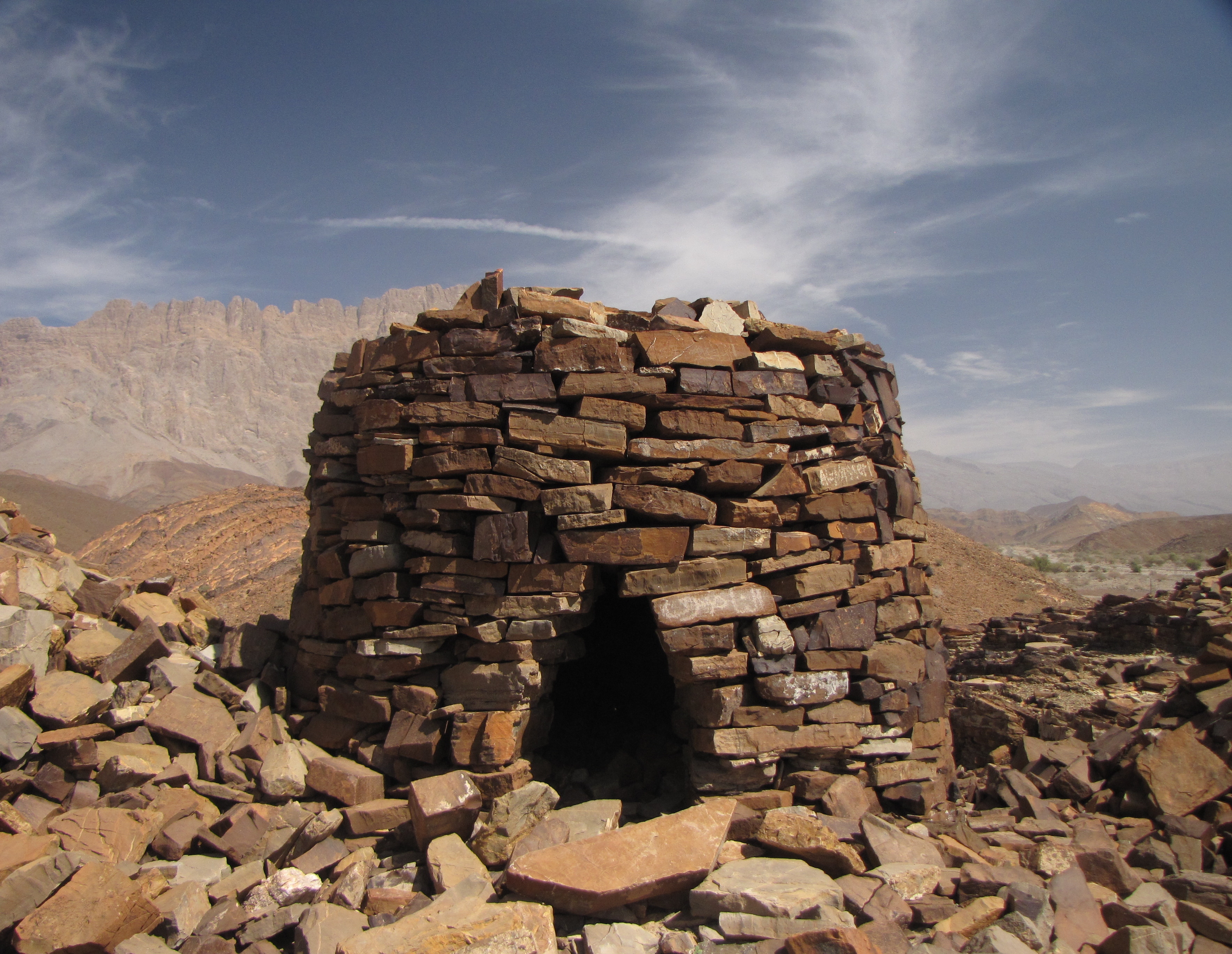
Archaeological Sites of Bat, Al-Khutm and Al-Ayn
No one knows what the circular buildings at Bat were for. Each one is about 20 meters in diameter. None has an outside opening. Archaeologists have suggested they served a ritual purpose, or stored grain like silos, or held water like cisterns. The honest answer is that five thousand years later, we simply cannot say. What we do know is that around 3000 BC, the people who built them were trading copper and diorite stone with the Sumerians of Mesopotamia, which means these remote structures in the Omani interior were connected to one of the earliest civilizations on earth.
Three Sites, One Story
The Archaeological Sites of Bat, Al-Khutm, and Al-Ayn form a constellation across the Omani landscape. Bat itself sits inside a date palm grove, the main site containing about 100 graves and those enigmatic circular buildings. Al-Khutm lies 2 kilometers to the west, where ruins of what appears to have been a stone fort include a rock tower 20 meters across. Al-Ayn, the smallest and best-preserved of the three necropolises, perches 22 kilometers to the southeast. Together they were inscribed as Oman's second UNESCO World Heritage Site in 1988, one year after Bahla Fort. The sites date to the Hafit period in the 3rd millennium BC, making them among the oldest documented human settlements in the region.
The Danish Excavation
In 1972, a Danish archaeological team led by Karen Frifelt began excavations at Bat that transformed understanding of the site. Her work demonstrated that the area had been continuously inhabited for 4,000 years, from the Bronze Age settlements through to later occupations. The beehive tombs -- stone structures with corbelled roofs that do indeed resemble hives -- contained burial goods that pointed to a trading community with connections reaching far beyond Arabia. The locally extracted copper was a valuable commodity in the ancient world, and the diorite stone found at the site matched material used in Sumerian construction. These were not isolated desert dwellers. They were participants in an international economy older than the pyramids of Egypt.
Protection by Abandonment
Before UNESCO designation in 1988, the archaeological sites had never been formally conserved or restored. Their isolation in the interior of Oman was, paradoxically, their best protection. No road ran through them. No city grew around them. The tombs and towers sat in the landscape much as their builders had left them, weathered by wind and time but undisturbed by development. That isolation has come with a cost: locals have sometimes taken building material from the ancient structures for their own construction. A new road connecting Ibri in Oman to Al-Ahsa in eastern Saudi Arabia, completed in September 2021, now passes through the area. The road measures approximately 160 kilometers on the Omani side and 580 kilometers on the Saudi side. It brings economic opportunity, but also brings the modern world closer to sites that have survived by being far from it.
Listening to the Stone
The beehive tombs at Al-Ayn remain in the best condition of the three sites, their stone walls still holding their distinctive rounded shapes against the desert sky. Walking among them, the scale is intimate rather than monumental. These are human-sized structures built for human purposes: burial, perhaps worship, perhaps something we have lost the vocabulary to describe. The circular buildings at Bat continue to resist explanation. Future excavation may provide answers, or it may deepen the mystery. For now, these sites stand as a reminder that Oman's interior -- so often dismissed as empty desert -- has been a place of sophisticated human activity for at least five millennia.
From the Air
Located at 23.27N, 56.75E in Oman's interior, near the town of Ibri. The sites are spread across an arid landscape with date palm groves. Nearest major airport is Muscat International (OOMS), approximately 250 km northeast. The terrain is flat to gently rolling desert. A new road to Saudi Arabia now passes through the area.