Archaeology of Igbo-Ukwu
In 1938, a man named Isaiah Anozie was digging in his compound in Igbo-Ukwu, a small Igbo town in southeastern Nigeria's Anambra State, when his shovel struck metal. What he pulled from the earth would take decades to be understood, but it would eventually reshape the history of African art. The bronzes of Igbo-Ukwu, dated to the ninth century, are among the most technically sophisticated castings ever produced anywhere in the world at that time. Art historians have compared them to the finest rococo jewelry of Europe and to the work of Faberge, except that they predate those traditions by centuries. They were created not by a centralized kingdom with royal workshops but by an egalitarian, decentralized Igbo society, a fact that challenged everything colonial-era scholars believed about who was capable of such work.
A Backyard Full of Masterpieces
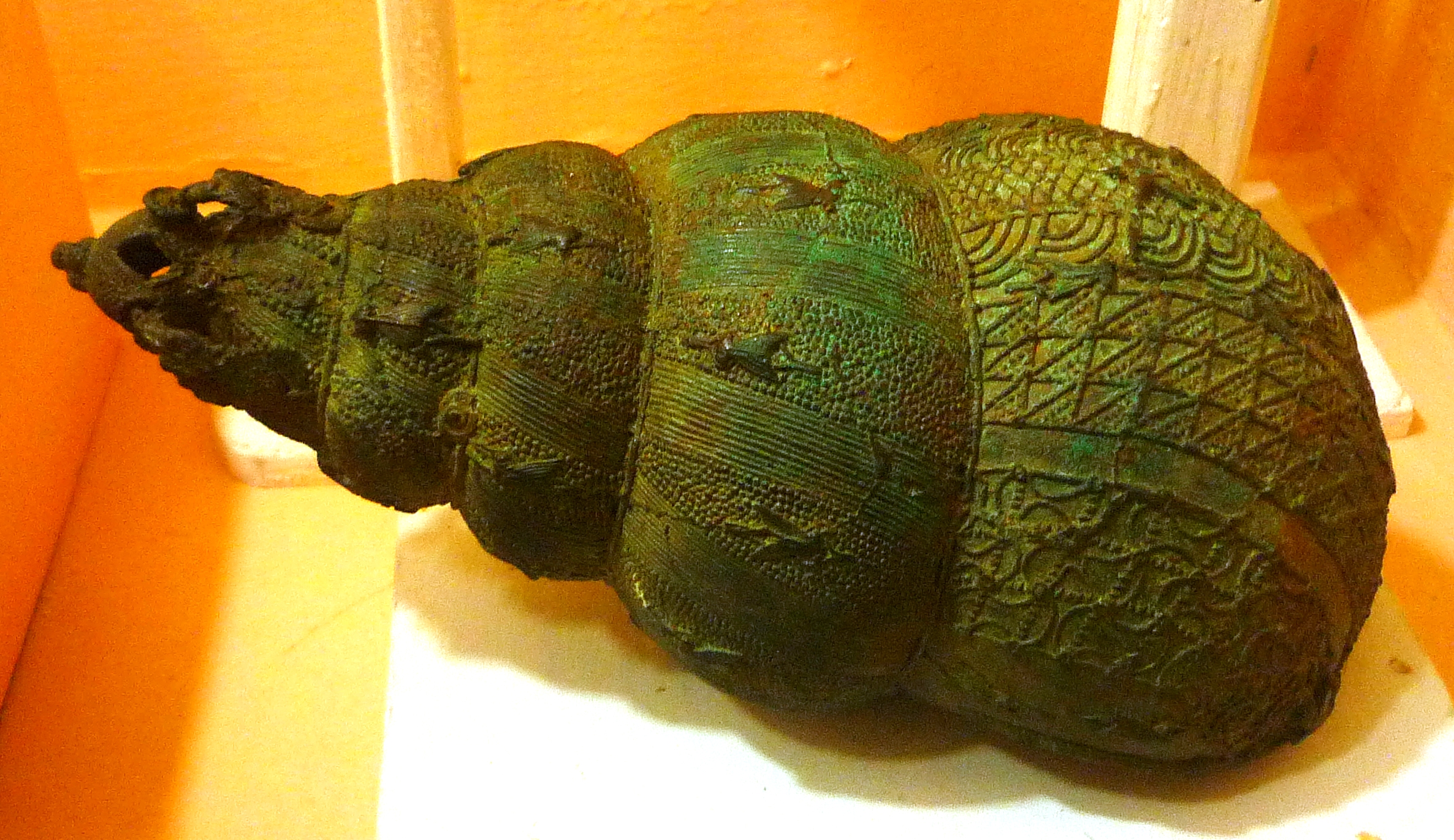
Anozie handed his finds to the Nigerian Department of Antiquities in 1946. Other artifacts from his compound were collected by Kenneth Murray, a Surveyor of Antiquities, in 1954. But it was archaeologist Charles Thurstan Shaw who opened three formal excavation sites between 1959 and 1964, naming them Igbo Richard, Igbo Isaiah, and Igbo Jonah. What emerged was staggering: more than 700 high-quality artifacts of copper, bronze, and iron, along with approximately 165,000 glass, carnelian, and stone beads, plus pottery, textiles, ivory beads, cups, and horns. The bronzes included ritual vessels, pendants, crowns, breastplates, staff ornaments, swords, and fly-whisk handles. One water pot, set within a mesh of simulated rope cast entirely in bronze, astonished specialists. The surface detail was so fine that tiny insects appeared to have landed on the metal, though they were not attached separately but cast as part of the original piece.
An Exquisite Explosion
The art world struggled to place what Shaw had found. Peter Garlake compared the bronzes to the finest jewelry of rococo Europe or of Carl Faberge. William Buller Fagg described their strange, almost Faberge-type virtuosity. Frank Willett argued that they achieved a standard comparable to that established by Benvenuto Cellini, the Renaissance master goldsmith, five hundred years later. Denis Williams called them "an exquisite explosion without antecedent or issue." The initial reaction in some academic circles was disbelief. Scholars speculated that the bronzes must have been created after European contact, positing phantom voyagers who might have introduced the techniques. Isotope analysis demolished that theory. The metals were of local origin, and radiocarbon dating confirmed a ninth-century date, long before any European reached the region.
Local Metal, Distant Glass
Between 85 and 90 percent of the copper ore used to produce the bronzes originated from mines near Abakaliki, about 100 kilometers from Igbo-Ukwu. The alloys are chemically distinctive, with an unusually high silver content that sets them apart from bronze traditions in Europe, the Mediterranean, and other African centers. A small percentage of the ore may have come from secondary sources, possibly including North African locations like Tunisia or Morocco, based on lead isotope analysis. But the most dramatic evidence of long-distance connection came from the beads. Analysis of 138 glass beads revealed that the most common type was soda-lime glass produced using plant ash, a composition consistent with glassmaking traditions in Mesopotamia and eastern Iran. These beads likely traveled along the eastern Niger corridor by the ninth or tenth century, evidence of trade networks that linked this corner of southeastern Nigeria to the wider world.
Overturning Colonial Assumptions
The Igbo-Ukwu finds dismantled a framework of colonial-era assumptions. Scholars had long held that sophisticated metalwork in sub-Saharan Africa must have originated through contact with Europe or the Mediterranean, and that complex artistic production required hierarchical, centralized states. The Igbo, however, operated in an acephalous society, one without kings or centralized authority. Their political organization was egalitarian and community-based. That such a society produced bronzes rivaling anything in the contemporary world forced a fundamental reassessment of what kinds of social structures could generate technical and artistic achievement. Archaeological evidence of iron smelting in the broader region reinforced the point: furnaces dating to 2000 BC have been excavated at Lejja and to 750 BC at Opi, both in the Nsukka region about 100 kilometers from Igbo-Ukwu. The metallurgical tradition here was ancient, deep-rooted, and entirely indigenous.
From the Air
Located at 6.02N, 7.02E in Anambra State, southeastern Nigeria. The town of Igbo-Ukwu is a small settlement in the Igbo heartland, not directly visible as a landmark from altitude, but the surrounding terrain of southeastern Nigeria with its dense vegetation and scattered settlements is characteristic. Nearest major airport is Akanu Ibiam International Airport (DNEN) at Enugu, approximately 80km to the north. The Niger River lies to the west. Onitsha, a major city on the Niger, is about 50km northwest. Best viewed at 3,000-8,000 feet where the settlement pattern of the Igbo region is visible.