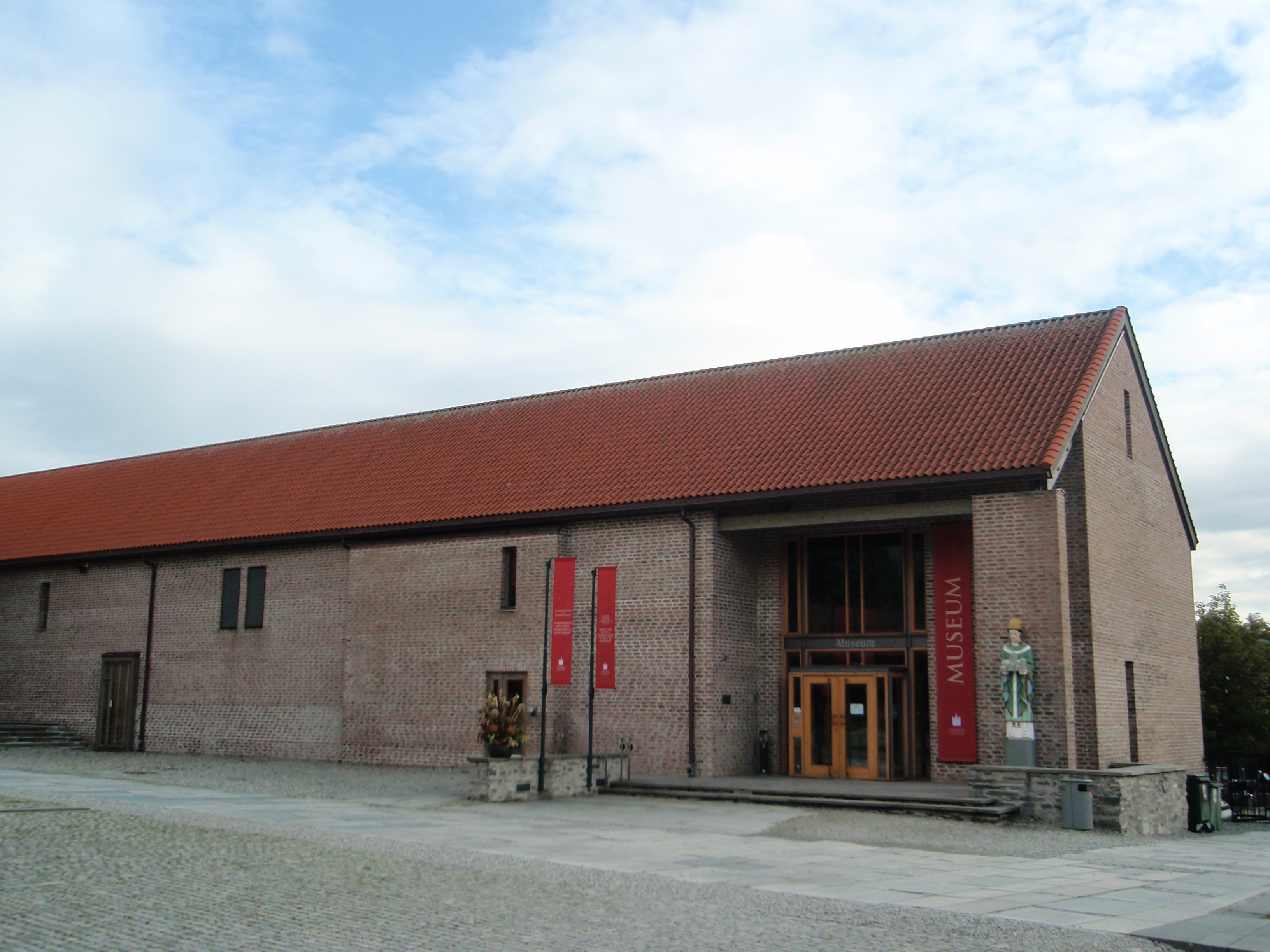
Archbishop's Palace, Trondheim
The Norwegian Crown Jewels sit behind glass in the western wing of a building that was old when they first arrived. The Archbishop's Palace in Trondheim -- Erkebispegarden in Norwegian -- stands just south of Nidaros Cathedral, and the two structures share more than proximity. Both were built to project the authority of the medieval church in Norway's spiritual capital, and both have survived centuries of fire, reformation, military occupation, and political upheaval to remain in active use. The palace is one of the largest medieval stone structures in Scandinavia, its oldest walls dating to the thirteenth century, and its purpose has shifted with every era of Norwegian history: from ecclesiastical seat to royal residence to military arsenal to the museum complex visitors walk through today.
The Archbishops' Fortress
For roughly three hundred years, the palace served as the seat, residence, and administrative center of the Archbishop of Nidaros -- the most powerful churchman in Norway. The archbishops expanded the complex gradually across the medieval period, adding great halls and residential quarters as their authority grew. Stone walls thickened. Courtyards multiplied. The building accumulated the mass and defensibility of a fortress, because that is partly what it was. Medieval archbishops were political figures as much as religious ones, and Trondheim's archbishop commanded resources, military retainers, and strategic position. The last Catholic archbishop of Norway, Olav Engelbrektsson, understood this better than most. When the Protestant Reformation reached Norway in the 1530s, he attempted to make a final stand at the palace, defending both his faith and his power. He failed, and fled into exile -- the last man to hold the office that had given the building its name and its purpose.
Crown and Garrison
After the abolishment of Roman Catholicism in Norway, the palace became royal property. The local lensherre -- essentially a feudal governor -- took up residence, and the buildings were restored and expanded to serve their new function. Over time, the palace shifted from civilian residence toward military use, with considerable new construction accommodating its role as an arsenal and garrison. The Sovereignty Act of 1660, which consolidated absolute royal power in Denmark-Norway, brought another transition: the palace became the seat of the amtmann, the Crown's regional administrator. Each change layered new architecture onto old, burying the medieval core under baroque additions and military fortifications. The building became a palimpsest of Norwegian governance -- church, crown, and army each leaving their mark in stone.
Digging Through Time
In the 1950s, archaeologists Nicolay Nicolaysen and Gerhard Fischer led substantial excavations that began to untangle the palace's layered history. Their work revealed the extent of the medieval structures hidden beneath later construction and provided the foundation for careful restorations. The archaeology confirmed what the written records suggested: this was not a single building but a complex that had grown organically over centuries, each generation adding to and modifying what the previous one had built. The restorations that followed sought to make this layering visible rather than to freeze the palace at any single historical moment. Today, visitors can read the building's history in its walls -- thirteenth-century stonework abutting seventeenth-century brickwork, medieval window openings framing modern museum displays.
Regalia and Festivals
The Regalia of Norway -- the crowns, orbs, and scepters used in royal ceremonies -- have been kept in the palace's western wing at various times since 1826 and have been on permanent display since 2006. Housing the crown jewels in a medieval archbishop's palace rather than, say, a modern vault is a choice that connects Norway's current monarchy to the deep history of the building and the city. Trondheim was Norway's first capital and remains its ceremonial heart; kings are still consecrated at Nidaros Cathedral next door. Beyond the regalia, the palace hosts several museums and serves as a venue for Olavsfestdagene, Trondheim's annual festival celebrating St. Olav, the Viking king whose death in 1030 made him Norway's patron saint and made Trondheim a pilgrimage destination. The palace has outlived every institution that built it, and found new purposes with each.
From the Air
Located at 63.43N, 10.40E in central Trondheim, immediately south of the distinctive Nidaros Cathedral with its Gothic spires. The palace complex is visible as a large stone courtyard structure adjacent to the cathedral. Best viewed at 1,500-2,500 feet AGL, where the palace-cathedral complex, the Nidelva river bend, and Trondheim's historic center are all visible. Nearest airport: Trondheim Airport Vaernes (ENVA), approximately 22 km east-northeast. The airport is connected to the city by rail and road along the south shore of the Trondheimsfjord.