Archdiocese of Beijing
In 1307, a Franciscan friar named John of Montecorvino stood in Khanbaliq, the capital of the Mongol Yuan dynasty, and received a title from Pope Clement V that would have seemed fantastical to most Europeans: Archbishop of a city at the far end of the known world. The archdiocese he established was one of the most remote outposts of medieval Christendom, separated from Rome by thousands of miles of steppe, desert, and sea. It survived just sixty-eight years before being suppressed in 1375. When Catholicism returned to Beijing three centuries later, it carried the weight of that earlier attempt and the knowledge that empires, both spiritual and temporal, have always struggled to maintain their grip on this city.
Montecorvino's Impossible Mission
John of Montecorvino arrived in China around 1294, having traveled overland through Persia and by sea through India. He was not the first European to reach the Mongol court, but he was the first to establish a lasting Catholic presence. Pope Clement V appointed him Archbishop of Khanbaliq in 1307 and sent auxiliary bishops to assist him, though several died en route in India, a reminder of how perilous the journey was. The archdiocese initially oversaw a diocese as far away as Quanzhou (Citong) on the southern coast. Montecorvino reportedly baptized thousands and built churches, but the Catholic presence was always thin, dependent on Mongol tolerance and the ability of friars to survive the journey east.
Three Centuries of Silence
When the Yuan dynasty fell in 1368 and the Ming dynasty took power, the archdiocese collapsed. By 1375, it had been formally suppressed. For over three hundred years, no Catholic bishop administered in Beijing. The revival came on April 10, 1690, when the Diocese of Beijing was established on territory carved from the Apostolic Vicariate of Nanjing. Its first bishop, the Franciscan Bernardino della Chiesa, arrived to find a city that had changed dynasties twice since Montecorvino's time. The Jesuits, led by figures like Matteo Ricci and Johann Adam Schall von Bell, had already established a foothold at the imperial court, and the cathedral they built, the Nantang, became the seat of the revived diocese.
An Empire of Territorial Losses
The history of the Archdiocese of Beijing reads like an atlas of partition. Over the centuries, the diocese repeatedly lost territory as new vicariates were carved from its jurisdiction: Korea in 1831, Liaodong in 1838, Shandong in 1839, southwestern Zhili in 1856. Each new vicariate represented both the growth of the Catholic Church in East Asia and the shrinking of Beijing's direct authority. In 1856, the diocese was even demoted to an apostolic vicariate. It was not restored to archdiocese status until 1946, the year the Chinese civil war was intensifying toward its conclusion.
Between Two Authorities
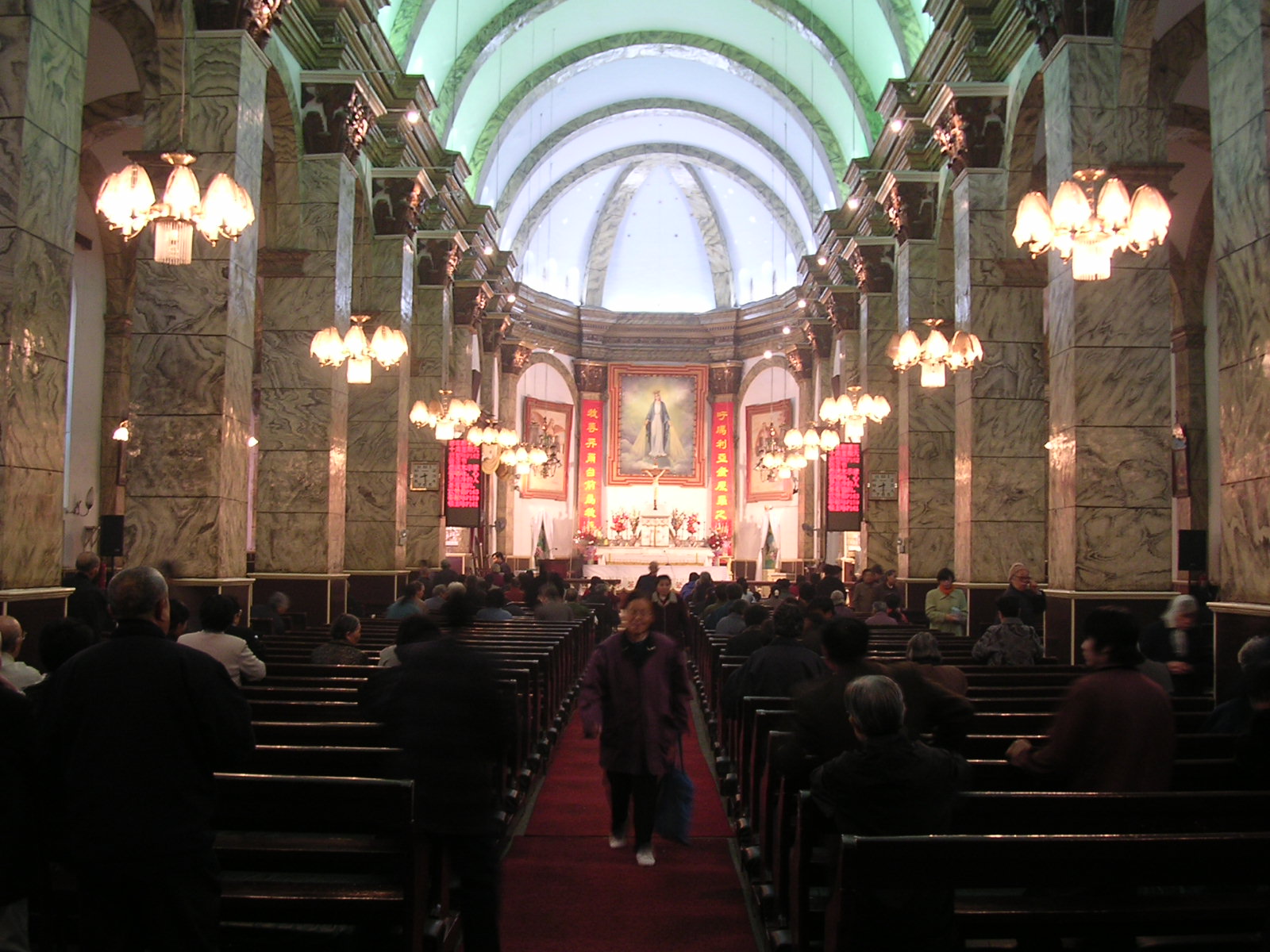
The archdiocese today navigates one of the most complex religious-political situations in the world. Its boundaries, as defined by the Chinese government, cover the provincial-level municipality of Beijing; the Vatican's historical boundaries extend into neighboring Hebei. The current archbishop, Joseph Li Shan, installed in September 2007, is one of the few Catholic bishops recognized by both the Vatican and the Chinese Catholic Patriotic Association, the government-supervised body that oversees Catholic affairs in China. The cathedral has alternated between the South Church, the Cathedral of the Immaculate Conception, and the North Church, the Church of the Saviour, which became the cathedral again in 2018 after renovations. Seven centuries after Montecorvino, the archdiocese endures, shaped by the same tension between universal faith and sovereign power that defined it from the start.
From the Air
Located at 39.90°N, 116.37°E in central Beijing, near the Cathedral of the Immaculate Conception (South Church) in Xicheng District. Nearest airport: Beijing Capital International (ZBAA), approximately 25 km northeast. The cathedral is a Baroque-style building dating from 1904, located near Beijing Financial Street, but is not individually visible from cruising altitude.