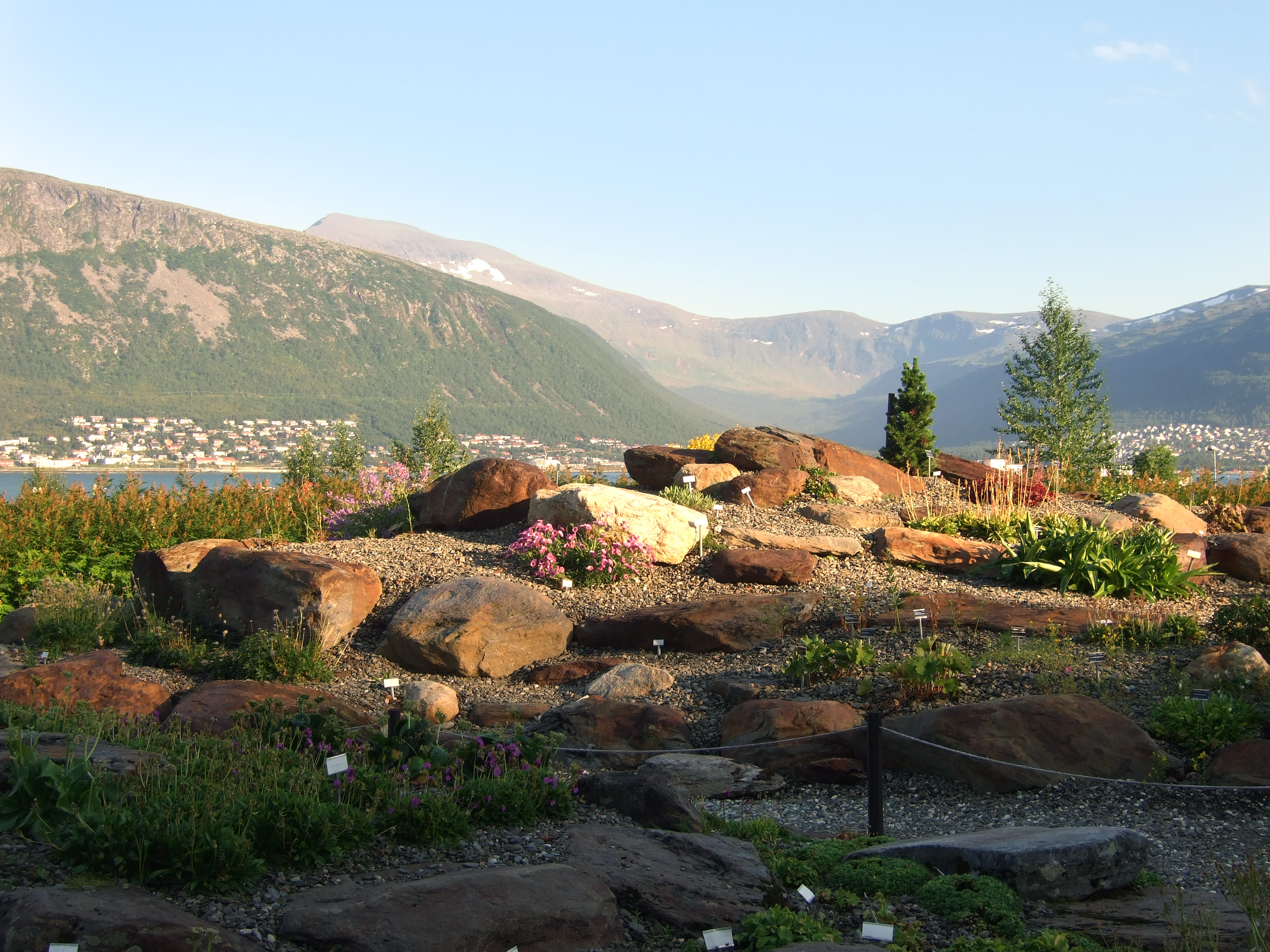
Arctic-Alpine Botanic Garden
There is no gate. There is no ticket booth, no opening hours, no closing time. The Arctic-Alpine Botanic Garden in Tromso, Norway, is open every hour of every day of the year, which means that in midsummer you can walk among Himalayan blue poppies at two in the morning under a sun that refuses to set, and in midwinter you can crunch through the same paths in polar darkness, the plants sleeping beneath snow. It is the world's northernmost botanic garden, and the fact that it exists at all is a quiet defiance of what this latitude is supposed to allow.
A Garden at the Edge of the World
Tromso sits at 69.68 degrees north, a latitude that corresponds roughly to the north coast of Alaska. The intuition is that nothing should bloom here but lichen and hardy grasses. Yet a branch of the Gulf Stream sweeps up the Norwegian coast and performs what amounts to a thermal miracle: Tromso's January average temperature hovers around freezing rather than plunging to the minus-30 extremes of comparable latitudes in Canada or Siberia. Summers are cool, with July averaging 11.7 degrees Celsius, but the endless daylight compensates with nearly 24 hours of photosynthesis. The garden exploits this narrow climatic window. Opened in 1994 and run by the Tromso University Museum, it sits southeast of the University of Tromso campus, commanding views of the Tromsdalen valley and the peak of Tromsdalstind to the east.
Plants from Everywhere Cold
The collection draws from across the entire Northern Hemisphere's cold regions. Alpine species from the Himalayas grow alongside Arctic wildflowers from Svalbard, Scandinavian mountain plants share beds with specimens from the Rockies and the Caucasus. The logic is geographic rather than decorative: the garden groups plants by their region of origin, so a walk through the grounds is also a walk across continents. What unites every specimen is adaptation to extremes -- short growing seasons, intense UV radiation, thin soils, and the constant negotiation between freezing and thawing. Many of these plants have evolved strategies invisible to the casual observer: antifreeze proteins in their cell sap, compact rosette forms that trap warmth, root systems disproportionately large for their above-ground size. The garden makes the invisible visible by placing these survivors side by side and letting visitors draw their own connections.
The Gulf Stream's Gift
Without the North Atlantic Current, Tromso would be uninhabitable in the way that most of the world at this latitude is uninhabitable. The warm water flowing northeast from the Caribbean moderates the entire Norwegian coast, keeping fjords ice-free and temperatures livable far beyond what latitude alone would predict. The botanic garden is, in a sense, a monument to this oceanic accident. Every plant that survives here does so because of heat transported thousands of kilometers across the Atlantic. The garden's researchers study how these species respond to changing conditions, making it a living laboratory for understanding what happens when the thermal envelope shifts. As Arctic temperatures rise faster than the global average, the garden's collection provides baseline data for tracking how cold-adapted plants respond -- whether they thrive, migrate upslope, or quietly disappear.
Midnight Gardens and Polar Nights
The garden's open-all-hours policy is not a gimmick but a recognition of the place. From late May to late July, the midnight sun turns Tromso into a city without night. Locals and visitors wander the garden paths at hours that would be absurd anywhere else, photographing flowers in golden sideways light at eleven at night. The experience is genuinely disorienting -- the body says sleep, but the sky says afternoon, and the poppies and primulas are wide open as if noon never ended. In winter, the equation reverses. From late November to late January, the sun never rises above the horizon. The garden lies under snow, the alpine beds invisible, the labels buried. But the paths remain open, and in the blue twilight of the polar noon -- when the sky lightens just enough to read by -- the snow-covered contours of the garden take on a sculptural quality, all curves and shadows, the plants invisible but very much alive beneath the insulating blanket of white.
From the Air
Located at 69.68N, 18.98E in Tromso, Norway. The garden is visible southeast of the University of Tromso campus with the distinctive Tromsdalstind mountain as a backdrop. Tromso Airport Langnes (ENTC) is approximately 5 km west. Best approached from the east to see the garden against the backdrop of the Tromso waterfront. At 2,000-4,000 ft altitude, the university campus and garden are distinguishable from the surrounding urban area. The Arctic Cathedral across the strait is a useful visual landmark.