The Arctic Circle on the Dalton Highway
At latitude 66°33' North, a sign stands beside a gravel highway in the Alaska wilderness. This is the Arctic Circle - the latitude where, on the summer solstice, the sun doesn't set, and on the winter solstice, it doesn't rise. It's one of Earth's fundamental geographical boundaries, and in Alaska, you can drive to it. The Dalton Highway runs 414 miles from Fairbanks to Deadhorse and the Arctic Ocean, crossing the Arctic Circle at mile 115. The road was built in the 1970s to supply the Trans-Alaska Pipeline; it remains one of America's most isolated routes, with three small settlements in 414 miles. Driving to the Arctic Circle is a bucket-list experience - and only the beginning of the journey north.
The Circle
The Arctic Circle is defined by Earth's axial tilt - currently 23°26' from vertical. At 66°33' North (90° minus the tilt), the sun remains above the horizon for 24 hours on the summer solstice and below for 24 hours on the winter solstice. North of the circle, these periods of continuous day and night grow longer until, at the pole, the sun is up for six months and down for six months. The circle isn't fixed; as Earth's tilt changes slowly over millennia, the circle moves. But for human purposes, crossing 66°33' means entering the Arctic - a zone defined by extreme light conditions, permafrost, tundra, and Indigenous cultures adapted to polar life.
The Highway
The Dalton Highway was built in 1974 to support construction of the Trans-Alaska Pipeline. Named for James Dalton, an Arctic engineer, the road runs from Fairbanks to Deadhorse, paralleling the pipeline. It was closed to public traffic until 1981; even today, commercial trucks hauling supplies to Prudhoe Bay oilfields dominate the traffic. The road is mostly gravel, often rough, with few services - gas and basic food at Yukon River (mile 56), Coldfoot (mile 175), and Deadhorse (mile 414). Cell service is unavailable for most of the route. The highway crosses the Yukon River, the Arctic Circle, and the Brooks Range before descending to the Arctic coastal plain.
The Crossing
The Arctic Circle crossing is marked by a sign and a small parking area at mile 115 of the Dalton Highway. There's nothing else - no facilities, no stores, no settlement. But the sign is famous, photographed by thousands of visitors who drive the gravel road just to say they've crossed into the Arctic. The Bureau of Land Management maintains a wayside with interpretive signs explaining the circle's significance. Many visitors time their crossing for the summer solstice, when they can experience the midnight sun firsthand. The crossing is 198 miles north of Fairbanks; most visitors make it a long day trip or continue north to Coldfoot.
The Journey Beyond
The Arctic Circle is only the beginning. Beyond lies Coldfoot - population 10, once a gold mining camp, now a truck stop and visitor center. The Dalton continues through the Brooks Range, crossing Atigun Pass at 4,739 feet - the highest road pass in Alaska. Beyond the mountains lies the North Slope, the Arctic coastal plain where the pipeline begins at Prudhoe Bay. Deadhorse, at mile 414, is an industrial camp serving the oilfields; tours to the Arctic Ocean are available but access is restricted. The complete journey takes most drivers two or three days; the landscape changes from boreal forest to alpine tundra to Arctic plain.
Driving the Dalton Highway
The Dalton Highway requires preparation. The road is rough gravel with few services; carry spare tires, extra fuel, food, and emergency supplies. Rental car companies typically prohibit Dalton Highway travel; some Fairbanks operators specialize in vehicles equipped for the road. Commercial trucks have right of way; pull over to let them pass. Weather changes rapidly; snow is possible any month. Summer (June-August) offers midnight sun and accessible conditions; winter is for experienced Arctic drivers only. The Arctic Circle crossing is achievable as a long day trip from Fairbanks (400+ miles round trip). Allow more time to continue north. This is wilderness - self-sufficiency is required.
From the Air
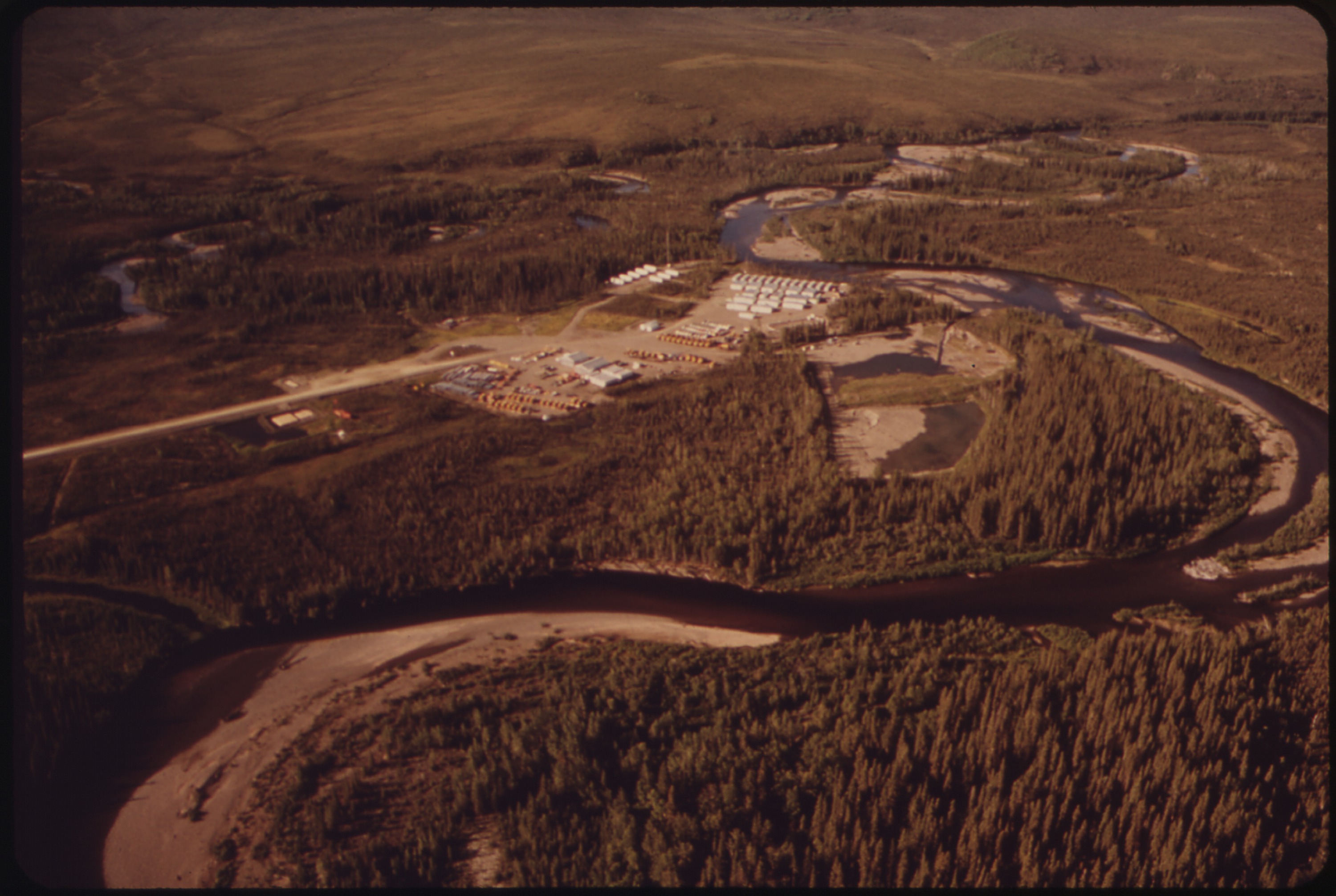
Located at 66.56°N, 150.48°W on the Dalton Highway in Alaska. From altitude, the Arctic Circle crossing is visible as a tiny clearing beside the gravel highway - look for the parking area and interpretive signs. The Trans-Alaska Pipeline parallels the highway, visible as a silver line through the landscape. The terrain is boreal forest transitioning to tundra - spruce trees thin and disappear moving north. The Brooks Range is visible to the north; Fairbanks to the south. The Yukon River crossing is visible 60 miles south. The isolation is profound - no settlements, no cross roads, just the pipeline and its service road extending toward the Arctic Ocean.