Arctic Submarine Laboratory
In 1946, a letter arrived on the desk of Dr. Waldo K. Lyon at the Navy Radio and Sound Lab in San Diego. Admiral Byrd was taking an expedition to Antarctica and wanted to know if Lyon had any research ideas to pursue in conjunction with the trip. Lyon's reply was brief and consequential: try a submarine in the cold water down there. That casual suggestion launched a program that would last over four decades and ultimately put American submarines under the Arctic ice cap in one of the Cold War's most significant strategic achievements.
From Mortar Battery to Research Pool
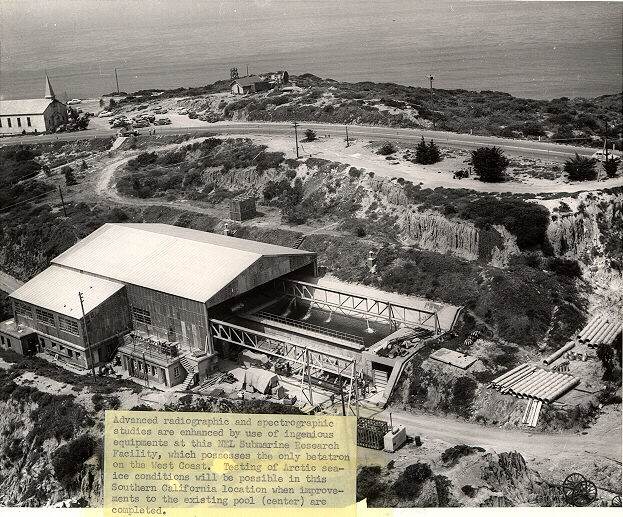
The Arctic Submarine Laboratory began life as Battery Whistler, a converted World War II mortar emplacement on the Point Loma peninsula at the mouth of San Diego Bay. In 1947, when the Navy Radio and Sound Laboratory merged with the University of California Division of War Research to form the Navy Electronics Laboratory, Lyon became head of the Submarine Studies Branch. The old gun battery was transformed: a test pool was constructed that could grow actual sea ice, simulating Arctic conditions in the San Diego sun. The facility also housed the only betatron — a particle accelerator used for X-ray imaging of metal structures — on the West Coast, allowing researchers to examine submarine components for hidden structural defects up to 18 inches in diameter.
The Ice Problem
Operating a submarine under Arctic sea ice presented engineering challenges that nobody had solved. Ice forms from seawater in complex ways, with brine content affecting its elasticity and behavior when struck. A submarine surfacing through the ice pack — or navigating under it — needed equipment designed for conditions no previous submarine technology had been designed to address. The laboratory measured brine content and ice elasticity to inform the design of submarines capable of punching through the ice cover. Researchers solved the icing problem on submarine snorkel head valves, which tended to freeze shut in Arctic conditions. Lyon and researcher Art Roshon developed an under-ice sonar by the elegant expedient of inverting a fathometer and mounting it on top of the submarine, pointed upward instead of down.
The Transpolar Voyage
The research culminated in 1958 with the transpolar submerged voyage of USS Nautilus, which crossed under the Arctic ice from the Pacific to the Atlantic — a journey that had never been made before and that demonstrated the strategic reality of submarine access to the polar region. The laboratory's decades of patient technical work made it possible. Through the 1960s, 1970s, and 1980s, the lab continued refining Arctic submarine technology: cryogenic facilities for ice testing, acoustic measurement of ice thickness using sonar, and ice breakthrough tests for newer submarine classes. A field station at Cape Prince of Wales, Alaska, established in 1951, provided real Arctic conditions for experiments that could not be replicated in San Diego.
Still Under the Ice
The Arctic Submarine Laboratory continues to operate today as a facility of the U.S. Navy's Undersea Warfighting Development Center, still headquartered on Point Loma in San Diego. Its missions remain essentially what Lyon established: developing technology for submarines operating under polar ice and providing operations staff to support actual Arctic submarine cruises. In 2020, the laboratory participated in ICEX, the periodic Navy exercise that sends submarines under the Arctic ice to practice operating in the region. As Arctic sea routes become increasingly navigable and strategically significant due to climate change, the technical knowledge concentrated in this converted mortar battery has taken on new relevance — the kind that Lyon could not have foreseen when he suggested, almost offhandedly, that someone should try a submarine in cold water.
From the Air
The Arctic Submarine Laboratory is located at approximately 32.68°N, 117.24°W on the Point Loma peninsula in San Diego, within the Naval Base Point Loma complex. The facility is within restricted airspace (R-2503 and associated MOAs). San Diego International Airport (KSAN) is approximately 10 km northeast. Point Loma's distinctive peninsula and lighthouse are excellent visual landmarks for orientation.