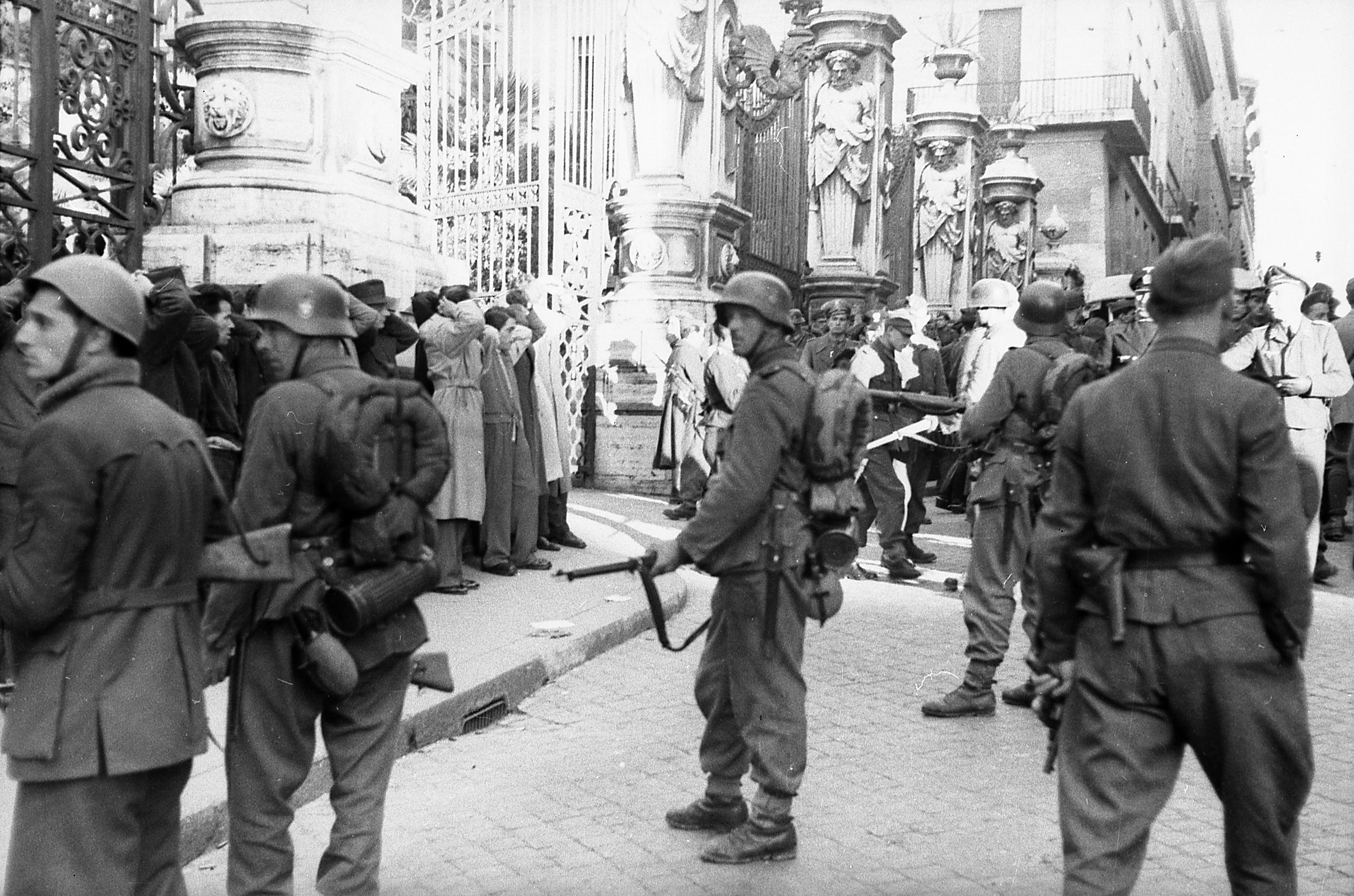
Ardeatine Massacre
The names are carved into the tomb slabs -- 335 of them, each covering a single coffin inside the Mausoleo delle Fosse Ardeatine on the Via Ardeatina south of Rome. Shopkeepers and soldiers, teenagers and grandfathers, Jews and Catholics, political prisoners and people simply grabbed off the street. None of them had anything to do with the partisan attack that the Germans used as their justification. On March 24, 1944, they were marched into abandoned quarry caves on the outskirts of Rome and shot, five at a time, by SS officers who had been given extra cognac to steady their nerves.
Forty Pounds of TNT on Via Rasella
The chain of events began the previous day. On March 23, 1944, seventeen members of the Gruppi d'Azione Patriotica, a Roman resistance cell, detonated a bomb hidden in a garbage cart as a column of the SS Police Regiment Bozen marched down the narrow Via Rasella. Rosario Bentivegna, a medical student, lit the fuse. The explosion killed twenty-eight German soldiers immediately; by the next morning, thirty-three had died, and more than a hundred were wounded. It was the single deadliest partisan attack in occupied Rome. The German command responded within hours. Herbert Kappler, the SS police chief in Rome, received orders to execute ten Italians for every dead German soldier. The reprisal ratio was not unusual by the savage arithmetic of Nazi occupation policy, but the speed and scale of what followed was staggering.
Three Hundred and Thirty-Five
Kappler and his deputy Erich Priebke assembled the victims from multiple sources. They pulled prisoners from Via Tasso, the Gestapo headquarters where resistance suspects were interrogated and tortured. They took seventy-five Jews from the Regina Coeli prison. They rounded up civilians from the streets. The list grew beyond the required 330 -- the ten-to-one ratio for thirty-three dead Germans -- but rather than release the extra five, Kappler ordered them killed as well. On the afternoon of March 24, the prisoners were transported to the Fosse Ardeatine, a network of man-made caves that had once been ancient Christian catacombs. They were led inside in groups of five, forced to kneel over the bodies of those already killed, and shot in the back of the head. The executions took hours. Afterward, German engineers detonated explosives to seal the cave entrances. The bodies were not meant to be found.
The People Inside the Numbers
Among the 335 were people whose lives spanned the breadth of Roman society. Colonel Giuseppe Cordero Lanza di Montezemolo had led the clandestine military resistance. Lawyer Manfredi Talamo had run intelligence operations for the Allies. There were tradesmen and students, a fifteen-year-old boy and men in their seventies. Seventy-five were Jews, many of whom had been arrested simply for being Jewish, not for any resistance activity. Others were political prisoners held for antifascist sympathies. Some had been swept up in random street roundups after the Via Rasella attack, bystanders who happened to be in the wrong place at the wrong hour. The youngest victim was Michele Di Veroli, just fifteen years old. These were not combatants. They were fathers and sons, neighbors and colleagues, people whose ordinary lives were ended to make a political point.
Silence and Its Consequences
Pope Pius XII learned of the massacre but chose not to publicly condemn it. His defenders argued the calculation was practical: Roman convents and religious houses were sheltering thousands of refugees -- Jews, antifascists, political dissidents -- and a papal protest might have triggered German searches that would have exposed them all. The Vatican's semi-official newspaper, the Osservatore Romano, published an editorial mourning the dead on both sides without directly naming the perpetrators. Historians have debated this decision ever since. Some see a leader protecting hidden refugees through strategic silence. Others see a moral failure -- a Pope who condemned the partisans for provoking violence while treating the Nazi reprisal as an act of fate rather than a crime. The Italian Supreme Court later ruled twice, in 1952 and again in 1999, that the Via Rasella attack had been a legitimate act of war.
Memory Carved in Stone
After Rome's liberation in June 1944, the caves were opened and the bodies exhumed -- a process documented on film that survives today. The site was transformed into the Mausoleo delle Fosse Ardeatine, a memorial where the victims lie in individual tombs beneath a massive concrete slab designed to evoke the weight of the earth that once sealed them in. Each tomb bears a name, an age, an occupation. The memorial forces visitors to confront the victims as individuals, not as a statistic. Of the perpetrators, Kappler was sentenced to life imprisonment in 1948. Priebke escaped to Argentina using Vatican ratlines and false papers, living undetected for nearly fifty years until an ABC television interview unmasked him in 1994. He was extradited, tried, and sentenced to house arrest. He died in Rome in 2013 at the age of one hundred. No Catholic church in Rome would hold his funeral. The Ardeatine caves remain one of Italy's most sacred sites of memory -- a place where the cost of occupation is measured not in numbers but in names.
From the Air
Located at 41.857N, 12.510E on the Via Ardeatina, approximately 3km south of the Colosseum. The memorial site is visible from low altitude as a large rectangular structure surrounded by parkland. Best viewed at 1,500-2,500 feet AGL. Nearby airport: LIRF (Leonardo da Vinci-Fiumicino, 16nm SW). The Appian Way runs parallel to the east. The distinctive outline of the Circus Maximus and Colosseum provide orientation from the north.