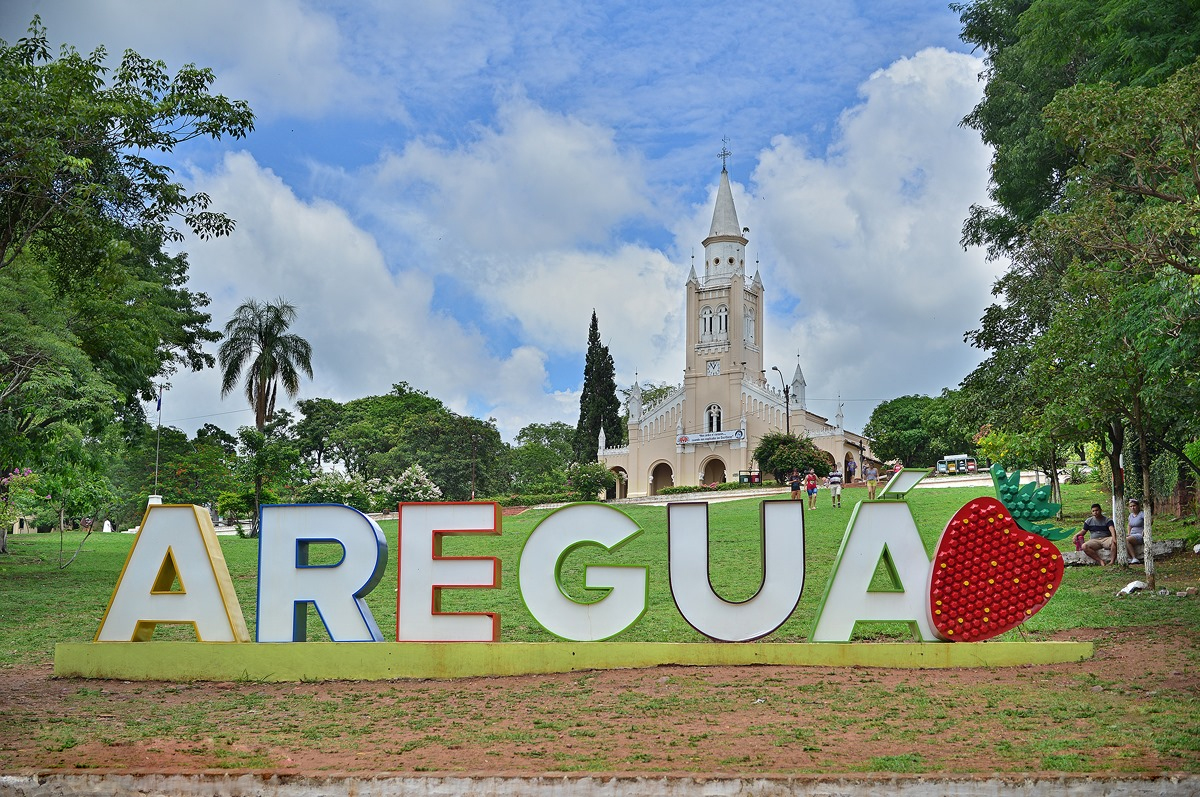
Aregua
The ceramic figurines appear before the town does. Driving from Asuncion along Ruta Aregua, the shops materialize on both sides of the road -- Snow White beside the Virgin Mary, garden gnomes next to saints, all painted in colors loud enough to stop traffic. This is how you know you have arrived in Aregua, a colonial town 31 kilometers east of Paraguay's capital that has turned pottery into both livelihood and landmark. Behind the ceramics, on a hill overlooking everything, a church surveys the rooftops below. And beyond the rooftops, at the town's lowest point, Ypacarai Lake stretches to the horizon -- beautiful from a distance, troubled up close.
Clay and Color on the Road to Luque
Aregua's identity is inseparable from its ceramics. Along the street Nuestra Senora de la Candelaria, workshops and storefronts display an improbable menagerie of painted figures -- everything from Princess Fiona to Jesus Christ, sized from tabletop ornament to garden sentinel. The craft tradition has deep roots here, fed by the region's abundant clay and generations of artisans who learned their trade from parents and grandparents. Throughout the year, fairs bring local potters together to sell their work, and the town has earned recognition as a creative hub. Aregua is compact enough to walk end to end, and that walk takes you from sacred to secular: the hilltop church at one extreme, the lakeshore beach at the other, with the workshops and colonial facades filling the space between.
A Strawberry Season Worth Celebrating
Every August and September, Aregua transforms. The strawberry festival draws visitors from Asuncion and beyond, celebrating the fruit that thrives in the town's subtropical climate. Street vendors pile their tables with fresh berries, strawberry ice cream, and preserves. The festival is more than agricultural -- it is a weekend excuse for capital-weary Paraguayans to trade the noise of Asuncion for Aregua's quieter rhythms. The town has always functioned this way, as a pressure valve for the city. Writers and artists have gravitated here, drawn by the colonial architecture and the unhurried pace. Small bars play Latin music into the evening, and hamburgers and doughnuts appear at the main plaza once the sun drops low enough to make the heat bearable.
The Lake That Changed Color
Ypacarai Lake once defined Aregua as a beach town. Families swam in its waters, fishermen worked its shallows, and the shoreline attracted weekend visitors by the busload. That era has passed. Factory pollution, agricultural runoff, and unchecked development have turned the lake green with toxic cyanobacteria. Swimming is no longer safe, and eating its fish is out of the question. The transformation is visible from the shore -- the water's color announces its condition plainly. For Aregua, the lake's decline is both environmental crisis and identity wound. The beach still exists, the views remain striking, and the public access endures, but the relationship between town and water has fundamentally changed. What was once Aregua's greatest recreational asset is now its most visible cautionary tale.
Getting There, Staying Put
Aregua's accessibility has always been part of its appeal. From Asuncion, Bus No. 111 Areguena, No. 11 San Augustine, or No. 56 Cerro Koi will take you into the center of town -- though it pays to ask the driver whether the route goes to el centro rather than the outlying rural companias. By car, the turn comes at kilometer 27 on Ruta 2, at the military college in Capiata. The town rewards walking once you arrive. Distances are short, the grid is simple, and the landmarks orient you naturally: church uphill to the right, lake downhill to the left. Nearby, the Cerro Koi geological formation and the historic churches of Yaguaron offer excursions that deepen any visit to this corner of Paraguay's Central Department.
From the Air
Located at 25.30S, 57.42W, approximately 31 km east of Asuncion. From the air, look for Ypacarai Lake as the dominant water feature, with Aregua on its western shore. The town sits between the lake and a ridge with a visible hilltop church. Nearest airport is Silvio Pettirossi International Airport (SGAS) in Asuncion. Cruising altitude offers clear views of the lake and surrounding towns in good weather. Elevation is approximately 130 meters above sea level.