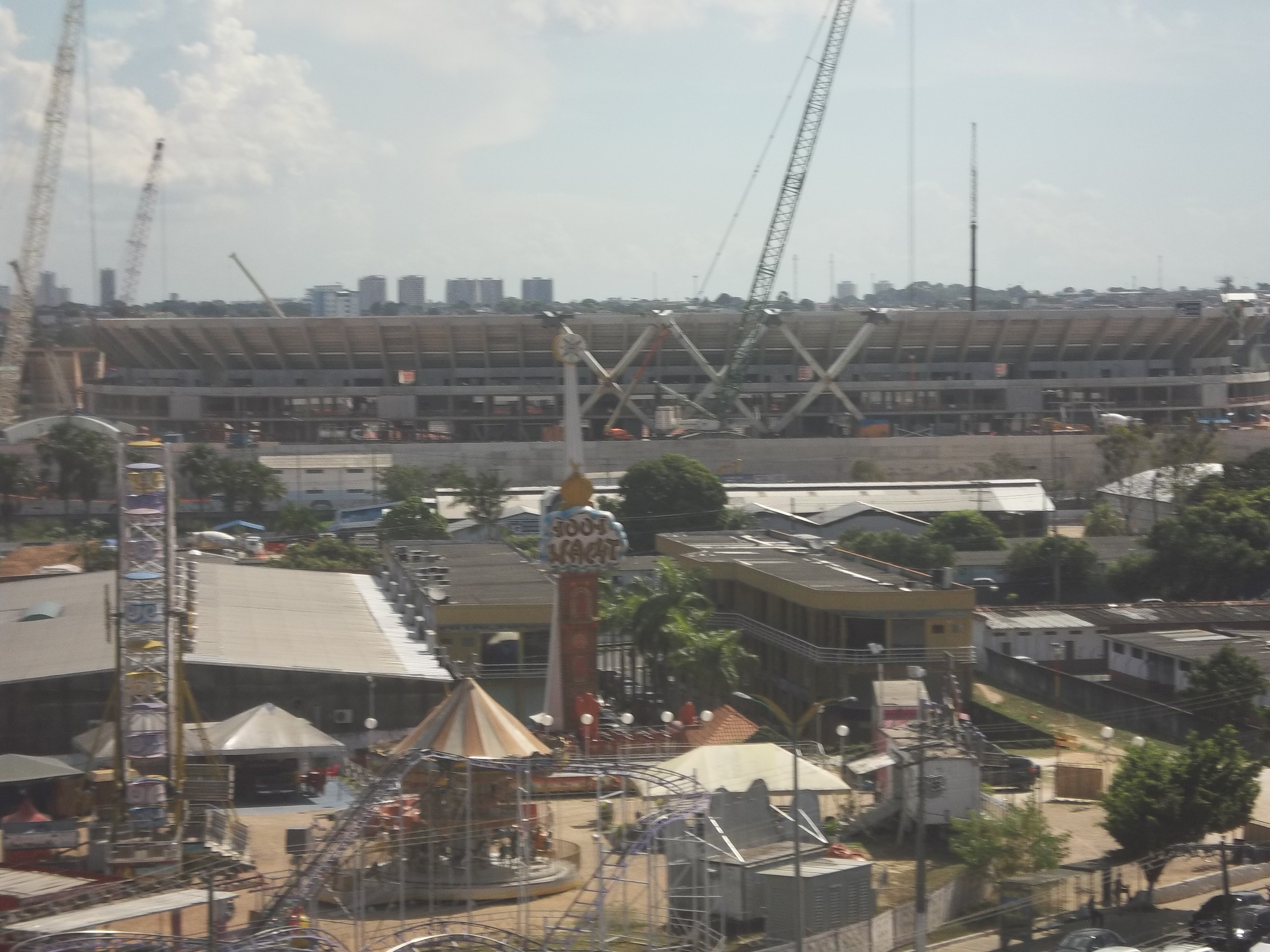
Arena da Amazonia
Four matches in a lifetime, for a stadium that cost roughly 300 million US dollars to build and stands in the middle of one of the most remote big cities on Earth. That is the arithmetic of the Arena da Amazonia, opened in Manaus on March 9, 2014, three months before the 2014 FIFA World Cup. The German architects Gerkan, Marg and Partners designed its striking metallic exterior to evoke the woven straw baskets made by Indigenous peoples of the surrounding rainforest. The engineering is genuinely clever, the visual impact genuinely striking. What the stadium does not have, and has never had, is a top-flight soccer team to fill it.
A Basket Woven in Steel
The exterior is the story people remember. Gerkan, Marg and Partners, the Hamburg firm also responsible for Berlin's central train station and Beijing's terminal 3, wrapped the bowl in a crisscrossing metallic shell meant to suggest the fiber baskets of the Amazon, as if a forest pattern had been extruded upward to enclose a football pitch. The structure does real work. It channels rain away and pulls outside air through the bowl, exploiting the equatorial breeze that moves between river and forest. The stadium holds 42,924 all-seater capacity, or around 44,300 with standing room, and includes a restaurant, luxury suites, underground parking and accessibility features. An on-site rainwater recycling system and sewage treatment reduce its water draw. More than 95 percent of the material from the old Vivaldao stadium, demolished on the same site, was recycled into the new build.
The World Cup Moment
FIFA gave Manaus four group-stage matches. England lost to Italy here in the sweltering humidity. The Ivory Coast played Japan. Cameroon faced Croatia. The United States ground out a 2-2 draw with Portugal on a Cristiano Ronaldo injury-time cross. Players complained about the heat. Manaus sits three degrees south of the equator; afternoon kickoffs ran in temperatures above 30 degrees Celsius with humidity stacked on top. The stadium construction ran down to the wire. In February 2014, the place was still a building site and serious doubts circulated about whether it would be ready in time. It opened on schedule, barely. Tragically, three workers died during construction, casualties of a rushed schedule that dogged several of Brazil's World Cup venues.
After the Tournament
When the trophies were handed out in Rio and the world moved on, the Arena da Amazonia was left in a city without a top-division club. Manaus's local sides play in lower tiers of Brazilian football and draw modest crowds to a stadium built for forty thousand. Since 2014 the place has hosted sporadic professional matches, the football tournament of the 2016 Rio Olympics, some of Brazil's 2018 World Cup qualifiers, evangelical Christian gatherings and a Guns N' Roses concert in 2022. Cultural festivals and community events have tried to fill the gap. The stadium has retained a kind of civic pride, but not a consistent programming schedule. FIFA later named it among venues for the 2027 Women's World Cup, a return engagement that may yet give the building another real sporting moment.
The Argument About What It Cost
The 300 million dollar price tag hit especially hard in a city of two million people where basic services remained stretched. Critics pointed out that the Brazilian Development Bank paid 75 percent of the bill and the Amazonas State Government paid the rest, meaning public resources funded a venue many locals felt had little to do with their daily lives. Money for healthcare, education and transit was scarce; money for a rainforest-themed stadium was apparently not. Urban upgrades came along with the project, including runway expansion at Eduardo Gomes International Airport and some road widening, but they concentrated around the stadium rather than extending through the city. The legacy debate is not unique to Manaus. Several of Brazil's 2014 venues face similar questions. But the Arena da Amazonia remains the most visible symbol of the issue, precisely because of where it stands. You do not expect to find a World Cup stadium in the Amazon. That is exactly why it was built there, and why afterward nobody quite knew what to do with it.
From the Air
Located at 3.08S, 60.03W, in the city of Manaus, Brazil. The stadium sits between Eduardo Gomes International Airport (SBEG) and central Manaus, roughly 7 kilometers from each. On approach to SBEG Runway 10 or departing Runway 28, the distinctive crisscross metallic exterior is visible in clear weather. Recommended cruise viewing altitude 33,000-35,000 feet when flying the jungle-capital corridor from Belem to Manaus. Expect afternoon equatorial convection October through April.